
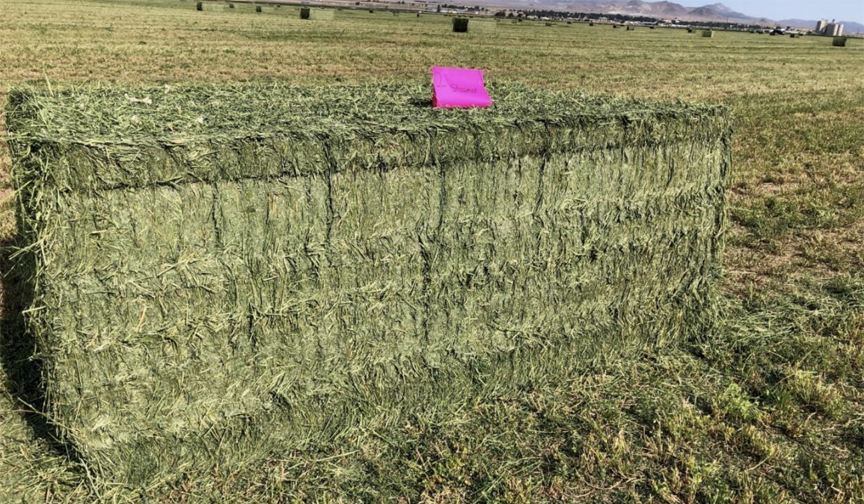
Having the correct amount of moisture in harvested alfalfa at the time of baling is critical to maximizing economic return. In many of the areas of the western U.S., moisture levels of alfalfa hay in the windrow can dry to the point that leaves and stems will shatter during the baling process. As a result, producers typically bale at night and early morning, relying on dew to provide needed moisture. The drawback to this strategy is the window at time of baling can be short and, often, unpredictable. In recent years, equipment that injects moisture into the windrow during the baling process has created an option for producers to bale when natural dew is not present. The purpose of this study was to test two different technologies to remoisturize alfalfa in the windrow and their effect on yield, quality, and economic return.
Materials and Methods
Studies were conducted in two cuttings during the 2020 growing season on a producer’s farm near Milford, UT. The farm has two Staheli Dew Point steamers in use and many alfalfa fields under pivot irrigation. Alfalfa stands had good density and vigor and were well managed in terms of weed and insect control, soil fertility, and irrigation. During 2nd and 3rd cutting, alfalfa was cut and conditioned according to normal practice on the farm. Several days later, fields were raked in the morning with dew to prevent leaf loss. In raking, two windrows were combined into a single large windrow between 1.5 to 1.75 tons/acre. A different field was used for each cutting due to the difficulty in predicting the speed of alfalfa dry down and the need to coordinate the logistics of the experiment several weeks in advance.
A total of 6 bales were evaluated per treatment (2 runs x 3 bales). Bale moisture was recorded from the Gazeeka moisture meter on the baler. The following morning, the moisture of each bale was measured with a Delmhorst moisture probe. Individual bales were sampled following the NFTA recommendations for coring (a composite of 6 cores, three per end on a diagonal) and run thru NIR analysis at Dairyland laboratory to test fiber (NDF and ADF), relative feed value (RFV), and crude protein. The length of windrow that it took to make each bale was marked and measured. The area required to make each bale was calculated as the length and width represented by the hay in the windrow. Bales were individually weighed on an electronic scale. The measured area and bale weight were used to calculate yield. Statistical analysis was conducted by ANOVA using ARM and means separated using the LSD method at P=0.10.
Results and Discussion
No differences in forage nutritive values were detected in this study (Table 3). Although numerically, the dry bales trended toward lower quality (lower CP and RFV, higher ADF and NDF), the differences were not statistically significant. The fact that the lack of moisture during baling did not adversely impact forage quality is surprising. This suggests that, although shattered and unattached, the leaves in the dry bales were largely captured during the bailing and coring process. The visual appearance of the bales produced using moisturizing systems may influence marketing, but that evaluation was not made in this study.
Table 1. Bale moisture, bale weight, yield of alfalfa of 3 x 4 ft bales treated with different technologies to remoisturize alfalfa windrows during second cutting near Milford, UT in 2020.
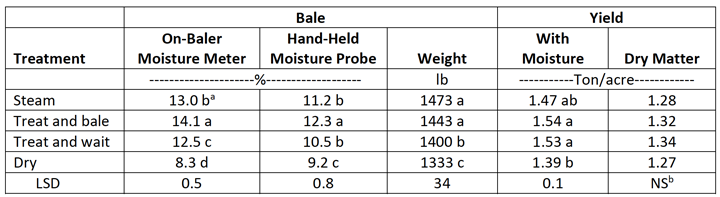 a Numbers in the same column with the same letter designation are not statically different (P=0.10)
b Not statistically different
Table 2. Bale moisture, bale weight, yield of alfalfa of 3 x 4 ft bales treated with different technologies to remoisturize alfalfa windrows during third cutting near Milford, UT in 2020.
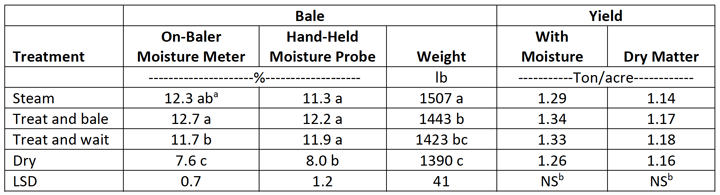 a Numbers in the same column with the same letter designation are not statically different (P=0.10)
b Not statistically different
Table 3. Crude protein, ADF, NDF, and RFV of 3 x 4 ft bales treated with different technologies to remoisturize alfalfa windrows over two cuttings near Milford, UT in 2020.
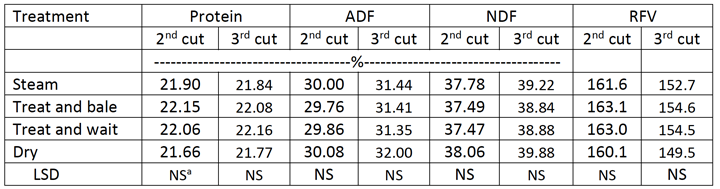 a Not statistically different
Economic Analysis
The economic analysis of these different remoisturizing alfalfa technologies utilizes only variables that are statistically significant. In this analysis, bale weight was the variable that was found to be statistically significant. The average bale weight from the two cuttings for the dry bale was 1,361.5 lbs., the Dew Simulator was 1,443, and the Steamer was 1,490. The Dew Simulator averaged an 82 lb. difference and the Steamer a 129 lb. difference in bale weights. Based on the trial data which averaged 1.79 bales per acre, we estimate that the Steamer will have an additional 258 lbs. per acre and the Dew Simulator an additional 217 lbs. per acre.
Understanding Partial Budgeting
Partial budgeting is a decision tool to help analyze financial impacts of changes to an operation. Partial budgeting only includes resources that will change such as adding remoisturizing technology in an alfalfa operation. The cost of baling will remain fixed and the financial impact of including remoisturizing technology will be analyzed. The four key components to a partial budget are increased income, reduction or elimination of costs, increased costs, and reduction or elimination of income. The net impact will be the positive changes minus the negative changes. Table 1 helps to identify these changes.
Table 4. Partial Budget Categories

Annual ownership cost is estimated by utilizing the capital recovery method. The capital recovery method utilizes the purchase price, salvage value, useful life, and a discount rate to estimate the annual ownership cost. The discount rate represents the opportunity cost of capital and accounts for owning the piece of equipment over multiple future periods. The operating cost is estimated by utilizing the fuel used per hour, labor cost, and repair costs on an annual basis. Utilizing the information from Table 1, we can analyze the net financial impact assuming 1,000 acres of alfalfa, a fuel price of $2.50/gallon, and an alfalfa price of $200/ton.
Table 5. Economic Analysis Summary Table
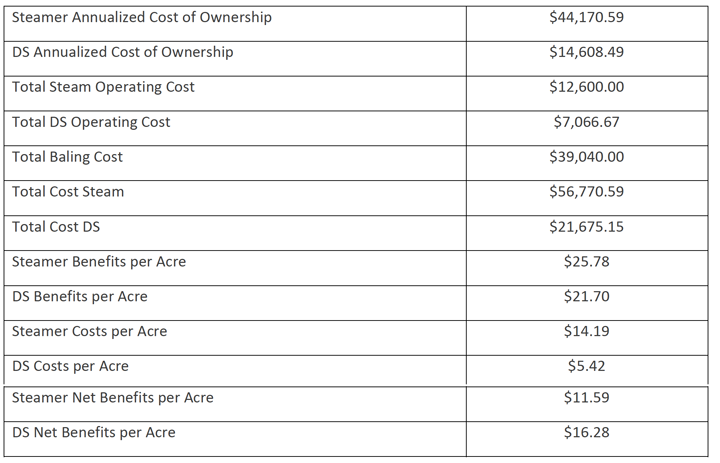
These numbers are based on one certain scenario so caution must be used when drawing specific conclusions from them. The Steamer has a higher ownership cost which drives the cost per acre up. This cost is reduced as the number of acres increases. These results also assume that both steam
Conclusion
In this study, both technologies tested to remoisturize alfalfa hay were successful in increasing bale weight. The weight increase was due to increased moisture content in the bale and not an increase in dry matter yield. Forage nutritive values of individual bales were not improved by remoisturizing hay in the windrow. The visual appearance of the bales produced using moisturizing systems compared to those baled dry were much more attractive and may influence marketing, but that evaluation was not made in this study. A partial budgeting strategy can be used to analyze the potential return of these technologies, the results of which will depend on the size and needs of a specific operation. It is important to note that the data presented in this report represent only two cuttings and a single year. Additional data generated in the years to come will help to refine these results so that they are repeatable over space and time.

Be the first to comment