
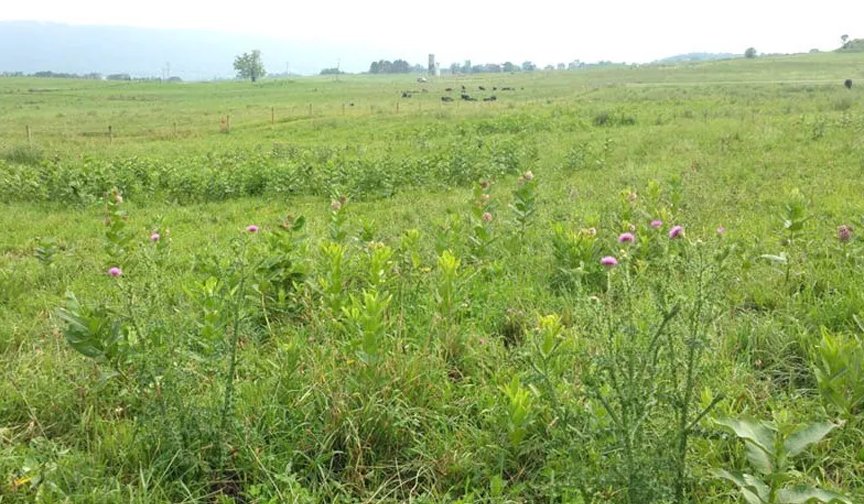
Considerations for weedy grass and broadleaf control options in grass forages during early spring.
Broadleaf weed control
Now is the time to scout grass pastures and hayfields in search of winter annual and biennial weeds. Both types of weeds are potentially susceptible to control right now, and an effective herbicide application will prevent flowering and seed production. Winter annuals including certain buttercups, mustard species, common chickweed, horseweed/marestail, deadnettle/henbit, fleabane, etc. are growing rapidly and have already or will begin to flower and set seed very soon. Biennials including poison hemlock, musk and plumeless thistle, burdock, wild carrot, etc. should be treated before they begin to bolt and the smaller the better. (Late fall or early spring is really the best time to treat biennial weeds). Management of perennial weeds such as dandelion, Canada thistle, and the woody perennials such as multiflora rose and autumn olive is best performed a bit later in early summer after plants reach the bud-to-bloom stage.
The most common herbicides used for control of many broadleaf weeds in grass hay/pasture this time of year are the plant growth regulator herbicides such as 2,4-D ± dicamba (Clarity, etc.), triclopyr products (Crossbow, Remedy Ultra, etc.), and clopyralid (Stinger, PastureGard, etc.). In most situations, a tankmix of 2,4-D (1 quart/acre) plus dicamba (1 pint/acre) usually does a good job on many annual broadleaf weeds. However, there are certain weeds where other herbicides will be necessary for optimal control and at a different time of year. In addition, products containing metsulfuron (Cimarron, other generic formulations, etc.) can provide good control of many broadleaf weeds in the spring. (Also, be cautious if forage grasses were recently seeded and are not yet established with a good root system (approx. 4-6 inches tall) since many of these herbicides can cause severe crop injury during this sensitive growth phase.) Refer to Table 2.6-11 in the 2023-24 Penn State Agronomy Guide for ratings of these herbicides on many different weed species.
Weedy grass control
Prowl H2O or Satellite HydroCap may be applied to established perennial forage grasses (including Kentucky bluegrass, bromegrass, tall fescue, orchardgrass, perennial ryegrass, timothy, switchgrass, and others) grown for forage, green chop, silage, hay production, and/or grown in pastures for livestock grazing.
- Apply at a broadcast rate of 1.1 to 4.2 quarts of product per acre in a single application or sequential applications made 30 or more days apart. Herbicide must be applied before weed germination in spring, or in-season between cuttings, otherwise weeds will not be controlled. These products may be tank-mixed with other labeled herbicides, but keep in mind nothing is labeled for control of emerged grasses in grass forage.
- Split applications of pendimethalin are better than a single, high-rate early season application. Make the first application in early spring (mid-March to early April) but before weed germination (2-3 pt/A); and then the second application right after first (or second) cutting (3-4 pt/A).
- These herbicides may be applied to mixed stands of established cool-season forage grasses and alfalfa (established alfalfa is defined as alfalfa planted in fall or spring which has gone through a first cutting/mowing). DO NOT to mixed stands of cool-season forage grasses with other forage legumes (e.g., clover) besides alfalfa.
- There is no preharvest or pre-grazing interval for pendimethalin-treated grass forage, green chop, silage, hay, or pasture.
- Mixed stand alfalfa/cool-season forage grasses may be grazed or harvested for forage or hay 14 or more days after application.
Comments about problem weedy grasses
Also, keep in mind that pendimethalin products do NOT control established perennials like roughstalk bluegrass (Poa trivialis) which is becoming more of a problem in small grain and forage fields across the state. Fall and early spring are the best times to apply effective herbicides to control this weed; but unfortunately, there are currently no herbicides labeled in our region that will control roughstalk bluegrass in grass pastures/hay aside from spot spraying glyphosate. However, in alfalfa settings, the use of Gramoxone/paraquat, Raptor, or Select/clethodim after the first cutting generally provides 85-90% control.


Be the first to comment