
This year’s corn silage harvest will present two distinctively different forages, often times on the same farm, sometimes in the same field.
On many farms, a portion of the corn silage acres have a reasonable chance to make it to proper corn silage maturity (approximataly 35 percent whole plant dry matter), while another portion of the crop will likely be harvested at an immature stage, where dry down may be induced by a frost.
Assessing Maturity & Harvest Timing
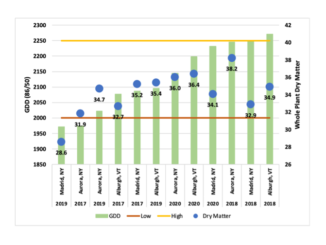
The date of silking can be used to determine silage harvest date based on growing degree day (GDD) accumulation. Work in New York by Dr. Bill Cox Using the Number of Growing Degree Days from the Tassel/Silking Date to Predict Corn Silage Harvest Date showed that the crop needs 750-800 GDD’s after silking to reach a whole plant DM of 32 percent. Under typical late season dry down conditions we can expect the crop to reach 35 percent DM four to seven days later.
A new growing degree day calculator from the Cornell Climate Smart Farm team can be useful to estimate harvest date and video instructions are provided on its use.
While this tool was designed to estimate GDD accumulation from planting, you can simply enter in silking/tasseling date in the planting date box and select 750-800 GDD’s in the “enable target” tab to get an estimated date.
Harvest management plans for these two different forages should include:
- identifying separate storage areas
- determining the desired length of cut and the need for kernel processing based on what group of animals
is likely to receive this feed, and
- identifying the inoculant that will work best for different dry matter (DM) forages
Separate Storage Areas
The ability to store these two different crops in different areas will be critical to be able to feed the right quality feed to the right group of animals. Properly mature corn silage is always valuable, but will be at a premium this year, and optimizing the value of this crop for lactating animals will be compromised if it is blended with immature silage.
Immature silage can be a useful feed for non-lactating animals but presents some additional challenges in terms of storage, with increased potential for improper fermentation (increased spoilage) and excess leachate. If a farm is
forced to put up wet silage, using the available storage location with the best setup to manage leachate is preferred.
• Wet corn silage can be an environmental challenge – Karl Czymmek, Peter Wright and Joe Lawrence
Harvest Strategies
For the portion of the crop that is expected to mature, following standard harvest recommendations for target whole plant DM, length of cut and kernel processing.
- Setting the Stage for Success: Corn Silage Harvest – Joe Lawrence, Cornell PRO-DAIRY Ron Kuck, Cornell Cooperative Extension
- Harvest Strategies and Forage Quality Monitoring for Corn Silage – Joe Lawrence, Cornell CALS PRO- DAIRYMargaret Quaassdorff, NWNY Cornell Cooperative Extension
For the portion of the crop harvested at an immature stage, adjustment to length of cut and kernel processing can affect both the use of the feed in a feeding program and its potential to result in excess leachate. Generally it is suggested that this immature crop be chopped at a longer length of cut to achieve desired particle size and often kernel processing is not necessary. Both of these adjustments are also known to help reduce leachate.
- Wet Forage Harvest – Tom Kilcer, Advanced Ag Systems
- Management Considerations for Immature and Frosted Corn Silage – Larry Chase, Cornell University
Forage Preservation and Quality
Additionally, wet forage and the increased chance for improper fermentation can increase the risk of anti-quality factors such as yeast and mold that, even if the silage appears ok, can create problems when re-introduced to oxygen and mixed with other ration ingredients. This may affect, animal health, palatability and stability of the ration when delivered to the cows. Separate storage of this forage will help reduce the chances of introducing these anti-quality factors into the higher value, properly matured, corn silage. Work with your nutritionist to monitor fermentation and forage hygiene.Bacterial based inoculants and other preservatives can facilitate proper fermentation and are an important tool for achieving high quality forage; however, they will not fix every situation.
Bacterial inoculants rely on moisture to activate and work properly but often time’s different inoculants are designed for different ranges of crop moisture. Consult with your supplier to determine which inoculant will work best in the case of wetter forages.
In the case of acid based preservatives, the excess moisture in wet forages will dilute out the acid which will result in the need for a higher application rate to achieve the desired drop in pH.
Be the first to comment