
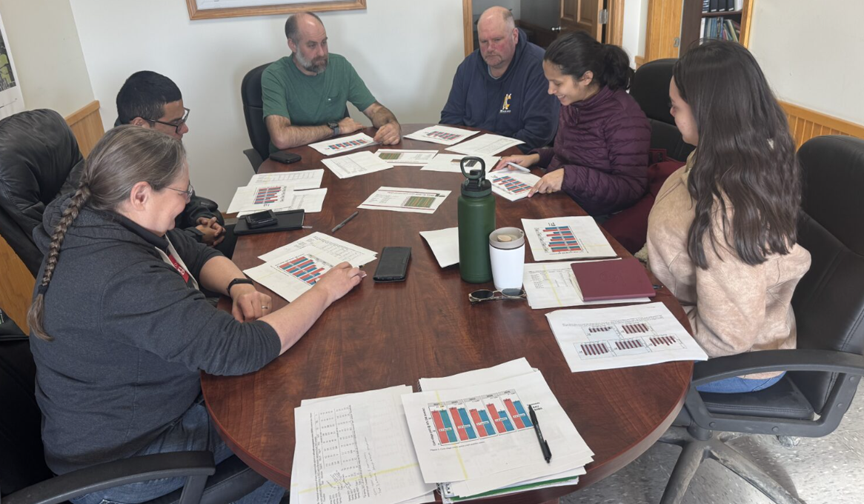
With the conclusion of field work in 2025, the Cornell University Nutrient Management Spear Program is diligently working to analyze comprehensive data collected during extensive field trials as part of the Dairy Soil & Water Regeneration (DSWR) project.
Initiated by Dairy Management Inc. and the Soil Health Institute in collaboration with eight research institutions across the U.S., DSWR is assessing the impact of farming practices on soil health, greenhouse gas (GHG) emissions, water quality and agronomic factors such as forage yield and quality to advance progress toward the dairy industry’s collective 2050 environmental stewardship goals.
All trials that took place in New York happened on commercial dairy farms under real-world conditions and management styles, a unique component to DSWR.
On March 18, members of the Cornell DSWR research team — Dr. Ketterings, Dr. Asmita Guatam, Juan Carlos Ramos Tanchez and Itzel Calles — sat down with participating farmers Rob Noble of Noblehurst Farms in Pavilion and Andy Miller and Glen Kilcer of Osterhoudt Farms in Genoa, at their respective sites. Conversations revolved around the trends and results seen over the past five years regarding soil health indicators, yield measurements, forage characteristics and GHG fluxes among treatments.
“Farmers participate in projects like DSWR to get the answers to questions that are relevant to them, without having to make a management decision before they are confident enough to do so,” Miller said. “As a farm who has a valuable dataset and accurate equipment to participate in opportunities like these, we should open our door.”
Some of the farmers’ key takeaways include a stronger understanding of the value of manure, clearer insight into yield differences and a greater ability to make targeted, field-specific management decisions. Noble recounted his experience on the project to be educational and particularly worth his participation.
“We were pleasantly surprised to see that we are on track with what we are doing,” Noble said. “This reinforces the decisions we’ve made in the field.”
When projects are conducted on commercial farms, the results become more applicable to producers. Close coordination and communication between Cornell and the farms have helped make DSWR a success and encourage future collaborations.
Be the first to comment