
Instead of leaving the land fallow after small grains, double crop soybeans, plant cover crops, or plant annual forages for grazing to improve your operation.
Winter barley and wheat and spring oat harvests are on the horizon. USDA National Agricultural Statistics Service (NASS) shows that in 2018 there were 45,000 acres of winter barley, 195,000 acres of winter wheat, and 65,000 acres of barley planted in Pennsylvania. The NASS indicates that, in Pennsylvania, typical barley harvesting dates are between June 25-July 20, for wheat July 10-July 30, and for oats July 25-August 20. Many times, farmers just leave the land fallow after the harvest of these crops, but you have the opportunity to grow something that may create extra value for your operation. The options are double cropping soybeans, growing a cover crop to protect and improve soil and fix atmospheric nitrogen for next year’s crop, or grow a summer annual forage for silage or grazing.
Double crop soybeans.
A recent USDA study showed that double cropping is practiced on only about 2% of U.S. cropland. However, in the Northeast nearly 10% of cropland was double cropped, showing the potential of the practice. About half of these acres in the Northeast are soybeans after fall-planted small grains. It is easiest to double crop soybeans after barley (due to its earliest harvest among the small grains), but it is also possible to double crop soybeans after wheat. In fact, about 60% of double cropped soybeans followed wheat in the northern U.S. However, it is almost impossible to double crop soybeans after oats because there is not enough growing season left to grow soybeans. But it is also important to include your location into the consideration whether double cropping soybeans is attractive for you. You can use the average first frost date as a guide, counting back 90 days, considering that is how long it takes soybeans to develop pods and dry seed. In north-central PA (Zone 4), the first frost date is between September 1 and 10, so in that area it is not possible to double-crop soybeans since all small grains are harvested after June 10.
Use cover crops.
All farmers should be aware of the benefits of cover crops to protect soil from erosion, increase soil organic matter content, stimulate soil biological activity, improve soil structure and tilth, take up mineral nitrogen from the soil and protect it from loss, and (in case of legumes) to fix atmospheric nitrogen. After small grains you have many cover crop species to choose from that are not recommended after corn or soybean harvest because they would not survive the winter and/or accumulate little growth before they winter kill. We evaluated latest establishment dates of cereal rye, wheat, annual ryegrass, hairy vetch, crimson clover, and rape in central and southeastern Pennsylvania and concluded that all of these cover crops will normally survive the winter in this region if they are established by mid-August (except for higher altitudes where some may not make it). It is often beneficial to put several species in a mixture, so you can really composite a diverse cocktail. Legumes such as crimson clover or hairy vetch contain typically 3-4% nitrogen in their above-ground biomass, and much of that will be released for uptake by a following nitrogen-demanding crop like corn. We have grown 4000 lb/A drymatter vetch which, at 4% N concentration, contained 160 lbs N/A. One year we were able to grow 150 bu/A corn with only 40 lbs/A nitrogen applied as starter fertilizer.
Plant annual forage mixtures for grazing or harvesting.
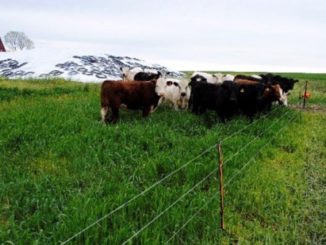
A third option that is gaining more interest now is the possibility to integrate grazing livestock in our grain cropping systems. The options are many after small grain harvest. Summer annuals such as pearl millet, sorghum, sudangrass, corn, cowpea, forage soybean, sunflowers, or pumpkins can be used if planted in June or early July. In some cases, they can be planted with cool season annuals that will survive the winter so there will still be living vegetation until springtime. The summer annuals will winter kill. Typically, 6-8 weeks after planting these summer annuals can be grazed for the first time. With management intensive grazing methods, you leave significant amounts of plant residue (at least 2000 lbs/A drymatter).
This residue provides the solar panel to fuel new regrowth so you can graze the cover another time. This summer we will start a research project to investigate the production, soil health, and economic benefits of double cropped soybeans versus a grazing a summer annual forage mixture on several farms in Adams and Franklin Counties. We will share results as we gather them. Further, we will collaborate with NRCS grazing specialists to give a demonstration of grazing summer annual mixtures for soil health and livestock feed at Ag Progress Days (3rd week of August in Rock Springs, Centre County). Everybody is invited to attend this free event.
In conclusion, you have many options to do something productive with your land after small grain harvest instead of leaving it fallow. This can add to the economic bottom line of your operation, but it can also help to improve soil health, reduce nitrate leaching, and reduce nitrogen fertilizer needs of following crops.


Be the first to comment