

Understanding Crossbreeding in Dairy Cows
Crossbreeding in dairy cows involves strategically mating individuals of different breeds to achieve specific goals in herd improvement. Farmers select breeds based on desirable traits such as milk production, health, fertility and longevity. Through this process, the aim is to capitalize on the strengths of each breed to create a hybrid or crossbred cow that inherits favorable characteristics from its parent breeds. The phenomenon of heterosis, also known as hybrid vigor, often accompanies crossbreeding. Heterosis results in offspring exhibiting superior qualities compared to the average of the parent breeds, leading to increased adaptability, resilience, and overall performance10 . This practice addresses challenges associated with purebred lines, such as genetic limitations or health issues, contributing to a more sustainable and profitable dairy operation7 . Successful crossbreeding demands meticulous planning, taking into account the genetic compatibility of selected breeds and aligning with the specific objectives of the breeding program.
Optimal Breeds for Crossbreeding
In the selection of breeds for crossbreeding, studies indicate the advantageous impact of crossbreeding programs, particularly when prioritizing fertility and longevity7 . Dairy farmers commonly seek combinations that not only enhance milk production but also uphold or enhance other essential traits. The Holstein breed, known for its high milk yield, is often a primary choice3 . However, solely focusing on milk production can lead to issues such as reduced fertility and increased susceptibility to disease. To counterbalance this, breeds such as Jersey, known for high butterfat content, Guernsey, noted for improved components and calving ease, and Ayrshire, recognized for robust health and longevity, are often used in crossbreeding programs2,6,14 . Another effective combination involves using Scandinavian Red breeds such as the Swedish Red or Norwegian Red which contribute to overall improved health traits and fertility, complementing the high milk yield of Holsteins10 .
Dr. Weigel’s research in 2006 revealed that Holstein x Jersey crosses perform better than purebred cows in terms of producing more butterfat and protein, having shorter calving intervals, and fewer days open15. This crossbreeding program is widely considered the most popular globally, as it improves overall profits by capitalizing on cheese premiums in the changing market1,15 . Similarly, crosses between Holsteins and Guernseys have shown higher survival rates during the first and second lactation calving, an average 8% improvement in milk components, and an 11.4% greater income per cow per year compared to purebreds13 . Holstein x Ayrshire crosses also show increased lifetime milk yields and a 20.6% higher annual return than both purebred Holsteins and Ayrshires8 .
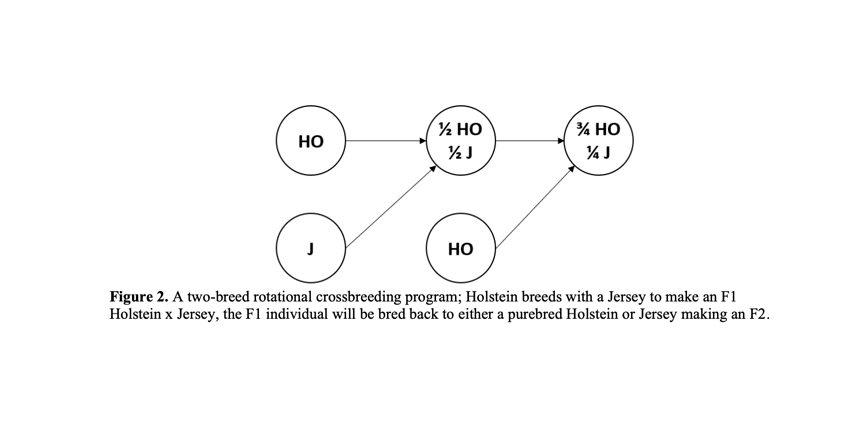
Backcrossing F1 Crossbreds
A two-breed rotational crossbreeding program involves breeding purebred individuals of Breed A with purebred individuals of Breed B in the first generation, resulting in a first cross or F1 generation. Subsequently, instead of continuing with the F1 generation, breeders then cross the F1 individuals back with purebred individuals of one of the original breeds, this is called backcrossing15 (Figure 2). This strategy is used to stabilize certain desirable traits from the parent breed in the offspring. For instance, backcrossing an F1 Holstein-Jersey crossbred with a pure Holstein can enhance milk production while retaining some of the robust health traits of the Jersey10 .
Challenges in Backcrossing
While backcrossing can stabilize desirable traits, it also comes with challenges. One significant issue is that heterosis is not heritable and therefore will decrease through advanced generations of crosses and have reduced performance when compared to the F1 generation. This is due to the cyclic nature of genes as the continuation of two breed rotation continues7 . It has been shown that between the first and second generation of crossing hybrid vigor can by 50% and continue at this rate in further generations5 . Inbreeding can also be a challenge faced if there is any relation when backcrossing an F1 to a purebred; however it can be mitigated with proper breeding records4 .
Mitigating Negative Aspects in Backcrossing
To reduce the negative aspects of backcrossing F1 generations, careful breed selection is crucial. No one farm is the same and producers must consider their goals, milk market, facilities, labor, and management ability when implementing a crossbreeding program10 . When backcrossing F1 Holstein-Jersey cows, for example, choosing Holstein sires with strong health and fertility traits can help maintain these qualities in the offspring. Similarly, using Jersey sires known for high butterfat content can enhance the milk quality of the backcrossed generation.
Best Practices for Successful Crossbreeding and Backcrossing
1. Strategic Breed Selection: Choose breeds that complement each other, focusing on combining high milk production with strong health and fertility traits.
2. Monitoring Genetic Traits: Use genetic testing and monitoring to select the best sires and dams for crossbreeding and backcrossing, ensuring the desired traits are passed on.
3. Managing Inbreeding: Keep detailed records to avoid inbreeding, which can lead to health and fertility issues.
4. Performance Tracking: Regularly track the performance of crossbred and backcrossed cows to assess the success of the breeding program and make necessary adjustments.
5. Health and Welfare: Ensure that the crossbreeding and backcrossing practices do not compromise the health and welfare of the animals.
Conclusion
Crossbreeding is a crucial strategy in modern dairy farming, adapting to the industry’s shift towards a components-centric market. It addresses key challenges faced by Holstein dairy producers, offering a comprehensive solution to enhance profitability amid growing market competitiveness. This article explores optimal breeds, backcrossing strategies, and the mitigation of potential challenges within the crossbreeding process. Strategic breed selection, genetic monitoring, and meticulous record-keeping are essential for success, with a steadfast commitment to the health and welfare of the animals. Through these best practices, dairy farmers can navigate the complexities of crossbreeding and backcrossing, ensuring sustainable and profitable outcomes tailored to their unique operational demands.
References
1 Ahlborn-Breier, G., and W. D. Hohenboken. 1991. Additive and nonadditive genetic effects on milk production in dairy cattle: Evidence for major individual heterosis. J. Dairy Sci. 74:592602.
2American Guernsey Association: Golden Guernsey. 2017. American Guernsey.
3 Bjelland, D.W., K.A. Weigel, P.C. Hoffman, N.M. Esser, W.K. Coblentz, and T.J. Halbach. 2011. Production, reproduction, health, and growth traits in Backcross Holstein × Jersey cows and their Holstein contemporaries. J. Dairy Sci. 94:5194–5203. doi:10.3168/jds.2011-4300.
4 Bourdon, R.M. 2000. Understand Animal Breeding. 2nd edition. Prentice Hall, Upper Saddle River, N.J.
5 Cross Breeding Dairy Cattle. 2009. Holstein Crossing. http://www.creativegeneticsofca.com/
6 “Crossbreeding 101, What Every Producer Should Know.” Select Sires. http://www.selectsires.com/dairy/crossbreeding_101.pdf.
7 Freyer, G., S. König, B. Fischer, U. Bergfeld, and B.G. Cassell. 2008. Invited review: Crossbreeding in dairy cattle from a German perspective of the past and today. J. Dairy Sci. 91:3725–3743. doi:10.3168/jds.2008-1287.
8 McAllister, A. J., A. J. Lee, T. R. Batra, C. Y. Lin, G. L. Roy, J. A. Vesely, J. M. Wauthy, and K. A. Winter. 1994. The influence of additive and nonadditive gene action on lifetime yields and profitability of dairy cattle. J. Dairy Sci. 77:2400-2414.
9Sire Catalogue. Norwegian Red, www.norwegianred.com/sirecatalogue/
10 Owens, P. 2010. A literature review on crossbreeding in dairy cattle. Research Gate.
11Select Sires Bull Search. Dairy Sire Selection, https://www.selectsires.com/bull-search.
12Swedish Red and White. International Dairy Cattle Registry, https://www.dairycattleregistry.com/swedish-red/
13 Touchberry, R. W. 1992. Crossbreeding effects in dairy cattle: The Illinois experiment, 1949 to 1969. J. Dairy Sci. 75:640-667.
14 U.S. Ayrshire Breeder’s Association. 2023. U.S. ABA.
15 Weigel, K. A. Crossbreeding: A Dirty Word or an Opportunity. American Jersey Cattle Association. http://www.usjersey.com/Reference/WeigelCrossbreeding%2007WDMC.pdf

Be the first to comment