

Heifers are both an asset and the foundation to the future success of a dairy operation. To maximize the productive lifetime of Holstein dairy heifers, producers should aim for an age at first calving of 23 to 24 months14 . Given that Holstein heifers reach puberty between 10 to 11 months of age with breeding initiated between 12 and 15 months of age, an efficient breeding program is essential to achieve a first calving age of 23 to 24 months14 . This article will discuss two heifer estrus synchronization protocols that control the induction of heat in heifers and require heat detection and artificial insemination. Before implementing any estrus synchronization protocol always consult with your herd veterinarian and/or reproductive management consultant.
Benefits of Controlling the Estrus Cycle
Implementing a synchronization protocol when raising heifers requires planning, time, and most importantly, adherence to the protocol. There are many different protocols to choose from depending on specific farm conditions and goals of the producer, but all of them can only be beneficial when followed correctly. The use of estrus synchronization and artificial insemination (AI) can help producers enhance overall genetic progress by reducing the number of services and improving pregnancy rates10 . When the age at first calving of heifers occurs earlier than 22 months or after 25 months, future performance and the overall productive life in the herd can decrease3 . For example, first calving of less than 22 months can reduce first lactation milk production, and first calving at 25 months or later can reduce the heifer’s productive lifetime8 .
To no surprise, feeding is the largest expense to raising heifers, thus when producers are able to manipulate the estrous cycle to maximize conception and reduce the number of days on feed, they can improve their financial return17 . In fact, a heifer does not start “paying back” the producer until almost the 2nd lactation or greater, therefore effectively breeding heifers to achieve the optimal age at first calving can increase operation profits 2,9,174.
Estrus Synchronization Protocols
Double Prostaglandin (PG) with Estrus Detection
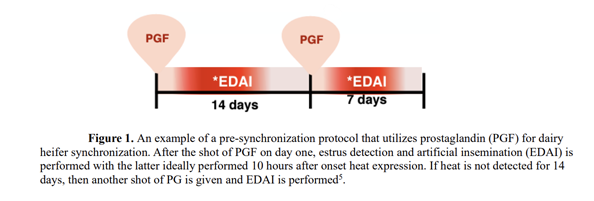
Prostaglandin (PG) is a hormone involved in the regression of a mature corpus luteum (CL), a structure on the ovary that produces progesterone, a hormone responsible for maintaining pregnancy. When progesterone is reduced in the circulatory system it allows growing follicles to reach dominance and ovulate. In a Double PG protocol, the first shot of PG is administered on day 0, the initiation of the protocol. Estrus will be detected for the following 13 days (Figure 1); however, most heifers will express estrus within 2 to 7 days of injection. If estrus is not detected a second shot of PG is given on day 14 and estrus will be detected for the following 7 days. Ideally heifers should be bred approximately 10 hours after estrus onset to reach the optimal timing for fertilization and maximize risk of conception. However, assessing the onset of thousands of heifers in large operations may not be feasible without the use of activity monitors. Therefore, breeding heifers right after being identified with signs of standing heat is more common12 .
Advantages
a) This double PG protocol is the same as a pre-synchronization protocol, therefore, can be easily implemented with other protocols.
b) This is one of the cheapest options for synchronization protocols. Since most heifers come into estrus with just one injection, it saves the producer money by not requiring the second injection 11,12.
c) Decreased stress on heifers as the protocol only requires 2 to 3 handlings depending on if heifer is receptive to first or second injection.
Disadvantages
a) PG alone is not able to start a heifer’s estrous cycle, therefore does not work on noncycling heifers1 .
b) Requires accurate estrus detection, and a need of trained personnel making frequent observations, resulting in increased personnel hours.
Controlled internal drug-releasing device (CIDR) and Prostaglandin (PG) Protocol with Estrus Detection
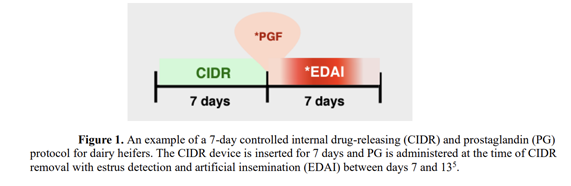
A controlled internal drug-releasing device (CIDR) is a T-shaped device that contains progesterone and is placed into the vagina which allows progesterone to be absorbed locally. The released progesterone prevents ovulation during the period of time the device is in the vagina4 . The CIDR + PG protocol requires 7 days from the time of CIDR insertion until removal. At the time of removal, a shot of PG is administered, and heat is detected from day 7 to 13 (Figure 2). Ideally, 12 hours after the onset of heat, the heifer is bred to achieve the proper timing to increase the probability of fertilization. Due to the short duration of CIDR placement, producers will be able to inseminate upon the first estrus as the oocyte has a lower chance of being aged.
Advantages
a) The synchrony of dairy heifer estrus cycles is within a shorter period of time when compared with other protocols10 .
b) With the use of CIDR, it may effectively bring acyclic heifers into cyclicity, which can help producers reduce the age at first calving5 .
Disadvantages
a) Strict protocols must be put into place to ensure a clean environment for insertion and removal of the device, research shows the risk of vaginal infections16 .
b) Although not very common, CIDR devices could potentially be lost during the protocol. The tail of the device that sticks outside of the vagina for identification and removal can also get broken off, therefore it is necessary to ensure that all CIDR are accounted for at removal15 .
c) CIDR device can be costly to the producer
Conclusion
Heifer rearing accounts for 15% to 20% of dairy farm expenses, the second highest after feed costs. Dairy heifers are a critical asset to dairy farms and can better used when first calving can be achieved at 22 to 24 months of age. Adding an estrus synchronization protocol when rearing heifers adds benefits for the producer, by reducing raising costs, increasing longevity of the animal’s life, and increasing milk production abilities. Furthermore, successful implementation will contribute to the overall sustainability and profitability of dairy operations. This article is for educational purposes only; always consult with your herd veterinarian and/or reproductive manager before implementing any breeding protocol.
Click for Reference Link


Be the first to comment