
The T.C. Jacoby Weekly Market Report
Week ending March 6, 2020
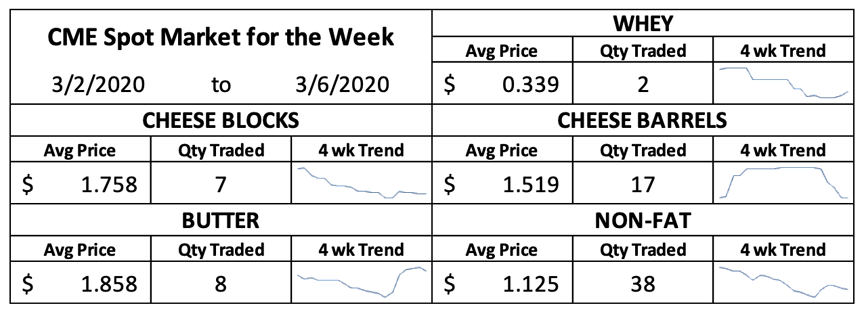
The dairy markets sprinted out of the gate on Monday, but they couldn’t sustain such an energetic pace. They managed to cross the finish line today in a slightly better position than last Friday, but they looked quite fatigued. Class III futures were little changed from last week, with 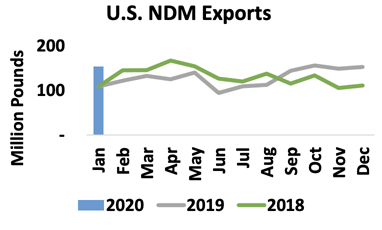 nearby contracts in the low $16s. Class IV futures improved. Most first-half contracts added roughly a nickel, while second-half futures climbed 20ȼ. Still, at prices ranging from $15.40 to $16.73 per cwt., Class IV values are uninspiring, to put it kindly.
The dairy markets – and markets of all stripes – are fixated on the spread of the novel coronavirus (COVID-19) and its potential impact on the economy and consumer behavior. This week, for the first time since the financial crisis, the Federal Reserve called an emergency meeting and cut interest points by 50 basis points. If the disease continues to unsettle the markets, they may make further cuts in the hopes of stimulating economic activity. The dollar weakened considerably in response, making U.S. exports more competitive.
U.S. dairy product exports made a strong showing in January, with $546.2 million in sales. 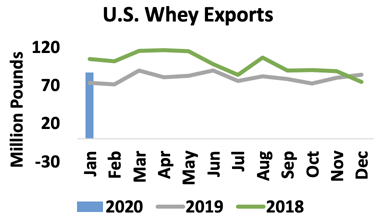 That’s only the second time ever that January sales topped $500 million. Milk powder exports were particularly strong. At 153 million pounds, they were up 40.8% from January 2019. U.S. cheese exports were up slightly from last year, while butterfat exports continued to lag. Whey product exports grew noticeably from the depressed levels of last year, when the trade war was in full swing. Chinese orders for U.S. whey products improved as the U.S. regained market share there. However, the severely diminished pig herd and COVID19 suggest that further upside may be limited.
U.S. exporters likely kept dairy products moving abroad for much of February, but Southeast Asian orders evaporated when the virus began to wreak havoc around the Lunar New Year. It seems that life is beginning to return to normal in much of China, outside Hubei province, but trade logistics are still a snarl. China is working through a backlog at its ports, and ships and containers are often not where international traders need them to be. Meanwhile, COVID-19 is
spreading quickly around the world, including in the United States. Countless corporations are canceling conferences and discouraging employee travel. Many people are opting to chat on a screen rather than face to face, reducing personal and business travel and all the consumption that goes with it. There are a lot of would-be steak dinners that won’t hit the company’s credit card this month, along with numerous baskets of bread with butter, creamy soups, sauces, and dressings, and cheesy appetizers. In many places, the grocery checkout lines are long and the shelves are starting to look bare, so it’s possible that gains in retail sales are offsetting slower restaurant traffic. But overall, dairy demand is likely losing ground.
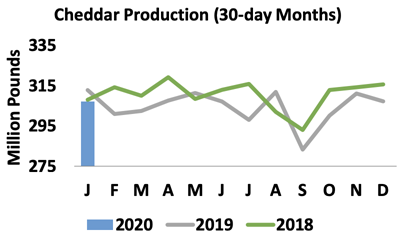 There was plenty of milk for driers, vats, and churns in January. While cheese and butter output increased only modestly from 2019, the 0.4% and 0.6% respective gains were enough to establish new production records for the month of January. Thanks to strong mozzarella output, Cheddar production continues to lag prior-year levels, which may help the spot cheese market to find its footing. Nonfat dry milk (NDM) output was just 0.3% higher than in January 2019, but skim milk powder (SMP) production jumped 29.5%. Manufacturers were
 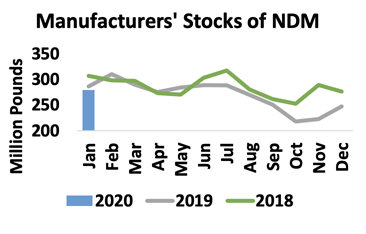 clearly making product for export, but foreign demand has since dried up. Despite strong milk powder exports in January, manufacturers piled up NDM. Stocks reached 279 million pounds, up 32 million pounds from December 31. That’s the largest December-to-January increase since 1999. Stocks are still below year-ago levels, but the deficit is shrinking.
Dairy product prices moved mostly lower at the Global Dairy Trade (GDT) auction on Tuesday, but the decline was not as steep as feared. The average price for SMP at the GDT slipped 3.2% to the equivalent of $1.33 per pound, after adjusting for protein. At the CME spot market, NDM bounced back from last Friday’s five-month low. It climbed a nickel to $1.115. Whey powder rallied too. It added 0.75ȼ and closed at 34.75ȼ.
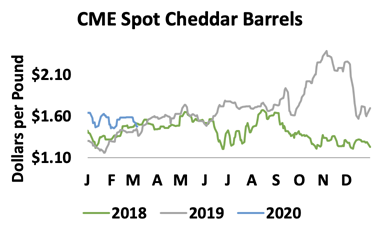 Now that traders March has arrived and brokers can no longer dump “old crop” butter in Chicago, pressure has abated. CME spot butter bounced back to $1.855, up 13ȼ from last Friday. The cheese markets were mixed. Spot Cheddar blocks climbed 2.75ȼ to $1.75. Barrels plummeted 11.25ȼ to $1.4775. For the first time since June, barrels are cheaper than they were a year ago.
There are a lot of good things to be said about dairy market fundamentals, and the most positive is that global milk output is growing very slowly. But demand seems to be moving backward for
Just like dairy, corn prices gained ground this week despite a lot of red ink on Thursday and Friday. May corn settled at $3.76 per bushel, up 7.75ȼ from last Friday. Soybean futures retreated 1.5ȼ to $8.9125. U.S. exports simply cannot compete with Brazilian soybeans. The Brazilian real stands at an all-time low against the U.S. dollar, and Brazilian farmers are enjoying their best soybean prices in a decade. As they bring in their bumper crop, they are selling immediately. Brazilian soybean exports are expected to be record large this month. The Argentine crop also seems to be in good shape, although it’s been a bit dry. The forecast promises that rains will return in a few days. But Argentina’s exports may not impress, because the government raised taxes on both soybeans and soy products.

Original post: https://www.jacoby.com/market-report/dairy-markets-are-fixated-on-the-spread-of-coronavirus/


Be the first to comment