
The T.C. Jacoby Weekly Market Report Week Ending June 4, 2021
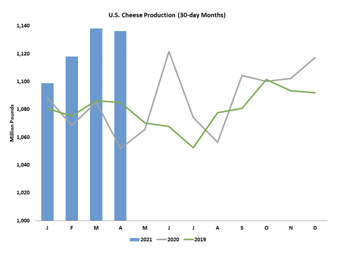
Exports will be an important outlet for a market that is heavy with product. There is plenty of milk, and cheese plants are running full throttle.
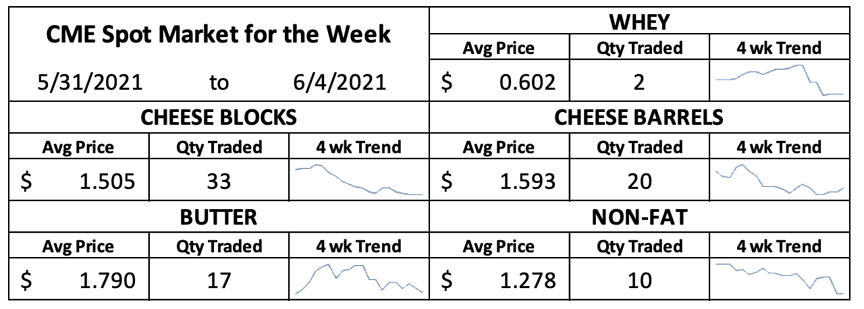
 The dairy markets dropped again this week. CME spot Cheddar blocks fell 3ȼ to $1.50 per pound, a one-year low. By any measure, blocks are a bargain, and they’re likely attracting some foreign buyers. Barrels are a bit pricier. They climbed 4.5ȼ this week to $1.615.
Exports will be an important outlet for a market that is heavy with product. There is plenty of milk, and cheese plants are running full throttle. USDA reported cheese production at nearly 1.14 billion pounds in April, up 8% from the somewhat depressed
Last April, butter churns ran at a frantic pace, to prevent the industry from dumping any more cream than was absolutely necessary. This year, operations returned to normal. April butter output totaled 185.2 million pounds, down a whopping 18.5% from a year ago. 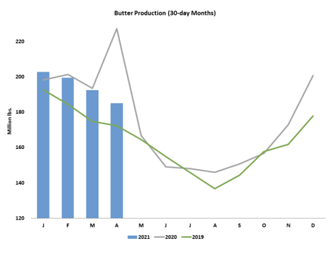 However, excluding last year’s massive output, this was the strongest April butter production on record. The fact that stocks did not balloon this spring implies healthy demand. More recently, butter makers tell USDA’s Dairy Market News that retail demand is fading a bit, while foodservice orders are climbing in fits and starts. CME spot butter slipped 3.5ȼ this week to $1.775. That’s about a dime lower than the recent highs but still on the upper end of the 2020 and 2021 trading range.
 After sprinting straight upward all spring, the powder markets found themselves alone at the peak. Buyers who had climbed with them step-for-step much of the way showed no inclination to linger with nonfat dry milk (NDM) above $1.30 or dry whey in the mid60s. So the powders have taken a few steps back to more accommodating elevations. CME spot whey retreated 2ȼ this week to 60.25ȼ. NDM fell 3.25ȼ to $1.26. At the Global Dairy Trade (GDT) auction on Tuesday, both skim milk powder (SMP)
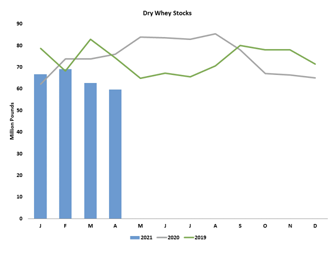
Demand for protein remains hearty. Despite a huge uptick in cheese production, dry whey output fell 1% from the prior year as manufacturers directed whey into higher protein concentrates and isolates. Whey stocks moved lower once again in April and now stand 21.5% below prior-year levels, thanks to strong demand from China.
Driers ran at a good clip in April, but, like butter churns, they fell short of the frenzied pace set last year at the height of the pandemic shutdowns. Combined production of NDM and 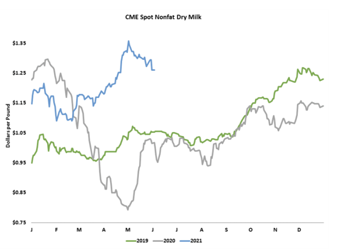 SMP totaled 236 million pounds, down 7.1% year-over-year but still high by historic standards. Nonetheless, manufacturers’ stocks of NDM dropped in April, signaling strong demand. We likely have exports to thank for keeping milk powder stocks in check.
Low slaughter volumes, an immense milk cow herd, and formidable dairy product output all point to the possibility of lower prices in the months to come. Indeed, both Class III and Class IV futures took another step back this week. Compared to last Friday, most Class III contracts settled about a dime lower, while Class IV contracts dropped 30ȼ on average. Cheddar block values are starting to strain under the weight of unprecedented production. But the other dairy markets look relatively resilient. They climbed a bit too high and suffered a small setback, but they seem stable. Milk and dairy product output is strong, but, thankfully, so is demand.
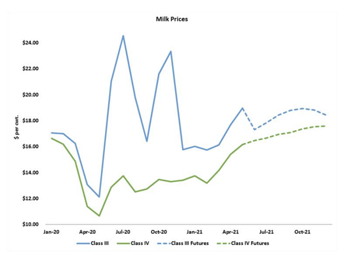 USDA announced the May Class III price at $18.96 per cwt., up $6.82 from the unbearably low depths plumbed a year ago. At $16.16, May Class IV was $5.49 higher than that of May 2020 and the highest Class IV price since February 2020, just before the pandemic began to sicken the market. The futures promise continued improvement in Class IV values, a welcome relief to those dairy producers who suffered watered down milk checks and punishing producer price differentials for the past 14 months.
The temperature rose this week and so did the grain markets. July corn jumped 26ȼ to $6.8275 per bushel. December corn rallied an astounding 46ȼ to $5.915. Amid a global shortage of vegetable oils, soybean oil futures reached their highest level since 2008. That propelled July soybean futures up more than 50ȼ this week, to $15.8375. The soybean meal market was calm in comparison. July soybean meal added just 70ȼ this week and reached $396.20 per ton.
Most of the corn crop is off to a great start. In its first assessment of the season, USDA rated 76% of the crop in good or excellent condition, one of the highest initial ratings on record. But while conditions are lush in the heart of the Corn Belt, they are dry at the fringes. USDA reports that 24% of the corn crop and 23% of soybeans are in an area experiencing drought. Farmers in the Northern Plains and around the Great Lakes would love a good soak. For the foreseeable future, the weather forecast will determine which way things go on LaSalle Street.
Original Report at: https://www.jacoby.com/market-report/dairy-markets-drop-again-this-week/


Be the first to comment