
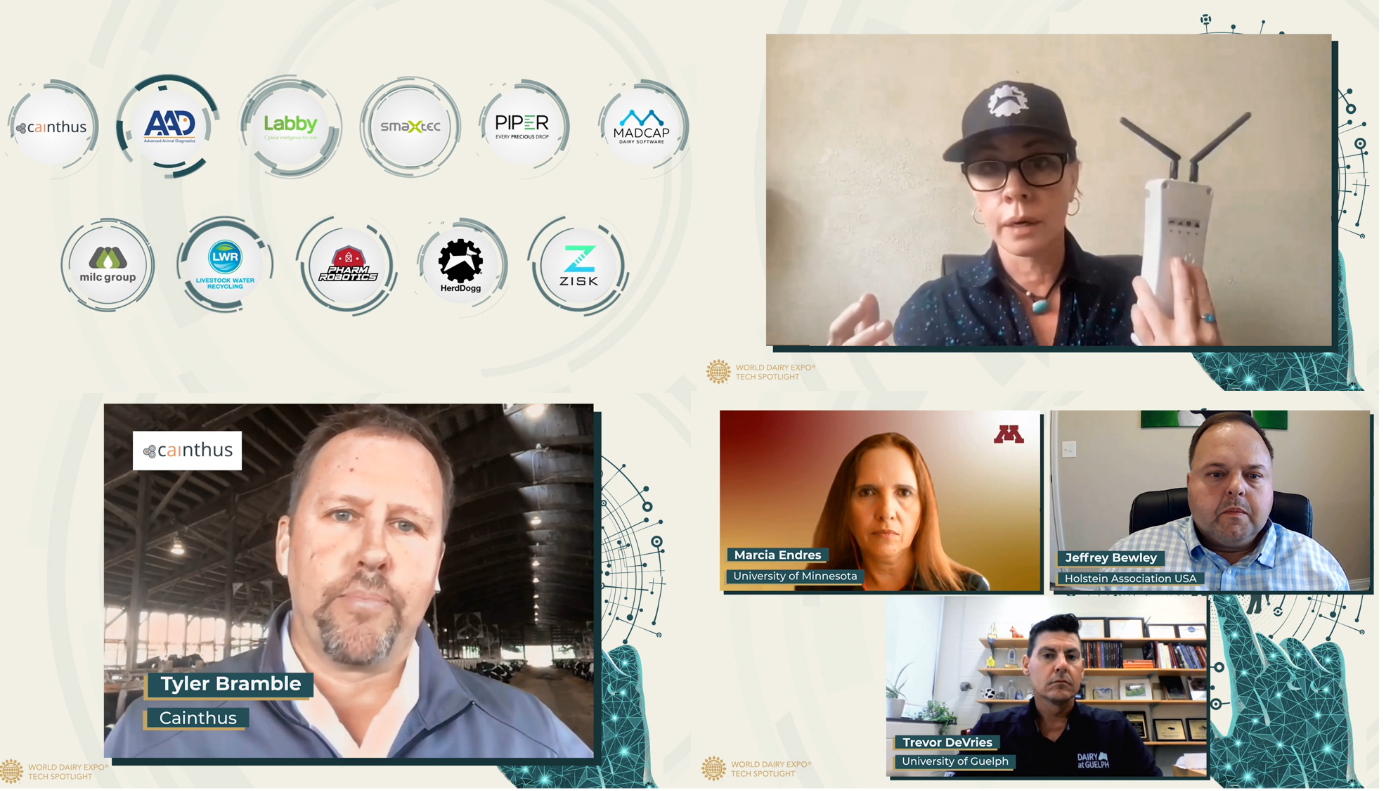
Technologies are the future of the dairy farms, but which solutions are out there and ready for the US market? At the World Dairy Expo TECH SPOTLIGHT online event, 11 dairy tech start-ups shared their innovative solutions and 3 dairy experts explained the keys to success for implementation tech on a dairy farm.
Key learnings from panel discussion
The pitches were followed by an in-depth discussion featuring Professor Jeffrey Bewley from the Holstein Association USA, Professor Marcia Endres from the University of Minnesota and Professor Trevor DeVries, University of Guelph, who shared their views on the future of dairy tech: what solutions to maximize efficiencies, increase profitability on the farm and answer the challenges we face of being sustainable?
According to Professor Endres, the diversity of options in the market today and the possibilities for the future in dairy tech are endless. “But what technology to choose is different for each individual farmer because each farm has its own needs. In addition, some technologies that have been developed in Europe, may not always work the same on large herd sizes in the US. In the near future, it will also become more important to find better ways to put different technologies together, to make a “package” to better manage the herd in terms of production, economics, health and welfare. To have better understanding on which technologies go well together for each operation will help farmers to better make decisions and reach their goals regarding profitability, sustainability, animal welfare and social aspects”, Endres explained.
3 main takeaways from the panel discussion:
- It is important to involve dairy farmers in developing and testing new technologies. Tech companies should understand the pain points and challenges on a dairy farm. This doesn’t always happen in practice.
- Good service and customer support is almost as important as the technology itself. When the technology breaks down you need the best service possible to keep the farm going.
Not all technologies work the same on each farm. Some EU technologies are not always suited for large US dairies and we have to find a better way to connect different technologies together to create a tailor made package that works for that particular farm.
Bewley clearly sees a shift in the market for dairy tech. “In the past, it was too much focused on developing the technology first and then start looking for a solution and how can I make this work. Now, technology is really solving a problem on a dairy farm. And the problem should be the incentive to develop a technology, not the other way around. I also strongly encourage start-up companies to involve the farmer as a co-developer to better understand their needs and then take it to a farm”, Bewley addressed. He also believes that data can really help farmers to improve feed management and cow health. “But to be successful, it is not only the technology and the reliability that counts. Good service and support by the tech companies is really important for customer success and adoption of the tech by the farmers”.
DeVries agrees that we are realizing more and more that not every type of technology works for every farm or situation. “I used to favor the tech focused on simply labor savings. To some degree, I still vote for that, but that doesn’t always work in every situation and may not always be the best cost-effective method for all farmers. I see a lot of potential in technologies that will further improve efficiency and consistency (managing variability) on dairy farms. Successfully developing a dairy tech solution is all about understanding the farmers, managers and other people around the farmer. The way they manage animals and staff is important to know to get the farmers interested in the technology in the first place”.
Start-up pitches per category
Effective mastitis prevention
Mastitis is a major health and economic issue for most farmers. Advanced Animal Diagnostics developed a rapid on-farm test kit called QScout MLD, that delivers a clear positive or negative quarter-level diagnosis that is reliable – and actionable. With this technology, dairy farmers know which cows and which quarters of the udder are infected. This improves the treatment protocol and can reduce antibiotics use.
Labby provides a rapid, low-cost, lab-quality milk testing solution to be used on the farm. It gives milk composition and quality information, including milk fat, protein and somatic cell count (SCC), using advanced mobile spectroscopy and AI. Testing the milk on-farm, allows farmers to make better decisions on a day to day basis and can help in cow selection processes and detect early onset of mastitis.
Cow management
SmaXtec develops technology to keep their cows healthy and productive. The smart bolus sensors continuously measure data. Each bolus measures direct, meaningful data with highest precision inside the cow’s rumen. This enables early detection of mastitis, pneumonia, ketosis and more. The technology also alerts the farmer when a cow is in heat, the best time of insemination (time window) and the predicted calving moment.
HerdDogg’s traceability program offers Bluetooth animal tags that enable the producer to develop data sets that can be linked to a physical QR code. Portable, easy to use and low cost. The company’s mission is to increase the value of livestock so that producers can make more money from every animal they raise. That value is raised by the amount of data that is available regarding heat and animal welfare.
Optimizing farm management
Cainthus explained to the viewers how they use cameras and Artificial Intelligence to monitor the herd and operations on the farm 24/7. The technology allows the producer to improve feedbunk management, making sure that cows always have access to feed. Cainthus also allows to maximize herd productivity and welfare by monitoring indicators such as lying time, time on feet, stocking density, cow comfort. It drives labor efficiency by making sure that feeding and milking protocols are being followed.
Milc group is a California-based company that brings innovation to the dairy industry through technology and education. Milc Group developed the one™ system, a cloud based management system, consisting of different modules focusing on milk production and milk quality, animal feed and staff training. Dairy farmers can benefit from a system like this that connects all relevant information in one system.
Optimizing profits
Livestock Water Recycling believes that manure has incredible value. LWR developed data driven process technologies to capture and concentrate valuable manure components and extract water from the manure to re-use on the farm. Upgrading manure by using technology can create additional revenue for dairy producers looking to grow more crops, increase natural fertilizer sales or receive greenhouse gas and carbon credits for example.
Zisk presented an interesting free app to determine the farm’s financial future. The Zisk app calculates the farm’s profits for the next 12 months and shows daily trends, based on market data. Market watch page shows prices of corn and soybean meal and milk. You can also ask the app to watch the market for you, by setting a custom alert. The Zisk app also includes a news section with the latest dairy articles.
Reducing labor
PharmRobotics explained the benefits of Sureshot™, an automated injection system for dairy and beef herds. This automated system eliminates the need for a (expensive) labor force when delivering vaccines or reproductive products. Shots are delivered at a 100% compliance rate. This technology can save dairy farmers up to 285 dollars per cow per year.
Milk supply chain management
Contec Group International Ltd developed MADCAP dairy software that offers a range of features that cover every aspect of milk supply chain management, from transport scheduling and route optimization through to milk testing and producer payroll. Already over 60,000 dairy farmers use this software to optimize their dairy business.
Piper Systems’ aim is to make milk collection more efficient and automated, as this process has stayed relatively untouched so far. Piper uses advanced automation and data technology to improve milk collection, loading, and sampling. This will increase the number of representative milk samples, increase traceability and reduce manual labor. Piper’s technology is suited for every size of farm.
You can re-watch the on-line event HERE. The World Dairy Expo Tech Spotlight will be followed by an in-person event taking place during World Dairy Expo in Madison, Wisconsin on September 28 at 10:30 a.m. (CST), Mendota 2, Exhibition Hall.


Be the first to comment