
De-pooling from a Federal Order has a significant financial impact on dairy farms. Why is milk de-pooled? This post will cover some of the impact. No detail is available on the price received for de-pooled milk, but it is likely to be at or near to the Federal Order pricing for the milk.
For details on de-pooling, see these prior posts:
Efforts by the USDA to reduce de-pooling have not worked!
There are different rules within each Federal Order for de-pooling. The process for de-pooling and delivering milk is managed by the “Handlers” that deliver the milk.
Charts in this post will show the impact covering the Federal Orders in the Upper Midwest, California, and the Southwest. These are the three largest Federal Orders and account for most of the de-pooling.
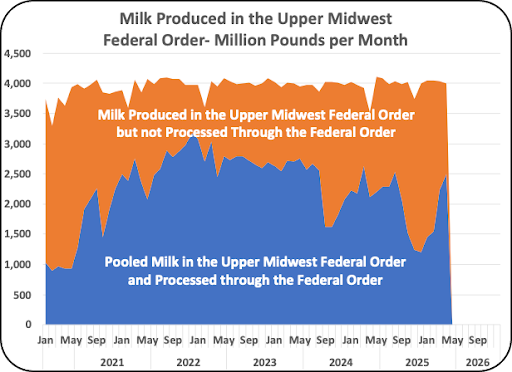
The Upper Midwest Federal Order has de-pooled 43% of its milk over the time covered in Chart I. The rules for the Upper Midwest allow up to 90% of Class III milk to be de-pooled to specific cheese plants that are non-pool plants. The de-pooled milk cannot be more than 125% of the prior month (except for March when the limit is 135% for the prior month). The “touch-base” rules are minor and applied only to new producers delivering to a non-pool facility.
De-pooled quantities in Chart I are published monthly estimates by the Midwest Federal Order.
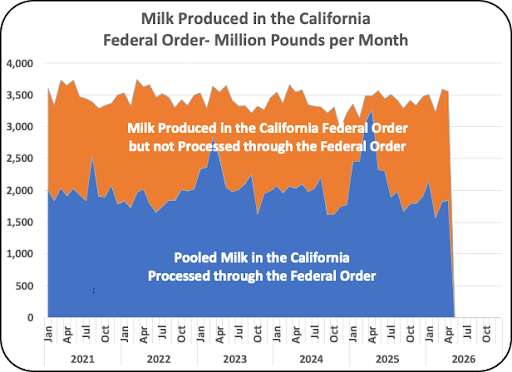
The California Federal Order was implemented in November 2018. California did not allow de-pooling prior to that time. From day one of being a Federal Order, de-pooling has been significant. During the time covered in Chart II, 41% of the California milk was de-pooled. The de-pooling in California varies between Class III and Class IV milk. California is by far the largest butter churner in the U.S.
There are few rules in the California Federal Order for de-pooling. Therefore, 100% of Class III or IV can be and is de-pooled. This was one of the main reasons for California becoming a Federal Order.

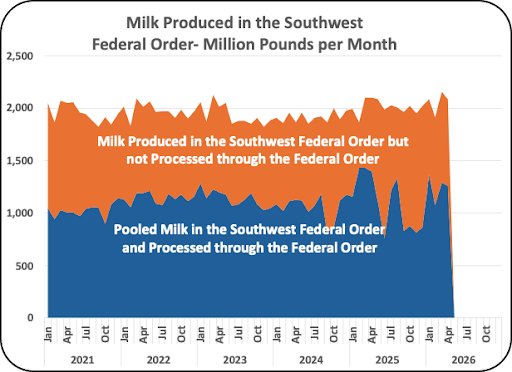
De-pooling milk in the Southwest Federal Order is limited, allowing only 70% of milk to be delivered to non-pool processing plants. There are also restrictions on re-pooling. However, the restrictions have not reduced de-pooling. The Southwest is de-pooling 44% of the milk produced (Chart III).

Rules for de-pooling are different in each Federal Order, and the Northeast Federal Order has the strictest rules to
If a handler or cooperative de-pools milk at any time during the low production months of July through November, that handler’s milk is prohibited from participating in the Federal Order pool during the subsequent high production months of December through June.
De-pooling is a controversial subject. Some producers make more money, and some make less money with de-pooling. Rules for de-pooling vary among Federal Orders making an inconsistent valuation process for producers in the U.S.


Be the first to comment