

Adoption of anaerobic digestion (AD) of dairy manure has grown in New York state and across the U.S. in recent years, driven primarily by strong market value for use of biogas as transportation fuel under national and state-level fuel standards (e.g., California’s Low Carbon Fuel Standard and Oregon’s Clean Fuels Program). Cornell CALS PRO-DAIRY estimates that over 15 million gallons of diesel consumption is reduced per year from the currently operating dairy manure AD systems in NY that provide biomethane1, also known as renewable natural gas (RNG). Additional on-farm AD systems in NY are generating approximately 38 million kWh of electricity per year,
PRO-DAIRY’s analysis of these factors has determined that:
A) Economic feasibility is achievable for AD systems that accept food waste in an equivalent amount to the co-digested dairy manure from at least 300 milking cows when the total revenue is equivalent to at least $34 per MMBTU in terms of the energy produced3. An example of this revenue breakdown might be $20/ton for food waste acceptance tipping and $25/MMBTU for renewable biomethane supply, with $0 revenue from the additional fertilizer production. Larger operations can also achieve economic feasibility with lower amounts of food waste and/or lower revenue values.
B) The most important practical considerations for farm operations are typically nutrient management of the digestate that includes imported nutrients from food waste acceptance, and management of food waste acceptance and the overall AD operation. Opportunities to partner with experienced developers and operations companies to provide AD system management are obtainable. The digestate nutrient management is almost always the farm’s responsibility and must follow an acceptable Comprehensive Nutrient Management Plan (CNMP) as permits require.
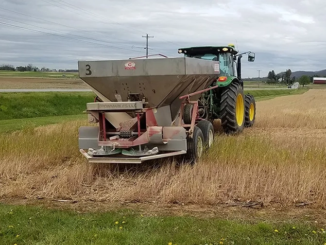
Starting with the practical considerations for on-farm operations, it is imperative to evaluate the impact of importing food or other organic wastes onto the farm for co-digesting with the existing dairy manure and nutrients being managed. The AD process alone does not remove the nutrients in the organic feedstocks, so they will be present in the liquid digestate effluent. While some volume reduction occurs during the AD process, it is difficult to quantify and typically is less than 5%, although higher volume reductions may occur with high ratios of food waste to manure4. Use of solids separation after digestion will reduce both the liquid stream volume and nutrient content more significantly5. Anaerobic digestion of organic matter results in a shift of the total nitrogen (N) to a higher concentration of ammonium-N and a lower concentration of organic-N. Dragline and injection of digestate are therefore more effective in reducing loss of the plant-available ammonium-N during application.
In a situation where imported nutrients for the co-digestion system create an imbalance in nutrient application onto land managed by the farm, solutions will need to consider the ability to export digestate to neighboring farms including non-dairy farms for use as fertilizer. An additional option is to evaluate advanced treatment of digestate to dewater and partition nutrient streams such that they can be more effectively transported and land applied6. Commercially available methods include fine solids filtration using chemically enhanced separation, ultrafiltration and reverse osmosis. These can add substantial cost to the project and have been implemented mainly on very large farm or multi-farm operations where local incentives are available.
The economic feasibility analyses that Cornell CALS PRO-DAIRY conducted with a grant from the New York Farm Viability Institute (NYFVI) considered low-cost food waste acceptance scenarios, which means they required no on-farm de-packaging equipment and were predominantly liquid-based food processing sources (e.g., whey, confectionary, fats/oils/greases, bakery wash water). Generally lower tipping revenue occurs with easier-tomanage food waste forms, and trends may be toward centralized food waste processing operations that supply feedstock to organics recycling operations. This makes the energy value and digestate fertilizer value increasingly important in the cash flow. In addition to evaluating the economic feasibility conditions for a 300-cow manure and food waste co-digestion system, we determined that a dairy with 1,000 milking cows could achieve economic feasibility with a 25:75 food waste to manure co-digestion ratio under high revenue conditions (e.g., equivalent to $35 to $42 per MMBTU in terms of energy produced). If they accept more food waste, the revenue values needed for feasibility become more moderate. Energy prices observed in the US for RNG from manure and food waste AD in 2024 ranged from $14 to $28 per MMBTU in voluntary markets and $45 to $68 per MMBTU in regulated markets7, however local regulated markets are not established in New York State.
There is no question that anaerobic digestion of waste is an important part of the climate change solution. This practice provides near-continuous energy output that ultimately comes from recycling carbon dioxide (CO2) in the
- Ray, L. (2025). Biomethane potential in New York. Cornell CALS PRO-DAIRY. https://cals.cornell.edu/sites/default/files/2025-03/anaerobic-final_0.pdf.
- Vafiadis, S. and Ray, L. (2024). Small-scale anaerobic digestion system technology. https://hdl.handle.net/1813/115779.
- Ray, L. and Tomich, M. (2025). Webinar: How small can co-digestion economically go? Cornell CALS PRO-DAIRY. https://cals.cornell.edu/how-small-can-co-digestion-economically-go.
- Morris, J. and Gooch, C. (2024). Estimating anaerobic co-digestion influent-effluent volume differences: Background, Method, and Application. https://hdl.handle.net/1813/114208.
- Bockhahn, J., Wright, P.E., Gooch, C.A. (2020). Screw press solid-liquid separation. https://hdl.handle.net/1813/102695.
- Terry, T. and Wright, P.E. (2020). Advanced Manure Treatment fact sheet series. https://hdl.handle.net/1813/102706.
- Ray, L. (2025). How small can on-farm co-digestion economically go? https://hdl.handle.net/1813/116806.

Be the first to comment