

The trace mineral requirements for dairy cows often cannot be met through forage and grain alone. Supplementation in the diet is often needed to bridge the gap between supply and requirement. Jöns Berzelius discovered selenium in 1817. However, selenium was only thought of as a toxic element for many decades. It was not recognised as an essential mineral until 1957. Adding a small amount of selenium to torula yeast diets was shown to prevent the development of liver necrosis in rats and exudative diathesis in chicks.
Glutathione peroxidase was the first selenium-containing enzyme identified in 1973 and has an important role in preventing oxidative damage to cells.
Impact on performance
Supplementing selenium generally elicits a positive response in animal health.
Research with dairy cows has found that selenium supplementation can reduce milk somatic cell counts, lower the incidence and severity of clinical mastitis, lead to fewer retained placental membranes and improve reproductive parameters.
Improvements in reproductive parameters included fewer days to conception, fewer services per conception and improved pregnancy rates at first service.
The requirements of dairy cattle
The most recent edition of the Nutrient Requirements of Dairy Cattle defines the selenium requirement for all classes of dairy cows as 0.3ppm. Selenium is perhaps the most regulated trace mineral in regard to supplementation for dairy cattle. The US Food and Drug Administration (FDA) has set the maximum supplemental level of selenium at 0.3ppm. There are also regulations about the forms of selenium that are allowed in the United States. Prior to 2003, the only legal forms of selenium in the US were sodium selenite and sodium selenate.
In 2003, the FDA approved selenium yeast for dairy cows as a legal form of selenium in the US; this approval was solely based on data submitted on Sel-Plex (Alltech, Inc). To this day, no other selenium yeast has been reviewed by the FDA. More recently, in 2020, the FDA also approved the category of selenomethionine hydroxy analogue, a chemically synthetic organic selenium.
Selenium supplementation guidelines, as well as approved selenium ingredients, can vary greatly between countries. It is always best practice to first check local regulations when making selenium supplementation decisions.
Differences in selenium sources
Inorganic selenium (selenite) is absorbed much less efficiently by ruminants than by monogastrics. Absorption of selenite by ruminants has been reported at 29% and between 17% and 50%.
Poor absorption of inorganic selenium is likely due to the ruminal environment, where oxidised selenite or selenate are in large part reduced by ruminal microbes to insoluble and unavailable elemental selenium excreted via the faeces.
Other dietary factors also influence the availability of inorganic selenium. Dietary concentrates alter ruminal reduction capacity with high concentrate/low pH, presumably increasing the amount of inorganic selenium that the microbes can make unavailable to the animal.
This variation in rumen acidity may be one reason why the response to a given amount of selenite can vary from farm to farm in the same region. In addition, other minerals, including sulfur and iron, interfere with selenium absorption.
Plants, marine algae, and bacteria can convert inorganic selenium into organic selenoamino acids like selenomethionine. These organic selenium sources are more available to the animal for absorption and utilisation. Yeasts, as part of the plant kingdom, have the ability to convert inorganic selenium into selenoamino acids.
A recent white paper compared form, source and function within the product categories generically defined as ‘organic selenium’. An important conclusion was that effects on animal health and performance must be assessed for each individual organic selenium product.
The major advantage of an organic selenium source such as Sel-Plex is its improved absorption and retention in the body. Selenoamino acids incorporated into body proteins provide a reserve of stored selenium when demand is high, particularly during disease challenge and gestation.
Maternal transfer of organic selenium through the placenta and colostrum improves the calf’s ability to survive and thrive. Additionally, organic selenium supports reproductive function, udder health and postpartum health.
Focus on reproduction
Research conducted at the University of Florida compared supplementing 0.3ppm selenium from either sodium selenite or selenium yeast in 574 dairy cows from 25 days before expected calving date through 80 days of lactation.
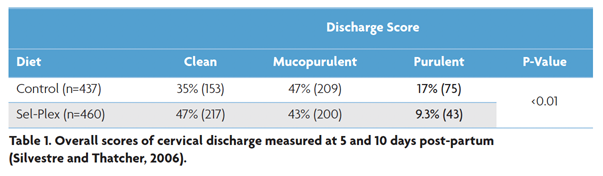
Results of vaginoscopy scores at 5 and 10 days after calving (Table 1) showed differences based on the source of selenium in the diet. Cows fed selenium yeast had 47.1% clear, 43.4% mucopurulent and 9.3% purulent discharge scores, while cows fed sodium selenite had 35% clear, 47.8% mucopurulent and 17.1% purulent discharge scores.
Feeding organic selenium was shown to improve the uterine environment after calving, as the frequency of purulent discharge was reduced while the frequency of clean discharge increased.
Additionally, measurements of immune function may help explain some of the differences reported above. Selenium yeast improved neutrophil function (innate immunity) at calving in multiparous cows. Neutrophil function was suppressed at calving in primiparous cows but was restored by 7-14 days postpartum with selenium yeast supplementation.
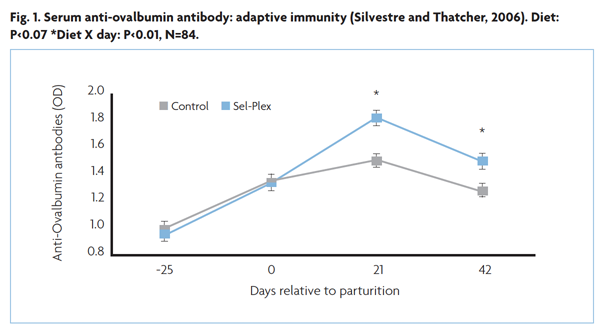
The researchers also examined the effects of selenium sources on acquired immunity by measuring the antibody response to an injection of ovalbumin (Fig. 1). Antibody concentration was higher in multiparous cows at 21 and 42 days postpartum, while antibody response was not different in primiparous cows.
Selenium source did not impact first-service pregnancy to artificial insemination. However, second-service pregnancy was improved in the selenium yeast diet (17.1% vs 11.3%). When looking at results for cows that lost an embryo after first service, second service was 22.7% successful for cows supplemented with selenium yeast compared to just 4.2% successful for cows supplemented with sodium selenite.
The authors hypothesised that cows in the selenium yeast group were better able to re-establish an embryotropic environment at second service following either early or late embryonic losses.
It is in the genes
Other research in cattle has looked at the effects of selenium source on gene expression. Research at the University of Kentucky compared diets with selenium yeast to diets only containing sodium selenite as a selenium source.
Cows supplemented with selenium yeast had increased transcripts involved in cholesterol biosynthesis and immune response. Some 887 transcripts were differentially expressed based on source of supplemental selenium. The upregulation of cholesterol pathways has an important role in increasing the luteal phase concentration of progesterone.
These same researchers looked at other impacts of selenium source on gene expression regarding endometrial function and development of the conceptus. Cows supplemented with selenium yeast had an increased amount of myostatin gene, which increases glucose secretion into the histotroph that can allow for advanced conceptus development.
In this experiment, the conceptus was examined on day 17 of gestation and was found to be significantly longer in cows supplemented with selenium yeast compared to sodium selenite (25.96cm versus 17.45cm respectively).
A recent dissertation from the University of Guelph also investigated gene expression among cows receiving selenium yeast (along with organic sources of other trace minerals) or cows fed sodium selenite (along with inorganic sources of other trace minerals).
The author reported that 83 of the differently expressed genes had an expression pattern indicating that the conceptuses from the selenium yeast treatment were more advanced in development compared to those from the sodium selenite treatment.
The gene expression results observed are thought to be required for the coordination of changes in cellular biology that are needed for conceptus elongation, allowing for maternal recognition of pregnancy, implantation, and pregnancy survival.
Summary
The saying that ‘form defines function’ is both important and true when it comes to supplementing trace minerals to dairy cows. Research around the world continues to prove the impact of organic selenium sources, such as Sel-Plex selenium yeast, on reproductive performance.
However, not all organic sources of selenium can be expected to perform the same. It is important to evaluate each option on its own merits.


Be the first to comment