
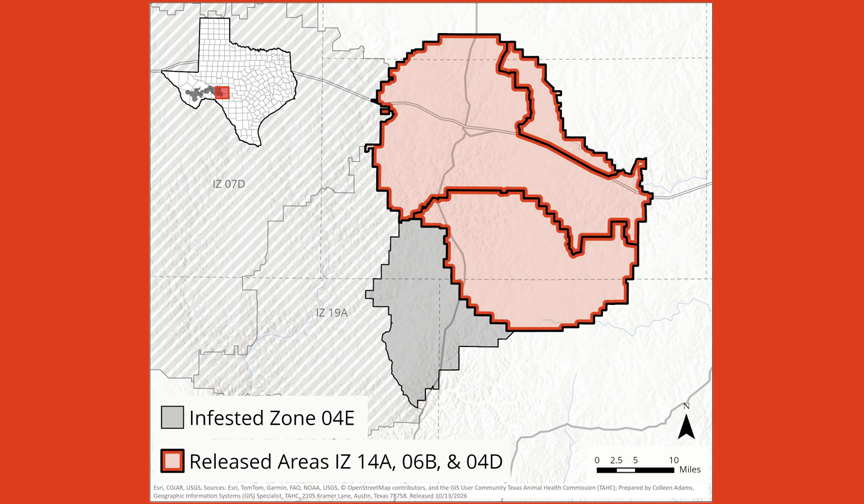
Since New World Screwworm (NWS) was detected in and around Edwards, Schleicher, Sutton, and Val Verde Counties, extensive NWS control measures were implemented in those areas and, as a result, additional areas within those counties are now eligible for release from NWS movement controls.
The following summarizes the establishment, modification, and epidemiological progression of Infested Zones 04, 06, 14, and 19 that support this determination.
Following the June 12, 2026 detection of New World Screwworm (NWS) in a sheep in Sutton County, the Executive Director established Infested Zone 06 and implemented animal movement restrictions in portions of Kimble, Schleicher, and Sutton Counties to support NWS containment and eradication efforts. Based on epidemiological assessments conducted on September 4, 2026, and October 10, 2026, the Executive Director determined that certain areas of Infested Zone 06 met the criteria for release from quarantine and movement restrictions. Accordingly, on September 4, the Executive Director released the portions of Kimble County previously included within Infested Zone 06 from quarantine and
On July 13, 2026, following the detection of NWS in a canine in Sutton County, the Executive Director established Infested Zone 14 in portions of Schleicher and Sutton Counties and imposed animal movement restrictions within the affected area. Subsequent NWS detections in Sutton County necessitated additional modifications to the affected area, including the establishment of Infested Zone 14.A.
In Val Verde County, NWS was detected in a sheep on August 15, 2026, and the Executive Director established Infested Zone 19 through the Executive Director Order Declaring Animal Movement Restrictions Due to New World Screwworm in Crockett, Sutton, and Val Verde Counties. Following an additional detection in a goat in Val Verde County on August 25, 2026, the Executive Director modified the affected area and established Infested Zone 19.A.
Since the zones were established in Edwards, Schleicher, and Sutton Counties, Texas Animal Health Commission (TAHC), Texas Parks and Wildlife Department (TPWD), and United States Department of Agriculture (USDA) have worked collaboratively with animal owners, veterinarians, livestock markets, industry organizations, local governments, and other state and federal partners to implement a comprehensive NWS eradication strategy throughout the affected areas.
Based on the epidemiological assessment of these zones and the surrounding areas, including fly trapping and monitoring data, evaluation of sterile fly dispersal, visual inspection of susceptible animals for myiasis, and the absence of NWS detections during the surveillance period, the Executive Director finds that sufficient evidence exists to support the release of certain areas from quarantine and movement restrictions.
Specifically, portions of Infested Zone 04.D have met the criteria for release; however, the proximity of recent NWS detections in Val Verde County within Infested Zone 19.A warrants the continued application of quarantine and movement restrictions in the remaining affected portions of Zone 04.D to support ongoing NWS control and eradication efforts.
The Executive Director further finds that Infested Zone 06.B and 14.A have satisfied the criteria for release from quarantine and movement restrictions and that surveillance conducted following implementation of control and eradication measures demonstrates that the restrictions imposed in those areas have achieved their intended purpose.
Therefore, the Executive Director releases the portions of Schleicher and Sutton Counties previously included within Infested Zones 06.B and 14.A from quarantine and movement restrictions. The Executive Director further releases portions of Edwards and Sutton Counties previously included within Infested Zone 04.D and modifies and redesignates the remaining affected portions of Edwards, Sutton, and Val Verde Counties as Infested Zone 04.E to maintain targeted movement restrictions and support ongoing NWS control and eradication efforts.
To protect the health of animals in this state, reduce the spread of NWS to noninfested animals, and prevent NWS from establishing in new areas, a quarantine remains imposed on Infested Zone 04.E. Infested Zone 04.E is subject to the following animal movement restrictions:
- Warm-blooded animals located within Infested Zone 04.E may not be moved outside of the zone without prior authorization from the Commission. Any person in possession or control of such animals must obtain permission and comply with all conditions set by the Commission before transporting the animals beyond the quarantine boundaries.
- To move warm-blooded animals outside of Infested Zone 04.E, the animal must be inspected and treated as required by the Commission and issued a permit or certificate for movement by a Commission representative.
- Hides, carcasses, and parts of any animal capable of serving as a host for NWS must be inspected and undergo any treatment deemed necessary by a Commission representative prior to removal from the Infested Zone 04.E.
- Unauthorized movement is prohibited and subject to administrative penalties and/or criminal prosecution.
Although quarantine and movement restrictions have been released from areas previously within the infested zone, continued vigilance remains essential to prevent the reintroduction or reestablishment of NWS in previously impacted areas. Animal owners and caretakers should continue to monitor animals for wounds and clinical signs consistent with NWS infestation and promptly report any suspected cases to TAHC. Continued surveillance, awareness, and timely reporting are critical to preventing new infestations and protecting animal health in Texas.
This order is issued pursuant to Texas Agriculture Code, Chapters 161-168, and applicable regulations found in Title 4 of the Texas Administrative Code, Part 2, Chapters 31-60, and is effective immediately.
This order will remain in effect until the quarantine is released by the Commission.
Lewis R. Dinges, D.V.M. Executive Director Texas Animal Health Commission


Be the first to comment