
Currently there are multiple factors that we are tracking that are affecting the U.S. dairy industry. In the U.S. dairy market, a hot topic of conversation over the last few years has been the decline in bottled milk sales. Currently we are seeing a fundamental change in the dairy market. There has been a recent shift where export demand is beginning to account for a greater portion of U.S. dairy sales than our domestic bottled milk sales, thanks in part to competitive prices. The first time exports were larger than fluid milk sales was back in April of 2018, but that only lasted for one month. Then it happened again in May and June last year, but now exports have consistently been higher than fluid milk sales since March of this year.
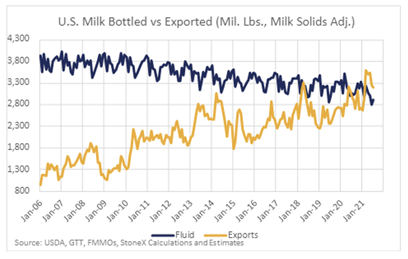
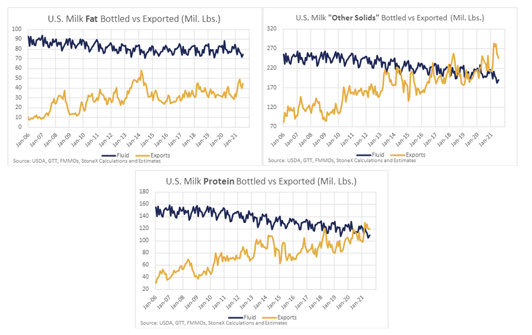
Comparing bottled milk to exports is tricky. The milk in a bottle is a blend of fat, protein, and other solids, but U.S. exports are biased strongly toward milk powders with varying levels of fat, protein, and other solids. It is interesting to look more closely at the individual components. When we do this, we
can see that while the fat content in exports only accounts for about half of the percentage of fat sold through bottled milk sales, YTD 84% more fat has gone into a bottle than has been exported. On the other hand, other solids exports, which is mostly lactose (the sugar in milk) has been running well above the amount of other solids going into a bottle for most of the past two years. This year we have exported 29% more other solids than what went into bottles. Protein exports versus bottled milk sales track look very similar to milk equivalent exports. YTD, the U.S. has exported 4.3% more protein than we put into a bottle thanks to record NFDM/SMP exports. Overall, this feels like a turning point, or at least mile marker in the structure of the U.S. dairy market but the fundamentals of the dairy market feel like they have been leading up to this point for some time.
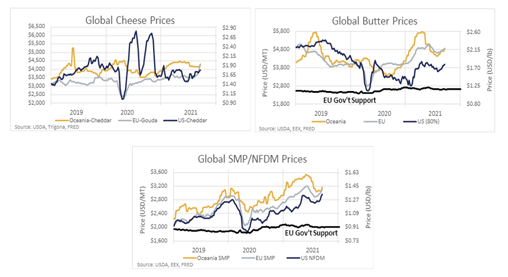
As mentioned, U.S. dairy prices have been competitive in the world market recently. These advantageous prices provide a competitive advantage for the U.S. across the export market. Cheese prices have begun to consolidate, along with SMP/NFDM prices, but butter prices continue to have a wide margin from other major exporting countries contributing to the competitive advantage that the U.S. holds. In the U.S. cheese prices are being impacted by the normal seasonal tightening. In the EU
cheese prices are increasing because of weak milk production. In the butter market prices are finding a conflict between seasonally tighter fresh supplies and ample inventory from butter production earlier this year. NZX futures are pointing toward lower butter/AMF prices at the GDT auction in mid-September as buyers push back against higher price levels. In the powder market prices have increased faster than expected and there are signs that export demand could push back against prices increasing much further.
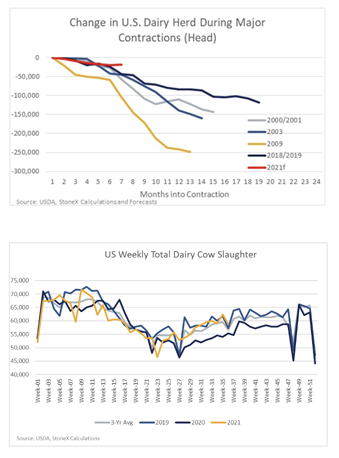
While prices have been competitive one of the fundamental factors that could pose a threat to the global U.S. market is the contraction of the dairy herd. Recently the U.S. dairy market has been seeing strong contraction signals as dairy cow slaughter levels have been high, but when you consider that herd size is larger than past years, we get an interesting picture. Contraction in the dairy herd is tracking closest with the 2018/2019 dairy herd contraction which makes sense as slaughter levels are tracking closest with 2019 and the 3-year average slaughter level. Margins aren’t as tight as they were in 2000 or 2009 so it makes sense that the dairy herd contraction won’t be as severe or as long as the really low margin year of 2009. Milk supply was strong at the beginning of the year so slaughter levels staying strong are likely a bullish sign for the supply chain being able to work through the backlog of inventory that we had at the beginning of the year.
Editor’s Note: For more information, Nate Donnay can be reached at phone: 952-852-2942 – Nate.Donnay@StoneX.com
Be the first to comment