
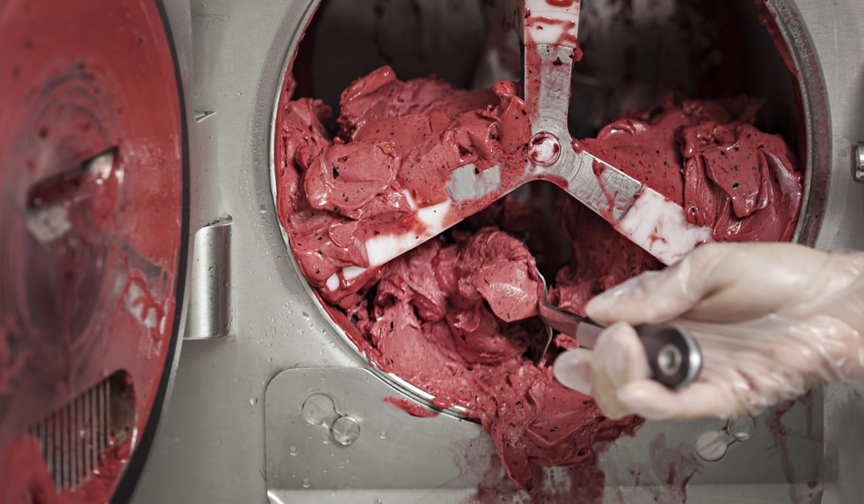
Researchers trying to solve a problem faced by makers of the sweet dairy treat for decades.
Millions of pounds of nutrient-rich ice cream go to waste each year, according to the International Dairy Foods Association, discarded after production. Nearly 5% of the raw materials used in ice cream production end up as waste — representing millions of dollars in lost product per year. This waste primarily results from batches thrown out for quality issues and equipment cleaning. Adding to this, regulations aimed at preventing cross-contamination with allergens have enlarged the dairy product’s waste footprint, greatly increasing the amount of discarded ice cream over the past two decades.
They found that ice cream waste, which typically has a fat content three to five times that of cows’ milk, doesn’t necessarily need complicated treatment to recover its fat. Simple separation, particularly centrifugation — a mechanical process that uses rapid spinning to separate mixtures of different sizes, shapes and densities — with alkaline treatment as a possible aid, will get the job done.
“Here in the Department of Food Science at Penn State we have a close relationship with the food industry, so it was through our industry partners that we first heard about the magnitude of the ice cream waste problem,” said study senior author Yi Zhang, Frederik Sr. and Faith E. Rasmussen Career Development Professor in Food Science. “After offering the Ice Cream Short Course for over 100 years, we have ties to nearly every major ice cream company in the world, so we wanted to see whether we could help solve the problem.”
The first approach researchers tried to collect the milk fat was a process called proteolysis — using enzymes such as pepsin, trypsin and bromelain to break down proteins that help stabilize the fat emulsion. The second approach was pH shifting, in which they made the waste strongly acidic (pH 2 or 4) or alkaline (pH 11) to destabilize the emulsion. After treatment, they centrifuged the material to separate the fat.
The team measured fat recovery — how much of the original fat they successfully recovered — and fat purity — how much of the recovered material was actually fat rather than proteins, water and other compounds. The result was somewhat surprising, Zhang noted.
“You might expect enzymes to be essential for breaking up the emulsion, but our study found that you don’t necessarily need them,” she said. “The untreated control, when simply processed by centrifugation, recovered about 95% of the fat and actually improved fat purity compared with the original waste.”
Short enzyme treatments of one to two hours sometimes helped fat separation, but longer treatment, higher temperatures and extensive proteolysis did not increase the total amount of fat recovered and could actually decrease fat purity. The pH experiments found that pH 11 — strongly alkaline conditions — separated fat better than acidic conditions.
Importantly, Zhang explained, the economics depended heavily on how much fat was present in the incoming ice cream waste. Higher-fat waste makes the process more profitable, because roughly the same amount of waste is being processed to obtain more valuable product. The research findings indicated that larger-scale processing operations could improve profitability.
She and her collaborators continue to explore value-added products from recovered fat, recycling and reuse pathways for the other recoverable byproducts in ice cream waste, such as proteins and sugars, and potential applications for using ice cream waste as a whole.
Contributing to the research at Penn State were: first author Fuad Ale-Enriquez, postdoctoral scholar in the Department of Food Science; Robert Roberts, professor and head of the Department of Food Science; Farhad Zaker Hosseiny, doctoral candidate in the Department of Chemical Engineering; and Zhe Xu, who graduated with a master’s degree in biotechnology. Brian Perry, with Perry’s Ice Cream Company, also collaborated on the project.
This research was funded by the Northeast Sun Grant Center of Excellence, U.S. Department of Agriculture National Institute of Food and Agriculture and support from Penn State’s Institutes of Energy and the Environment Seed Grant Program. This content is solely the responsibility of the authors and does not necessarily reflect the views of the funders.
Ice Cream Short Course
It is fitting that Penn State, the university offering the Ice Cream Short Course — the oldest, best-known and largest educational program dealing with the science and technology of ice cream — is home to ongoing research focused on recycling ice cream waste.
Penn State’s Ice Cream Short Course is believed to be the first continuing education course in the United States. Beginning in 1892, when Penn State was known as The Pennsylvania State College, the School of Agriculture offered a class in dairy manufacturing during winter, “when farm work is least pressing and the boys can best be spared.” Tuition was free and students were charged $5 in incidental expenses and laboratory fees.
By 1925, ice cream had become so popular that a separate course devoted exclusively to the subject was established. Today, the College of Agricultural Sciences still offers the course in January, which is normally the slowest time for the ice cream industry. The Department of Food Science sponsors this program.
Just about every major ice cream company in the world has a Penn State connection, whether it is someone on the staff who has attended the short course or who is a Penn State graduate.
Be the first to comment