Efficient amino acid balancing helps cows make better use of energy and supports higher milk yields.
Protein plays a critical role in milk production and cow health, growth and reproduction. For years, the industry has aimed to meet dairy cow needs by including more protein in rations than needed to ensure an adequate supply. However, ongoing research suggests that feeding more protein doesn’t necessarily correlate with better performance.
Feeding excess protein can have unintended consequences, including wasted energy and reduced efficiency. By looking closer at the amino acid balance of a ration and optimizing it rather than focusing on total protein level, you can help reduce nutrient waste, conserve energy and improve overall feed efficiency.
How is protein used by a dairy cow?
True protein consists of amino acids, which are composed of nitrogen and carbon. Crude protein, on the other hand, includes both amino acids and non-protein nitrogen sources.
“When we talk about protein in dairy diets, we need to consider what the rumen microbes can use,” says Essi Evans, Ph.D., E+E Technical Advisory Services. “The microbes are not particular about whether nitrogen comes from a true protein or non-protein source as long as it’s accessible to them.”
In order for nitrogen to be used by rumen microbes, it needs to be both soluble and degradable. The microbes use this nitrogen to grow and digest fiber and other nutrients, which supplies energy to the cow and supports microbial growth. The microbes help supply the majority of the protein that is needed by the cow. They also provide amino acids in the proportions that the cow needs for all her protein-requiring functions.
Solving the protein puzzle
In general terms, about 8 to 10% of ration dry matter is converted into microbial protein. The remainder of the cow’s diet needs to supply the rest of the amino acids she requires to thrive. The closer this balance of amino acids aligns with the cow’s requirements, the less energy she spends synthesizing the proteins she needs.
Think of amino acid balance as a puzzle: about half of the pieces are provided by the microbial protein. If the rest of the dietary pieces are readily available and fit properly, the cow completes the puzzle efficiently. If pieces are missing or there are too many, energy will be diverted from milk production to managing the imbalance, either by compensating or disposing of the excess.
“Every gram of excess protein that a cow doesn’t use is a gram she must eliminate,” says Dr. Evans. “That disposal costs energy which could otherwise be used to support milk production.”
In one beef cattle study, feeding excess protein from corn byproducts (poorly balanced proteins) increased maintenance energy use by more than 5%.1 This energy was spent breaking down the excess protein, converting it into urea via the liver and then sending the urea to the kidneys to be excreted.
Another study determined that excess dietary protein directly impacts milk gross energy output, which means the disposal of any protein overage has a direct effect on milk yield.2
What is the “ideal” protein for dairy cows?
To help farmers visualize amino acid balancing, Danish researchers explored the concept of an “ideal” protein for dairy.3 An ideal protein may be from a single source, or it can be formed from mixtures of protein ingredients that collectively meet the ideal amino acid requirements, while minimizing excess that must be disposed of through the liver and kidneys.
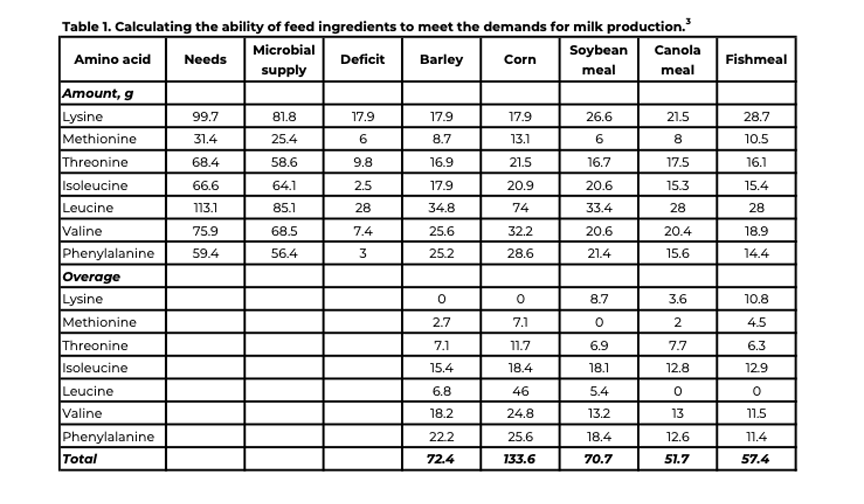
The researchers presented an example where they calculated amino acid needs for a cow producing 66 pounds of milk and evaluated how well different feed ingredients – barley, corn, soybean meal, canola meal and fishmeal – filled the gap left after microbial contribution (Table 1).
Using estimates for how much each amino acid would be available from rumen microbes, they calculated the deficit by subtracting the microbial supply from the total needs and then determined how much protein from each of the ingredients would be needed to fulfill the deficit.
For each ingredient, the protein inclusion rate stopped when the limiting amino acid was met. To demonstrate the excess, the deficit was subtracted from the amount of the ingredient provided after the first limiting amino acid was met. The values are zero for the limiting amino acid. The total overage is the amount that must be processed by the cow.
“This research demonstrates that some proteins are better aligned with the cow’s amino acid requirements,” says Dr. Evans. “For this example, canola meal stands out as a highly efficient source.
This example found that canola meal and fishmeal were the proteins that best meet the needs of the cow. Corn protein is a poor source of amino acids when it comes to meeting the needs of cows for milk production. The amino acids from barley and soybean meal are intermediate sources.
Precise feeding pays off
While meeting the amino acid needs of cows is essential for milk production, doing so conservatively is more important as it’s the cow’s energy use that determines how she performs. By meeting the amino acid needs of cows and avoiding overage, less energy is wasted.
However, these energy losses may not be considered by ration formulation programs and consequently, an opportunity for greater milk production and improved feed efficiency can be lost.
“When formulating rations, it’s important to go beyond just meeting crude protein levels,” explains Dr. Evans. “Targeting the right amino acid profile helps you reduce energy waste and optimize protein utilization and milk production.”
By focusing on the quality of protein sources, particularly those like canola meal that deliver amino acids more efficiently, you can improve milk yield, reduce energy waste and support long-term performance. Visit canolamazing.com to learn more.
Canola meal is a coproduct of canola processing and is approximately 36% crude protein, with a high bypass protein value and amino acid profile well-suited for milk production. Because of its high protein content, canola meal is often used as a protein supplement for animal feeds, including dairy rations. Visit canolamazing.com to learn more.





Be the first to comment