

My goal has always been to help show dairy farmers and veterinarians the positive impact that strategic genetic investments can have on animal health, welfare and their bottom line. With our most recent peer-reviewed validation study, our team can help dairy producers visualize the applicability of the Dairy Wellness Profit Index® (DWP$®) and how, when used to rank cattle, it can help impact dairy profitability through cow production, reproduction, longevity, disease incidence, milk quality, turnover costs and sustainability.
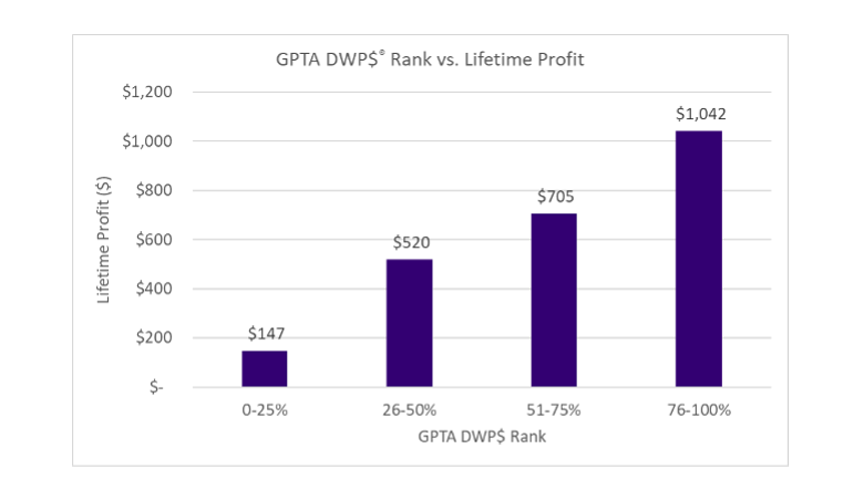
DWP$ is a selection index included with CLARIFIDE® Plus that was formulated to predict the potential lifetime profit an animal would generate throughout its life. Zoetis conducted a validation using 2,185 Holstein animals to determine if DWP$ successfully predicted which animals would generate the most profit throughout their lives. As demonstrated in Figure 1, herd profitability is driven by DWP$ selection index with cows in the best DWP$ group generating $895 more profit in their lifetime than cows in the worst DWP$ group.1
FIGURE 1. Demonstrates the association between lifetime profit and DWP$ 2020 genomic ranking for 2,185 Holstein cows born in 2011.2
 A cow’s ability to be profitable requires she is successful in all components of dairy production. As demonstrated in Figure 2, this is why DWP$ accounts for factors influencing both income derived from animal production and associated costs of production.
FIGURE 2. Demonstrates the emphasis placed on each production category included in Holstein DWP$ 2020.2
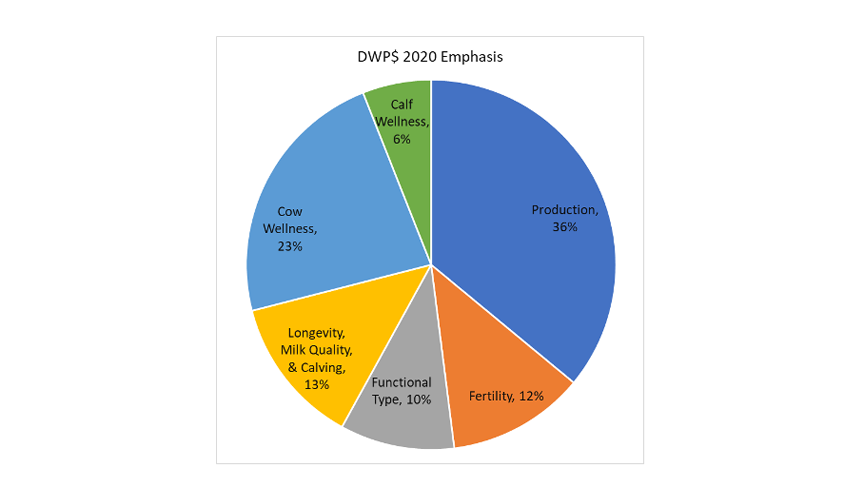
It is important to understand the relationship between DWP$ and success in these seven key areas of dairy production so you can apply genomic information to your breeding and business decisions.
Production. DWP$ balances reproduction, health and production traits so producers can make selections toward better lifetime yield compared with just lactation milk production. Another point of emphasis with the DWP$ index is that we are focusing on producing more saleable milk — this index accounts for the effects of disease and maximizes the amount of saleable milk per animal.
Reproduction. It is no secret fertility and reproductive efficiency of dairy cows is one of the main drivers of sustainability and profitability on the dairy operation. The DWP$ index helps producers select for higher fertility in heifers and cows in addition to lower disease risk including twins, retained placenta, metritis, cystic ovaries, abortions, calving difficulty and stillbirth.
Longevity. Who doesn’t love a barn full of healthy cash cows? Through our recent validation study, you can see that the top 25% of cows stayed in the herd seven months longer1 than the worst 25% and were at a lower risk of disease incidence, which can help improve animal welfare and the sustainability of your herd. And, as they stay in the herd longer, the opportunity for them to produce more saleable milk increases.
Milk Quality. When it comes to making breeding selections, it’s important to weigh factors like Cheese Merit (CM$) and PTA for fat and protein against the likelihood of lower udder quality and getting mastitis. To have a more mature, higher-producing herd, we should make breeding decisions that help improve our cows’ genetic ability to resist mastitis.
Turnover Costs. Net Herd Turnover Cost (NHTC) is a valuable measurement of profitability because it takes several key metrics into account. In the validation study, we saw the highest-ranking group of cows had an NHTC that was 44% lower than the lowest-ranked group. This allows for more strategic and cost-efficient decision-making while managing your herd inventory.
As dairy producers strive to increase herd profitability and achieve their performance goals, increasing the herd’s genetic merit ranking per DWP$ is crucial. Incorporating insights pulled from DWP$ into breeding, culling and bull-selection decisions can help dairy producers create future generations of animals with the capability for higher lifetime profit when combined with best management practices.
FOR ADDITIONAL INFORMATION ABOUT DWP$ SEE THIS VIDEO WITH THE AUTHOR AND JEFF ZIEGLER OF SELECT SIRES HERE
https://dairybusiness.com/dwp-index-from-zoetis-does-indeed-predict-lifetime-profitability/
1 Zoetis Technical Bulletin. Association Between Dairy Wellness Profit Index® (DWP$®) Predictions and Lifetime Performance Detailer — Fact Sheet. 2020.
2 Fessenden B, Weigel DJ, Osterstock J, Galligan DT, Di Croce F. Validation of genomic predictions for a lifetime merit selection index for the U.S. dairy industry. Slide Deck, Zoetis, 2020.
All trademarks are the property of Zoetis Services LLC or a related company or a licensor unless otherwise noted.
© 2021 Zoetis Services LLC. All rights reserved. CLR-00506


Be the first to comment