
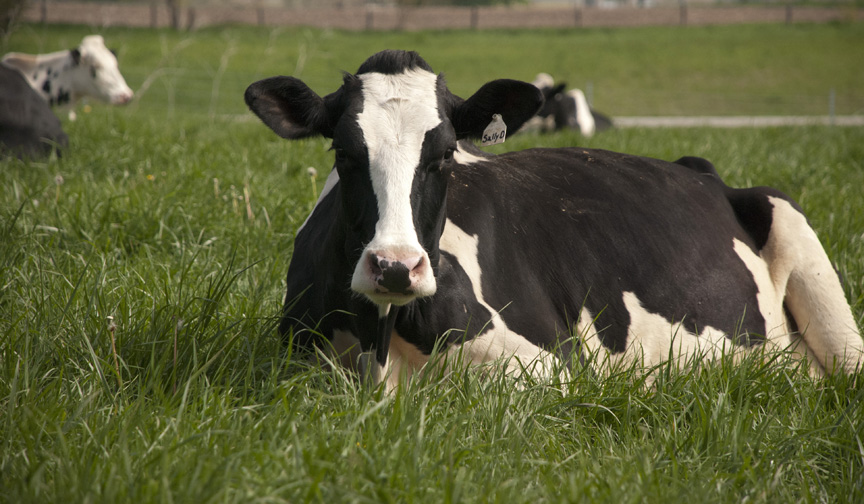
Cow comfort is important at all times, but particularly during the dry period. “We’ve learned that managing dry cows pays dividends down the line,” said Luciano Caixeta, DVM, PhD, assistant professor, University of Minnesota. “How the cow moves through the dry period influences her production, health, ability to become pregnant again and ability to stay in the herd.”
So how can we help cows stay comfortable and healthy through the dry period? Drs. Caixeta and Tikofsky emphasize that it starts at dry off, and offer four ways to dry off cows more comfortably:
1 – Use an appropriate dry cow antibiotic. About 60% of mastitis cases that occur during a cow’s lactation can be traced back to the dry period.1 A dry cow antibiotic tube can treat current subclinical infections and prevent new infections during the dry period. For producers looking to cut antibiotic use and associated costs, selective dry cow therapy (SDCT)—when antibiotics are only used to treat cows with likely mastitis infections—is an option to explore with a veterinarian.
2 – A teat sealant is a must no matter your dry cow antibiotic protocol. More than 25% of cows don’t form a keratin plug at dry off,2 so cows need a teat sealant to provide a sterile, antibiotic-free physical barrier between the udder and its environment.
3 – Ensure high-producing cows are ready to be dried off. Cows that are dried off giving large amounts of milk can experience serious udder engorgement. They are also more likely to leak milk and become infected with mastitis.
Producers can reduce milk production before dry off in a few different ways. They can move animals to a separate pen and feed a lower-energy diet, or they can reduce the number of milkings to once per day just before dry off.
A new approach is to provide cows with an oral mineral bolus designed to reduce milk production. Administering two boluses 8-12 hours prior to dry off creates a mild, temporary metabolic acidosis that decreases dry-matter intake and impacts milk synthesis.
4 – Vaccinate. Cows vaccinated during the dry period are more likely to enter the next lactation with a robust immune system to fight off infectious disease threats.
- Killed vaccines keep the dam healthy and enhance antibody levels found in colostrum.3
- Coliform mastitis is the source of 50% of mastitis infections in U.S. dairy herds.4 Look for a coliform mastitis vaccine that’s effective against Escherichia coli and the effects of endotoxemia caused by E. coli and Salmonella Typhimurium.
5 – Work with your veterinarian. The right dry off program varies from farm to farm. Before making a new protocol decision or change, talk with your veterinarian. They understand your operation’s specific challenges and can ensure the change is right for your herd.
Provide comfort through the dry period
Both Drs. Caixeta and Tikofsky agree that cow comfort doesn’t stop at dry off. It’s crucial to keep cows comfortable through the entire dry period. To provide optimal comfort, keep the following factors in mind:
- Heat abatement. Helping dry cows stay cool is just as important as keeping lactating cows cool. Dairy cows can experience heat stress beginning at 68 degrees Fahrenheit. Provide dry cows with proper shade, fans and sprinklers.
- Ventilation. A well-ventilated building prevents high humidity in the winter and heat buildup in the summer. Signs of poor ventilation include air that smells like ammonia and animals that are coughing or experiencing nasal discharge or open-mouthed breathing. A cow’s hair coat should be free of moisture when you run your fingers through it.
- Stocking density. Dry cows require significantly more space than lactating animals. To ensure dry cows have enough space to eat and rest, keep stocking density at or below 85%.
- Nutrition. Adopting a negative dietary cation-anion difference (DCAD) diet can help reduce the risk of subclinical hypocalcemia. Studies have shown a DCAD diet results in increased dry-matter intake in early lactation, increased milk production, fewer fresh cow health events and improved reproductive performance.4
- Cleanliness. Remove manure as soon as possible and keep plenty of fresh bedding under animals. Manage water tanks, feeding areas and walkways to eliminate standing water or manure.
“The dairy industry is on a continual path of improving cow comfort and overall animal well-being,” concluded Dr. Tikofsky. “Work with your herd veterinarian to stay on top of the latest animal welfare research and to create a cow comfort program that’s best for your operation.”
The lives of animals and humans are interconnected in deep and complex ways. We know that when animals are healthy, humans are healthier too. Across the globe, our 9,700 employees are dedicated to delivering value through innovation, thus enhancing the well-being of both.
Respect for animals, humans and the environment guides us every day. We develop solutions and provide services to protect animals from disease and pain. We support our customers in taking care of the health of their animals and protect our communities against life- and society-threatening diseases.
Boehringer Ingelheim Animal Health is the second largest animal health business in the world, with net sales of $4.7 billion (4.1 billion euros) in 2020 and presence in more than 150 countries.
Boehringer Ingelheim Animal Health has a significant presence in the United States, with more than 3,100 employees in places that include Georgia, Missouri, Iowa, Minnesota, New Jersey and Puerto Rico. To learn more, visit www.boehringer-ingelheim.us, www.facebook.com/BoehringerAHUS or www.twitter.com/Boehringer_AH.
Making new and better medicines for humans and animals is at the heart of what we do. Our mission is to create breakthrough therapies that change lives. Since its founding in 1885, Boehringer Ingelheim has been independent and family owned. We have the freedom to pursue our long-term vision, looking ahead to identify the health challenges of the future and targeting those areas of need where we can do the most good.
As a world-leading, research-driven pharmaceutical company, with around 52,000 employees, we create value through innovation daily for our three business areas: Human Pharma, Animal Health, and Biopharmaceutical Contract Manufacturing.
In 2020, Boehringer Ingelheim achieved net sales of around $22.33 billion (19.57 billion euros). Our significant investment of over $4.2 billion (3.7 billion euros) in 2020 (18.9% of net sales) in R&D drives innovation, enabling the next generation of medicines that save lives and improve quality of life.
We realize more scientific opportunities by embracing the power of partnership and diversity of experts across the life-science community. By working together, we accelerate the delivery of the next medical breakthrough that will transform the lives of patients now, and in generations to come.
©2022 Boehringer Ingelheim Animal Health USA Inc., Duluth, GA. All Rights Reserved. US-BOV-0463-2021-A


Be the first to comment