
Practical mastitis approaches guided by today’s research

Studies on mastitis management over the past decades could fill hundreds of volumes of research journals. Through research and on-farm data, the industry has made tremendous strides to understand the causes and most effective treatment approaches for intramammary infections. How can we translate all this knowledge into simple and practical on-farm protocols?
Let’s start on the same page
With realistic mastitis management as our goal, let’s start by establishing a consistent definition of mastitis types. Mastitis can be classified based on its visual appearance. Subclinical mastitis is characterized by an inflammatory process in the mammary gland, typically caused by an infection but without visually evident clinical signs of disease. In contrast, clinical mastitis presents with visible signs of inflammation in the milk, udder and, in severe cases, systemically.
Treating subclinical mastitis during lactation typically does not pencil out, except in specific scenarios involving contagious bacteria. Because of this, let’s focus on strategies for treating clinical mastitis.
When addressing cases of mastitis, most producers’ first goal is to get the affected cow’s milk back in the tank as soon as possible.
I recommend producers start by categorizing cases of mastitis based on their clinical presentation. Train employees to identify inflammation in early stages and categorize mastitis based on clinical signs as first steps toward implementing an effective and targeted mastitis control program.
Four practical questions to ask before treating a cow
Typically, fewer than 15% of clinical mastitis cases occurring on a regular farm are severe. These should be treated as medical emergencies following the protocol established by your veterinarian. The remaining cases are mild to moderate and are referred to as non-severe clinical mastitis. Symptoms for these cases include both abnormal milk and an abnormal udder (or quarter). Before grabbing a tube and treating these cases, think about cow-specific factors that could impact a successful cure.
Ask these questions to help determine if treatment is warranted:
1. What is the cow’s history of somatic cell count (SCC)? Is she a chronic cow?
2. Has she had other clinical mastitis episodes in the same quarter before? How many?
3. Is she experiencing or has she experienced any recent health events that could compromise her immunity and response to an infection?
4. What is the cow’s parity and stage of lactation?
Answering those questions is only possible with good recordkeeping. Sometimes, the best decision might be to stop milking a chronic quarter or cull that animal instead of repeated treatments. But, if based on these questions, we believe treatment is warranted, our next step is to classify the cause of mastitis.
Identifying causes of mastitis correctly
Knowing the opponent before choosing weapons for battle can increase your chances of winning the war. Similarly, culturing of milk samples can guide mastitis treatment decisions by identifying the cause of infection. But culturing does not have to provide a definitive identification of a pathogen. Knowing whether bacteria grow through culturing is helpful.
What we learn from culturing provides insights into the causes of clinical mastitis cases and may help you adjust treatment protocols and management. Because not all mastitis-causing bacteria require treatment, culturing supports the judicious use of antimicrobials, may help prevent antibiotic resistance and protects food safety.
Milk culturing
It is important to remember that not all cultured cases will return a clear answer, but that’s typically an answer in itself! A “no-growth” result is common in non-severe cases of mastitis and typically (not always) means the immune system has already cleared the infection or a non-bacterial pathogen is at play.
Developing a treatment approach
Making a treatment plan is the next step. This plan should be developed with guidance from your veterinarian, based on the causative pathogen, severity of the case, general health status of the cow, and balanced with the realities of the operation.
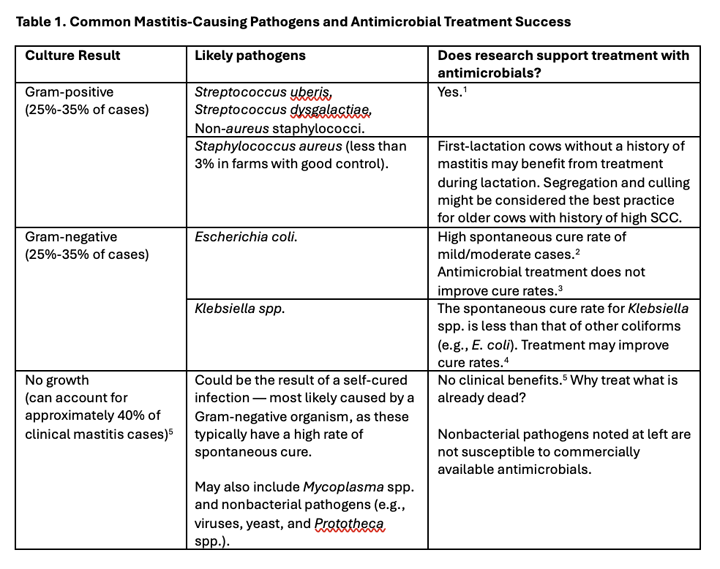
In general, non-severe clinical mastitis caused by Gram-positive bacteria, including Streptococcus spp. and non-aureus Staphylococcus spp. are candidates for treatment, while Gram-negative and “no-growth” mastitis do not show benefits from treatment. However, this is not a hard rule. Always consider your answers to the four questions above. If they indicate the cow may be immunocompromised, treatment may still be the most appropriate course of action, regardless of culture results.
To support your efforts in building a strategic treatment plan, Table 1 provides a quick reference guide of the most common mastitis-causing pathogens and what research supports in terms of clinical mastitis treatment.
The bigger picture
Mastitis is one of the most studied and managed conditions of modern dairy production. And yet, mastitis remains one of the costliest diseases for the dairy industry.
The cost of mastitis is not just the result of treatment. Discarded milk and loss of potential future production also contribute to the cost. Along with this, high SCC milk reduces product yield due to lowered fat and protein content and may result in milk price deductions. And the list goes on: labor costs, increased culling, decreased reproductive performance and increased risk of antibiotic residues also diminish profitability.
What the industry knows about mastitis continues to grow. Unfortunately, dollars lost at the farm level continue to grow, too. Implementing strategic and realistic treatment decisions can lead to better cow outcomes and more profitable operations.
REFERENCES
1. Tomazi, T., Sumnicht, M., Tomazi, A. C. C. H., Silva, J. C. C., Bringhenti, L., Duarte, L. M., Silva, M. M. M., Rodrigues, M. X., Bicalho, R. C. Negatively controlled, randomized clinical trial comparing different antimicrobial interventions for treatment of clinical mastitis caused by gram-positive pathogens. J. Dairy Sci. 2021. 104(3), 3364–3385. https://doi.org/10.3168/jds.2020-18830
2. Ashraf, A, Imran, M. Causes, types, etiological agents, prevalence, diagnosis, treatment, prevention, effects on human health and future aspects of bovine mastitis. Anim. Hlth. Res. Rev. 2020. 21(1), 36–49. https://doi.org/10.1017/S1466252319000094
3. Fuenzalida, M. J., Ruegg, P. L. Negatively controlled, randomized clinical trial to evaluate intramammary treatment of nonsevere, gram-negative clinical mastitis. J. Dairy Sci. 2019. 102(6), 5438–5457. https://doi.org/10.3168/jds.2018-16156
4. Schukken, Y. H., Bennett, G. J., Zurakowski, M. J., Sharkey, H. L., Rauch, B. J., Thomas, M. J., Ceglowski, B., Saltman, R. L., Belomestnykh, N., Zadoks, R. N. Randomized clinical trial to evaluate the efficacy of a 5-day ceftiofur hydrochloride intramammary treatment on nonsevere gram-negative clinical mastitis. J. Dairy Sci. 2011. 94(12), 6203–6215. https://doi.org/10.3168/jds.2011-4290
5. Fuenzalida, M. J., Ruegg, P. L. Negatively controlled, randomized clinical trial to evaluate use of intramammary ceftiofur for treatment of nonsevere culture-negative clinical mastitis. J. Dairy Sci. 2019. 102(4), 3321–3338. https://doi.org/10.3168/jds.2018-15497



Be the first to comment