

|
Many acres across New York were unable to be planted to corn, soybeans or new perennial forages due to extended wet conditions during this spring’s planting season, resulting in several crop insurance claims.
|
|
This has put some dairy farmers in a challenging position. Three scenarios have been described:
|
|
General guidance for summer 2025 manure applications in the context of prevented planting acres
- Farms operating under NY’s CAFO permit should always check with their CNMP planner before making changes to planned manure applications. Be sure to update the CNMP with new manure allocations so that farms can document compliance.
- Per the CAFO permit, planners are required to utilize NY Phosphorus Index 2.0 (NY-PI 2.0) when planning new summer 2025 manure applications, as they are intended for crops being harvested in 2026. NY-PI 2.0 may provide additional flexibility for manure applications, especially for farms utilizing cover crops, with whole farm P balances below 12 lbs. P/acre, timing manure applications with planting crops and injecting or incorporating manure within 24 hours.
- Manure being allocated to a crop that will be planted in August (new perennial seedings, small grains, etc.) can be credited toward the 2026 crop year if it is being applied in conjunction with the planting of that crop. You do not need to wait until September/October. Follow the descriptions in P-Index 2.0 for method and ground cover/timing as best fits the specific situation.
- Nitrogen. Nitrogen credits from previous manure applications should follow the guidance in the Cornell University Nitrogen Guidelines for Field Crops in New York. Applications made last fall or this spring would be considered “last year” and be credited for 12% of the organic nitrogen as reported on the manure analysis. Any applications happening this summer, fall or next spring would be counted as “present year” and be credited accordingly based on the source and dry matter content for organic nitrogen and based on the timing of incorporation for the percent of ammonium nitrogen available. Also be sure to follow guidance in the NY Nitrate Leaching Index for beneficial management practices in fields with NLI scores with intermediate or high risk for nitrate leaching.
- Phosphorus. Recognizing this is a unique situation and not a regular occurrence, farms may credit phosphorus from new manure applications as you would normally for the upcoming 2026 crop year and follow the management implications of NY-PI 2.0 for phosphorus or nitrogen-based management for those applications. If a manure application was made in anticipation of a 2025 crop that was not able to get planted and a new application is made this summer/fall, farms should maximize crop removal and it’s advised to take an out-of-cycle soil sample this fall to identify any potential increases in soil test P in order to prioritize proactive management across the crop rotation.
- Wherever possible farms should plant a small grain for spring harvest to increase the total nutrient need (and crop removal) to make up for the loss of crop uptake of the crop that did not get planted in the spring of 2025. This will also improve P-Index scores.
|
Some scenarios to maximize the utilization of manure nutrients include:
|
|
Explore export opportunities now if you are concerned about manure storage capacity. Communicating with crop producing neighbors with open small grain fields could be a good opportunity for an export under these circumstances. Please remember to document all exports appropriately per the CAFO permit requirements.
|
FIGURE 1. Guidance from Regional Deputy Director RMA
|
||||
|
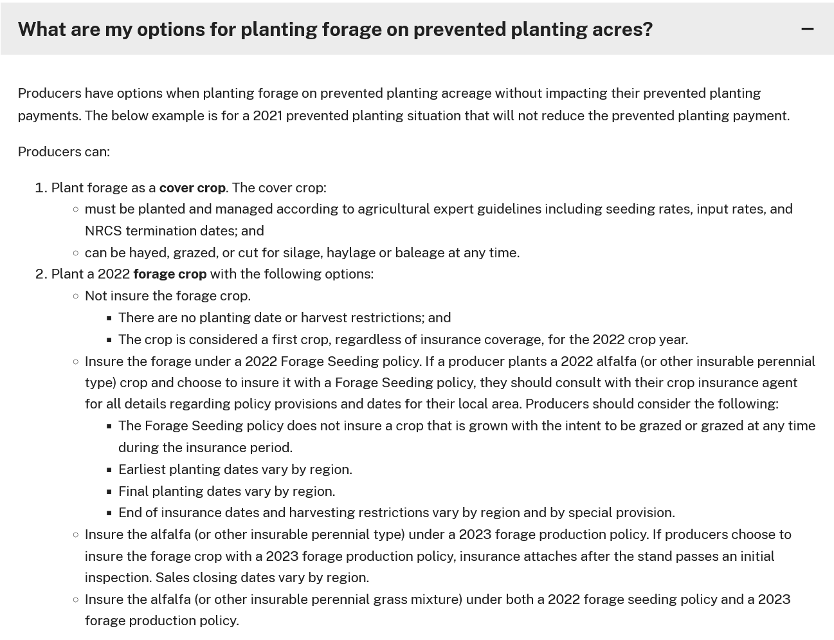
This policy update from 2022 has not been superseded and still stands as current policy. The policy and more information about prevented planting coverage are available online.

Be the first to comment