

Generally, the H-2A program is discussed on a fiscal year basis (October – September). However, we can all agree that calendar year 2020 was a beast all its own, giving us a reason to look at H-2A data through a calendar year lens. We’ll start by looking at the fiscal year though, given that it is the primary basis for comparison.
Fiscal Year Basis
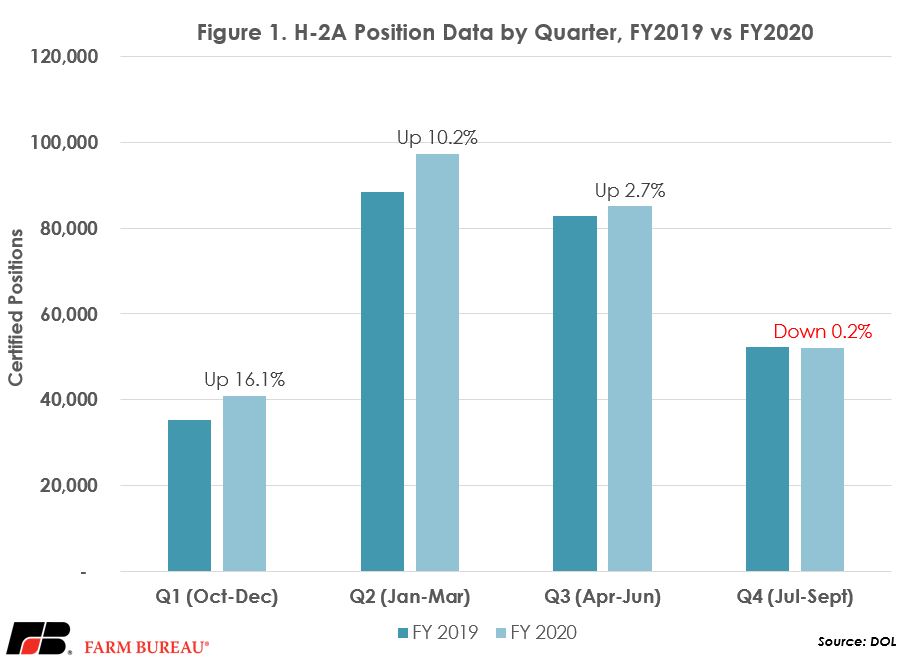
Overall, usage of the program in fiscal year 2020 (Oct. 1, 2019 – Sept. 30, 2020) continued its steady upward march. More than 275,000 H-2A positions were certified in fiscal year 2020, up 6.5% from fiscal year 2019. This was the eighth consecutive year that usage of the H-2A program set a record. As shown in Figure 1, program growth in fiscal year 2020 started off strong and then petered out as the year — and the COVID-19 pandemic — wore on.
Calendar Year Basis
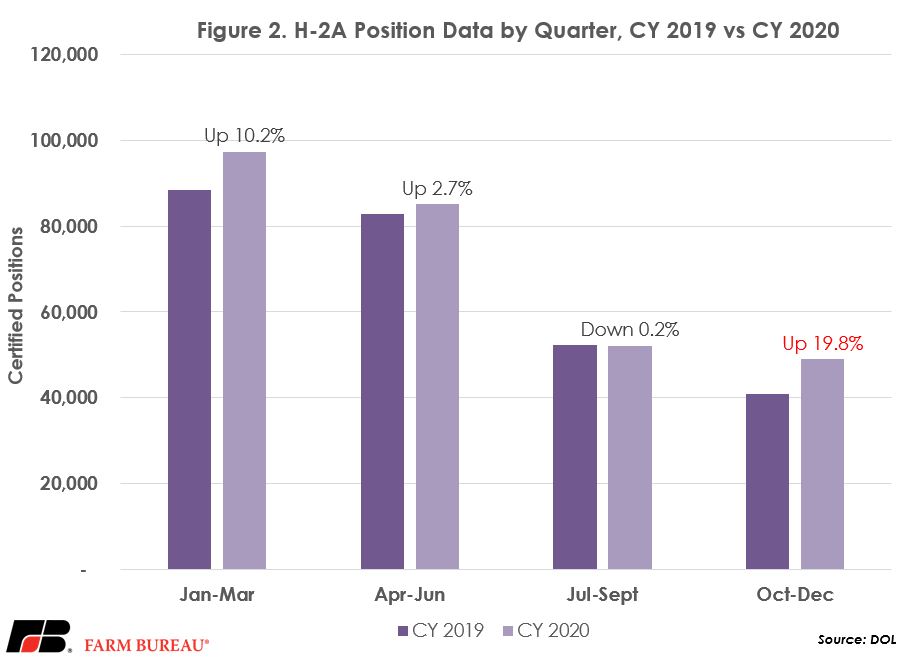
When the data provided by DOL is transformed from a fiscal year basis to a calendar year basis, the impact of the global COVID-19 pandemic becomes
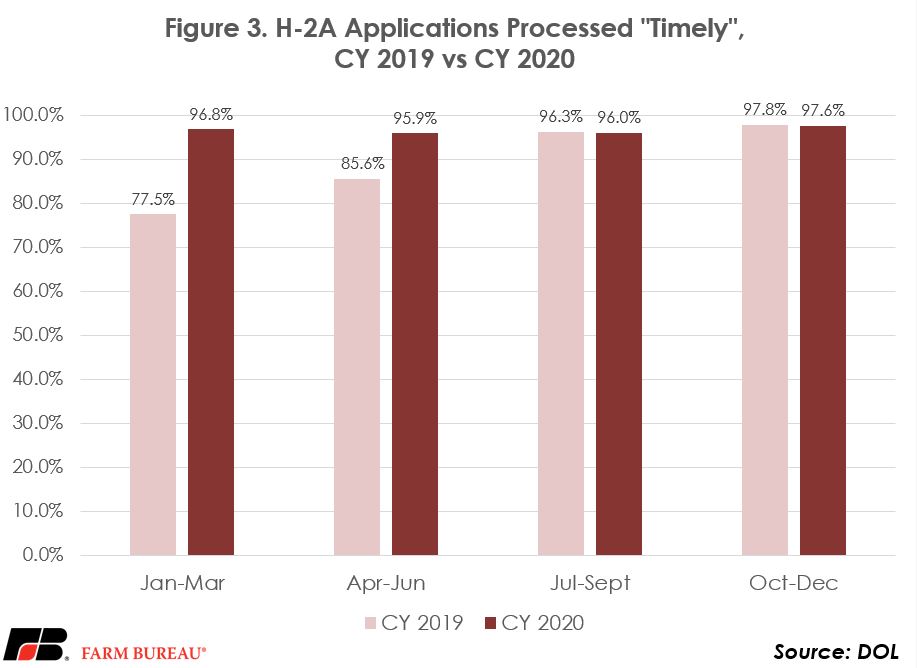
Keen observers of the H-2A program will immediately wonder if the slowed growth in H-2A positions was related to slow application approval. According to the same DOL data, this does not appear to be the case. Over the course of calendar year 2020, the share of applications processed in a timely manner averaged 96.6% and, as shown in Figure 4, there was little variation across quarters, less than in 2019, in fact.
Takeaways
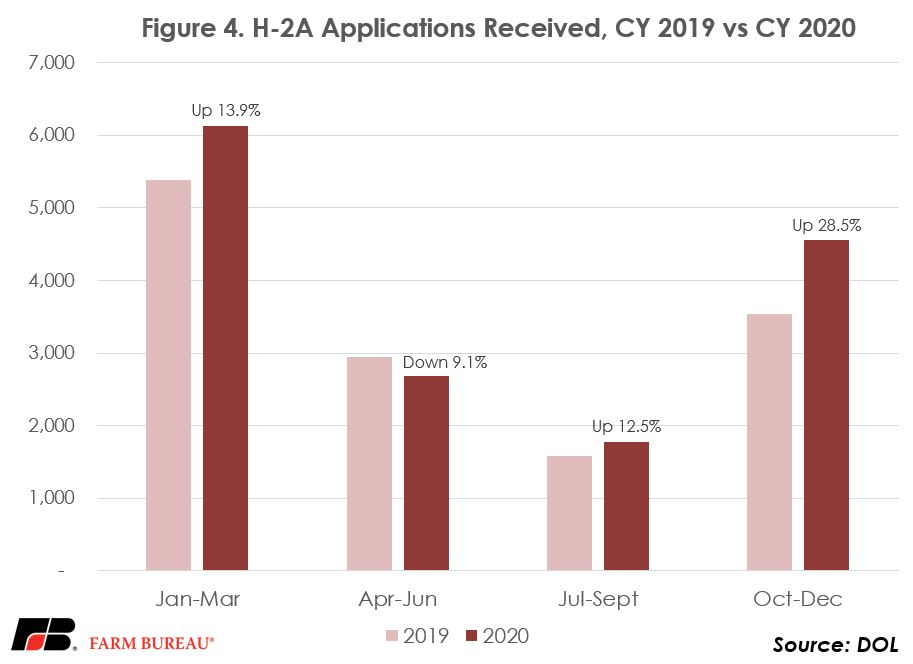
When Figures 3 and 4 are considered together, there are two main takeaways from the data. First, it seems that the initial impact of the COVID-19 pandemic was a decline in the number of applications and subsequently the number of certified positions in the following quarter. Second, that initial decline was not the result of lack of demand, but rather uneasiness about how the H-2A program would operate as a result of COVID-19. We all
New Travel Restrictions
On Jan. 26, travel restrictions to combat coronavirus infections went into effect for several countries. For some countries this was a reinstatement of previous restrictions, for others the restrictions were new. The restrictions apply to non-U.S. citizens who have been in Brazil, China, Iran, the Republic of Ireland, South Africa, the United Kingdom and the Schengen Area of Europe (Austria, Belgium, Czech Republic, Denmark, Estonia, Finland, France, Germany, Greece, Hungary, Iceland, Italy, Latvia, Liechtenstein, Lithuania, Luxembourg, Malta, Netherlands, Norway, Poland, Portugal, Slovakia, Slovenia, Spain, Sweden, and Switzerland).
These restrictions immediately became a concern for H-2A program users, especially those who hire approximately 5,000 of these valued essential workers from South Africa, 90 from the Schengen Area, 40 from Brazil and 90 H-2A each from the United Kingdom and the Republic of Ireland. After outreach by the agricultural community, the State Department quickly clarified on Jan. 28 that agriculture workers from South Africa entering the U.S. qualify for national interest exceptions on a case-by-case basis. Restrictions on H-2A workers from the other countries remain in place.
Summary
Despite the challenges the pandemic has brought to farmers who rely on skilled workers from other countries, H-2A program demand continues to grow.
Contact:
Veronica Nigh
Economist
(202) 406-3622
veronican@fb.org



Be the first to comment