
The T.C. Jacoby Weekly Market Report Week Ending September 11, 2026
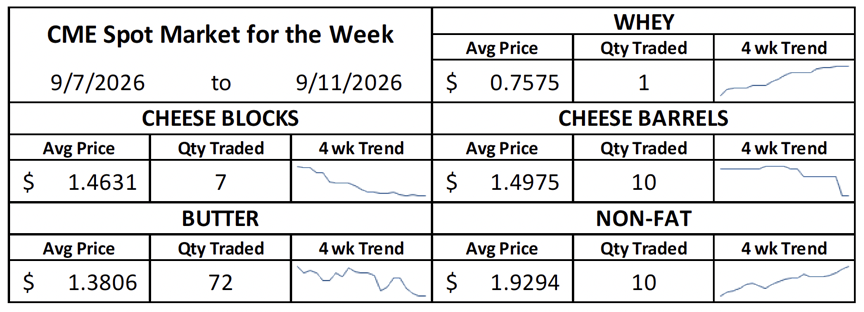
Consumers are hungry for dairy proteins, but demand for dairy fats is not keeping pace with formidable growth in supplies. Heavy 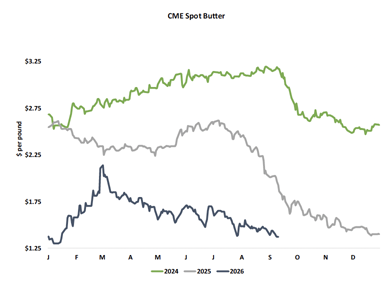 output is weighing on prices for cheese and butter. At the CME spot market, butter plunged 7ȼ to $1.37 per pound, its lowest price since mid-January. Traders exchanged 72 loads in Chicago this week. American butter is the cheapest in the world, but manufacturers haven’t made enough 82% unsalted butter to increase the volume of U.S. butter moving offshore. Industry insiders tell USDA’s Dairy Market News that “inventories of 80% butterfat remain ample, while stocks of 82% butterfat are reported to be tight.”
Cheese exports are booming, and the types of cheese that are popular with exporters are selling quickly. But domestic demand is lackluster. Tepid sales to grocery stores and restaurants reflect the changing appetites of the GLP- 1 era and the soft underbelly of the K-shaped economy. Consumers paid an average of $4.29 per gallon for gas this week, and that left lower-income consumers with less to spend on quick-service burgers or carryout pizzas. Meanwhile, cheese makers are running as hard as they can, cranking out as much valuable whey protein concentrates (WPCs) as their facilities will allow. Supplies of40-lb. Cheddar blocks – the determinant of CME cheese prices – are burdensome. Spot Cheddar blocks fell another half-cent this week to $1.46.
Spot whey values inched up again. They gained 0.75ȼ and reached 76ȼ, a fresh 2026 high. There’s plenty of whey to make WPCs and whey powder, but robust exports are keeping dry whey supplies in check. Meanwhile, WPC-80 prices are fading from the highs. Americans still want protein, but the recent record-shattering prices have pushed food manufacturers to consider other ingredients. The whey complex featured prominently in the tit-for-tat trade spat between the U.S. and Canada. The two sides raised tariffs on certain whey products and, ultimately, President Trump banned imports of Canadian whey, modified whey, and WPC-34. While Canada and the U.S. are one another’s top market for exports of these products, the impact so far has been limited. Exporters on both sides of the border are likely to shift their trade to other markets.
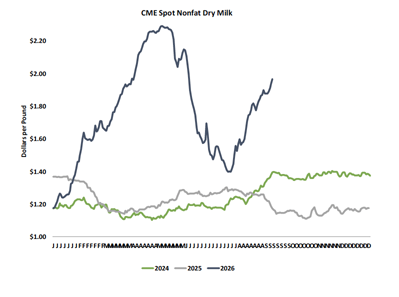 A late-Autumn heat wave and competition from other processors has reduced milk powder production in the Central and East regions. Dryers continue to run hard in the West, but supplies are not keeping pace with demand. European milk powder output is also running light after a punishingly hot summer. In New Zealand, milk production is ramping up quickly as the herd leans toward peak production next month. But, on the heels of the winter off-season, milk powder inventories are scant. Tight global supplies are crashing headlong into strong demand as international buyers stock up ahead of the winter holidays, including Christmas, Ramadan, and the lunar new year. There are firm bids on every setback, and the milk powder market just keeps climbing. This week, CME spot nonfat dry milk jumped 9ȼ to $1.97.
The bearish tone in the cheese market dragged Class III prices downward again. Most 2026 contracts lost around 20ȼ and hovered in the $16s. The futures still forecast $17 milk in 2027. For Class IV, the strong milk powder market propped up nearby prices. The November and December contracts gained 20ȼ and 29ȼ, respectively. Meanwhile, most 2027 contracts lost a little ground. August through October Class IV settled north of $19 per cwt. while November and later contracts traded in the $18s.
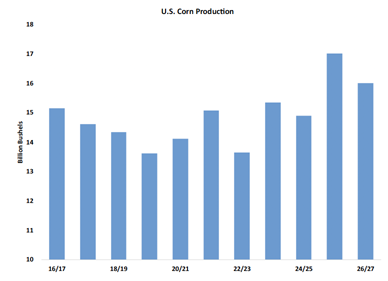 Feed prices retreated after USDA’s latest update to its monthly World Agricultural Supply and Demand Estimates. As expected, USDA trimmed its corn yield, as drought in the Plains and dry conditions in the northwest Corn Belt will reduce the harvest in those regions. But yields are expected to top year-ago levels in the eastern Corn Belt, and USDA predicts that Iowa farmers will reap an average of 219 bushels per acre, up 9 bushels from last year’s bumper harvest and a new all-time high. All told, USDA now expects the corn crop to average 178.5 bushels per acre. That’s 2.2 bushels lower than the August forecast and sharply lower than the 2025 crop, which averaged a whopping 186.5 bushels per acre. Still, with variable yields and big acreage, this year’s corn crop is likely to be the second-largest on record.
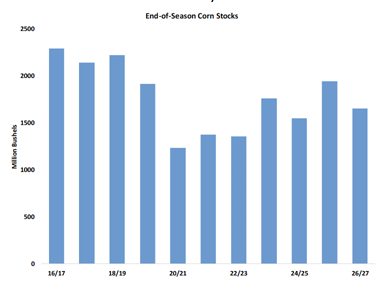 But demand is big too, and corn inventories are projected to tighten 18.5% in the new crop year. Today’s report quashed the most bullish arguments about disastrous corn yields and the likelihood of $6 corn. But the balance sheet is much tighter than it once was. Dairy producers should brace for much higher feed costs than those they enjoyed the past three years. This week December corn slipped 4.75ȼ to $5.32 per bushel.
August rains benefitted the soybean crop, and USDA inched up its soybean yield to 52.8 bushels per acre. The soybean crush – and soybean meal production – will be record large. Even so, massive demand for feed and for export is expected to keep soybean meal inventories in check. December soybean meal futures dipped only a dollar this week to $353.80 per ton.
Original Report At: https://www.jacoby.com/market-report/heat-wave-has-reduced-milk-powder-production/


Be the first to comment