
Organic milk production overview
For a dairy farm to be certified organic, it must comply with USDA-approved methods of production. Some important requirements include that cows must graze for at least 120 days/year and 30% of the dry matter intake needs to come from pasture. Also, there are restrictions on the use of some medications like antibiotics. For welfare reasons, cows that require a more intense treatment can receive antibiotics, but their products cannot be sold as organic.
The importance of intramammary infections for the dairy industry
What do we know about intramammary infections in organic herds?
Generally, the same pathogens that cause IMI in conventional herds are also the cause of IMI in organic dairies. Conventional producers are very familiar with the impacts they can have on their herds: decreased milk production2 , impaired fertility3 and increased risk of culling4 . In addition to best milking and hygiene practices, most conventional dairies use antibiotics to control IMI, but this strategy cannot be applied to cows producing organic milk. Even though IMI affects at least the same proportion of cows in organic systems compared with conventional systems, not much information is available on how IMIs can impact the performance of cows raised in a system where the use of antibiotics is restricted.
We recently published an epidemiological analysis of IMIs in two USDAcertified organic herds located in the High Plains5 . We utilized farm records from 1,511 cows for our analysis, and we defined IMI based on the somatic cell counts from milk collected in the first month of lactation. We observed that greater somatic cell counts (a measure of IMI) from cows diagnosed with postpartum IMI remained elevated throughout the entire lactation and were even greater in the previous lactation (Figure 1). This observation suggests a chronic aspect of IMI in organic herds, probably due to the lack of use of antibiotics to prevent or treat IMI. Additionally, IMI caused losses in milk production throughout the entire lactation and increased the proportion of cows that left the herd. However, IMI did not seem to impact reproductive outcomes in organic dairies in our study. Hence, we can conclude that organic cows are affected by IMI in a similar way as conventional cows, and alternative strategies to treat and prevent IMI in cows managed under organic systems are needed to reduce economic losses caused by the
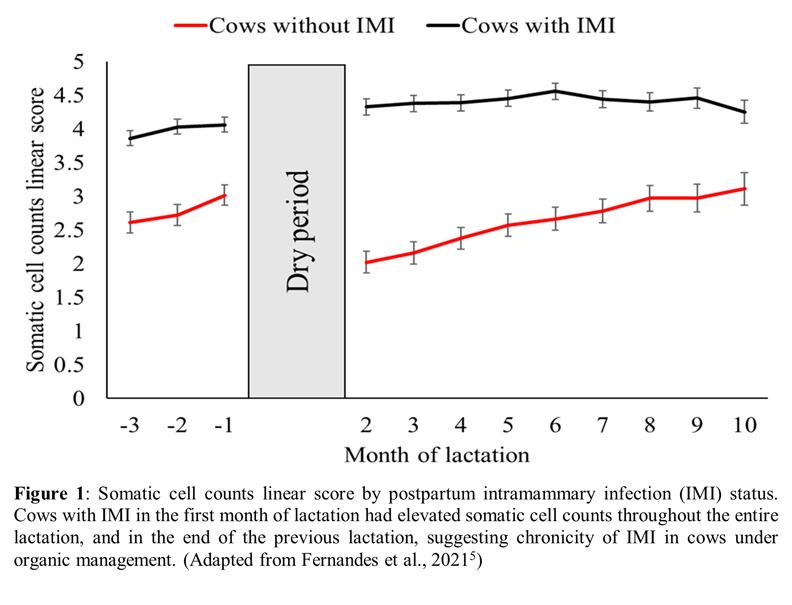 disease. Some strategies to control IMI such as drying off affected quarters, homeopathy, and botanical products are used by organic producers, but there is a lack of evidence on Figure 1: Somatic cell counts linear score by postpartum intramammary infection (IMI) status. Cows with IMI in the first month of lactation had elevated somatic cell counts throughout the entire lactation, and in the end of the previous lactation, suggesting chronicity of IMI in cows under organic management. (Adapted from Fernandes et al., 20215 ) the effectiveness of these strategies6 . Further research is needed to help organic producers find new and efficient tools to prevent and treat mastitis that are alternative to antibiotics.
Acknowledgement
This work was supported by Organic Agriculture Research & Extension Initiative [grant no. 2018-51300-28563/project accession no. 1016766] from the USDA National Institute of Food and Agriculture.
References
- USDA, 2019. Organic survey highlights. USDA, National Agricultural Statistics Service, Washington, DC.
- St. Rose, S. G., J. M. Swinkels, W. D. J. Kremer, C. L. J. J. Kruitwagen, and R. N. Zadoks. 2003. Effect of penethamate hydriodide treatment on bacteriological cure, somatic cell count and milk production of cows and quarters with chronic subclinical Streptococcus uberis or Streptococcus dysgalactiae infection. J. Dairy Res. 70:387–394.
- Dolecheck, K. A., A. García-Guerra, and L. E. Moraes. 2019. Quantifying the effects of mastitis on the reproductive performance of dairy cows: A meta-analysis. J. Dairy Sci. 102:8454–8477.
- De Vliegher, S., H. W. Barkema, G. Opsomer, A. De Kruif, and L. Duchateau. 2005. Association between somatic cell count in early lactation and culling of dairy heifers using cox frailty models. J. Dairy Sci. 88:560–568.
- Fernandes, L., I. Guimarães, N. Noyes, L. Caixeta, and V. S. Machado. 2021. Impact of subclinical mastitis detected in the first month of lactation on milk yield, fertility, and culling of dairy cows on USDA-certified organic herds. J Dairy Sci. 2021 Feb; 104 (2): 2140 -2150.
- Ruegg, P.L. 2009. Management of mastitis on organic and conventional dairy farms. J. Anim. Sci. 87:43–55. doi:10.2527/jas.2008-1217.
Editor’s note: This article appears in the February issue of the Dairy Dispatch from the Texas Association of Dairymen and is used here with permission.


Be the first to comment