
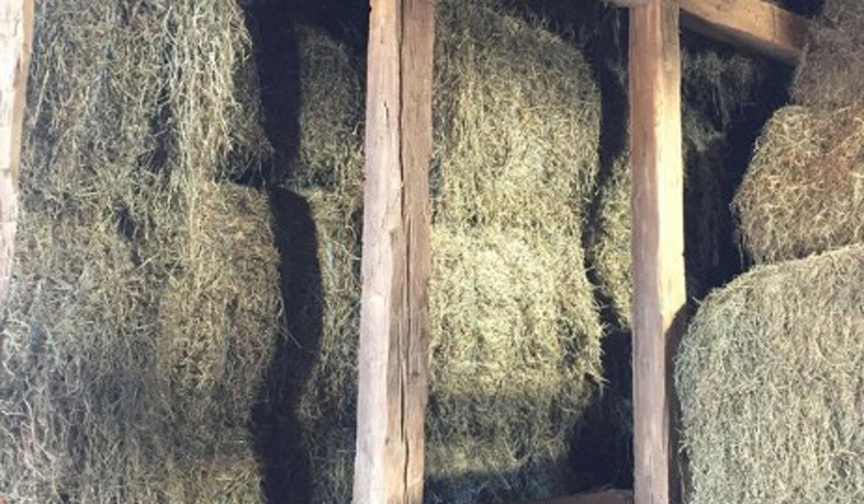
Take time to monitor hay temperatures in order to prevent a possible barn fire.
As hay dries, it continues to respire. When hay is baled, the respiration continues, giving off heat. There are microorganisms in the baled hay, and with excessive moisture these microorganisms will multiply, and generate more heat. The cycle can continue until the hay reaches a temperature where combustion will occur.
This process doesn’t necessarily happen quickly; it can take a few weeks (3-4 weeks) for hay to reach these critical temperatures. So, it’s important that producers take time to check the status of hay that was put away wetter than normal. Here are recommended temperatures and corresponding actions that should occur:
- Temperature 125oF — No action needed.
- Temperature 150oF — Entering the danger zone. Temperatures should be checked twice daily. If possible, stacked hay should be disassembled to allow more air to move around heated bales for cooling.
- Temperature 160oF — Reaching the danger zone. Temperature should be checked every two hours. If possible, stacked hay should be disassembled to allow more air to move around heated bales for cooling.
- Temperature 175oF — Hot spots or fire pockets are likely. If possible, stop all air movement around hay. Alert fire service of a possible hay fire incident.
- Temperature 190oF — Remove hot hay. This should be done with the assistance of the fire service. The fire service should be prepared for hay to burst into flames as it contacts fresh air.
- Temperature 200oF or higher – Most likely a fire will occur. Remove hot hay only with assistance from the fire service.
(Source: National Resource, Agriculture, and Engineering Service [NRAES])
As a side note, hay that has heated during storage will often appear brown in color, with a caramelized appearance. While livestock often prefer this flavor, nutrients have been lost due to excessive heating. A forage analysis is recommended prior to feeding to determine the accurate quality of the hay.

Be the first to comment