
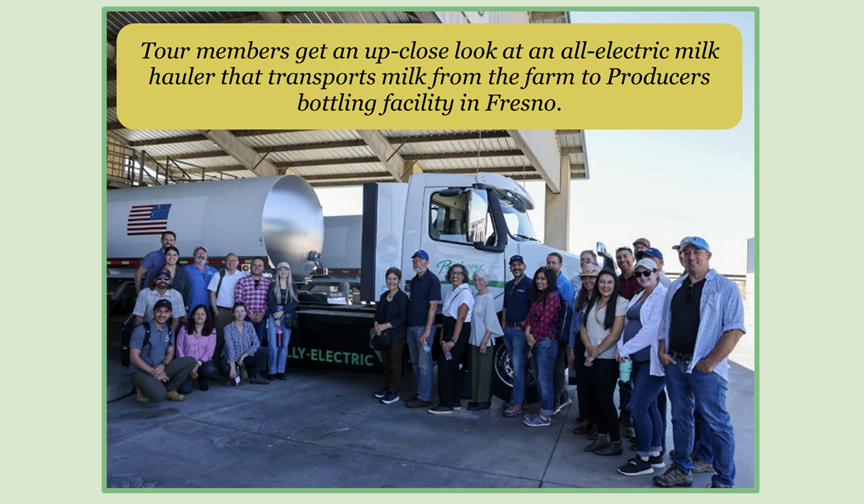
Two days ago, one of the most consequential events of my professional 30-year career working with dairy families took place at Bar 20 Dairy Farms in Kerman. The Shehadey family, Milk Producers Council, and Dairy Cares organized and hosted a dairy tour on Wednesday for members of the California Air Resources Board(CARB), along with CARB and San Joaquin Valley Air Pollution Control Districtstaff. The tour preceded a critically important public workshop hosted yesterday in Fresno by CARB, where it shared its latest work to evaluate the dairy community’s emissions trends and heard public comment from stakeholders, including dairy farmers and environmental activists.
Many factors made Wednesday’s dairy tour so significant. The audience we hosted is directly responsible for regulating our farms on greenhouse gas emissions, such as methane, as well as air quality pollutants, such as oxides of nitrogen (NOx) and volatile organic compounds (VOCs). For some on the tour, whether CARB Board Members or staff, this was their first time visiting a dairy. There’s no substitute for actually showing them what our dairy families do on a daily basis. Thanks to the Shehadey family, we were able to showcase a variety of sustainable technologies on a single dairy, which we noted are being employed on many dairies throughout the San Joaquin Valley. Our regulator audience learned about animal care, carousel milking parlors, weeping walls, nutrient management, digesters, fuel cells, electric feed-mixing wagons, feeding byproducts, solar panels, as well as hydrogen production from dairy biogas. They also enjoyed some delicious chocolate milk, courtesy of Producers Dairy!
How have California dairy families achieved this impressive milestone? Collaboration. Thanks to CARB’s voluntary, incentive-based approach, our dairy families have significantly reduced greenhouse gas emissions from the atmosphere, all while creating renewable energy and carbon-negative transportation fuel.
Unfortunately, for anti-dairy activists, delivering tangible methane reductions for the benefit of the environment, our neighbors, and local economies isn’t good enough. These activists distort dairy farmers’ efforts and investments, and they knowingly put forth false narratives about how dairies operate – especially as it relates to CARB’s successful strategy
for mitigating methane from dairy sources. Here are just three examples of misrepresentations by anti-dairy activists.
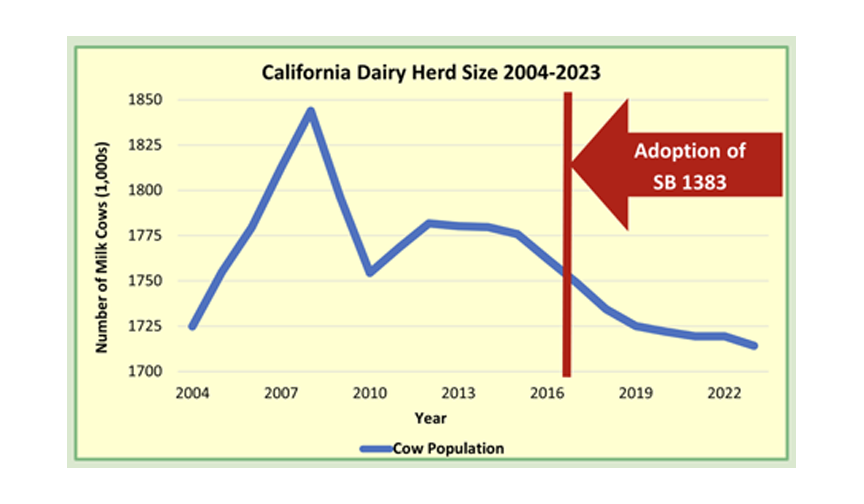
MYTH #1 The California dairy industry is growing due to incentive-based programs to install digesters. FACT If you’re done laughing (or crying), here are the numbers. More than 1,000 dairy farms have gone out of business in California over the past 20 years. But surely you’re thinking those cows just went to other dairies so that the total California herd size remained the same, and according to activists, probably even grew so digesters could be built, right?!? Nope. Look at the graph below. You’ll see that since the adoption of SB 1383 to regulate methane, the California milk cow population has been in steady decline. And now for the icing on the cake. At the hearing in Fresno on Thursday, CARB staff reported that an “analyses of dairy trends suggest that there has not been any relationship between the installation of digesters and dairy growth rates.” That’s from CARB’s own detailed analysis from years of work to accurately quantify California’s herd size.
MYTH #2 Lagoon manure-holding ponds are being built on dairies just because of digesters. FACT Lagoons have been an integral part of California dairy farming since the 1980s. Their advent – and prevalence today – has nothing to do with dairy digesters or methane. In short, lagoons were designed to promote cow health, improve manure management, and protect water quality. Lagoons help keep cows clean, thanks to a gravity flush system that removes manure from barn floors with recycled water. This flush water is stored in the lagoon where it is recycled throughout the year as a nutrient-rich fertilizer to grow feed for cows. Having a lagoon on a dairy also provides stormwater protection to ensure that all water used on the farm stays on the farm, where it can be recycled multiple times.
MYTH #3 Dairies are actively working to maximize methane production from manure due to the installation of digesters. FACT Dairies – including those with digesters – are doing the opposite. As we showed our tour guests on Wednesday, the Shehadey family is avoiding methane production from manure thanks to its use of a weeping wall in front of its digester. Conservatively, the weeping wall
is reducing methane emissions by 60%. Many dairies are using some type of mechanical solids separator in front of a digester, which can reduce methane emissions from manure by up to 30% before hitting the digester.
Between our tour at Bar 20 Dairy Farms and the CARB public workshop in Fresno, I feel like we provided a positive, earnest, and fact-based education to our regulatory partners. To sum up what I said during the public comment portion of yesterday’s workshop, we hope that CARB will continue its incentive-based strategy for regulating methane because it works. We also know what doesn’t work: command-and-control regulatory schemes. You can watch my comments here.
A lot of work went into preparing for this tour and public workshop, and I want to thank the many people who made it possible. First, thank you to the CARB Board members who joined us on the tour: Chair Liane Randolph, Susan Shaheen, Dr. John Balmes, and Diane Takvorian, and thank you to the nearly 20 CARB staff members who also joined us. Thank you to Samir Sheikh, Sheraz Gill, Ryan Hayashi and the many Air District staff that also joined us on the tour. Thank you to Steve Shehadey, Bonney Shehadey, Sal Rodriquez, Sarah Dean, and the entire team at Bar 20 Dairy Farms for hosting such a large group of people on the farm and answering any question that was asked of you. Thank you to the panel of dairy farmers that presented at yesterday’s public workshop: Jeff Troost, Jenn De Boer, Sal Rodriquez, Brian Pacheco, and Andre Brasil. Your personal stories and experiences put a face on our industry and I’m thankful to be able to work with you.
Thank you to all the dairy farmers and allied industry folks who attended in-person or online to make comments. Thank you to Michael Boccadoro, Jennifer Bingham, and the whole team at Dairy Cares. As a dairy community, we work best when we work together, and Dairy Cares is the epitome of that statement.

Be the first to comment