

CME spot cheese prices have been much stronger than expected since November, which has forced me to take a step back and think about how we’re modeling and analyzing the U.S. cheese market. When you open the Commodity Analysis 101 text book, the first thing you’re supposed to do is determine whether the commodity you are analyzing is a flow commodity or a storable commodity. Flow commodities are being produced every day and typically aren’t storable, or there is only limited ability to store them. When you’re analyzing a flow commodity, price will be determined by the short-term supply and the short-term demand. A storable commodity usually has many months, or even years, of inventory on hand. That means stocks relative to demand is usually the metric that drives prices.
Is cheese a flow commodity or a storable commodity? We often treat it like a storable commodity, talking about inventory levels, and over the past 3-4 years, inventory has been a good predictor of price (except during the middle of 2020 due to pandemic disruptions and government purchases), but cheese is produced continuously and we only have 1-2 months of inventory on hand at any point. And the only cheese that can trade on the CME spot market is Cheddar cheese, aged between 4 and 30 days. Once the cheese is 31 days old, it is no longer eligible to trade on the exchange. That means large inventories may not hold the price down if fresh supplies become tight, which I think is what has played out over the past 3 months.
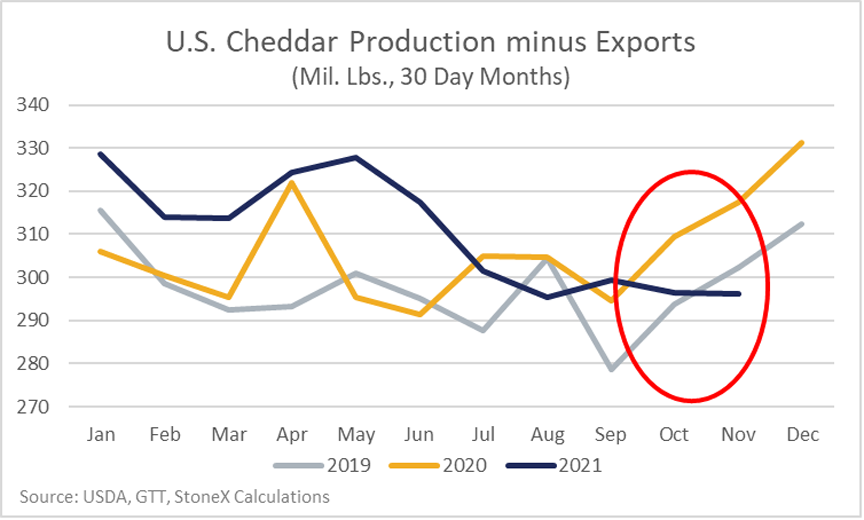
Cheddar production was down 1.5% year over year in October and down 4.4% in November. The slowdown in production, combined with strong exports, pulled the amount of fresh Cheddar available for the spot market down 4.3% YoY in October and –6.7% in November. I think the drop in Cheddar production is being driven by four things. First, there is just less milk around and some of the
Given the tighter supply of fresh Cheddar, we should probably expect the cheese market to be strong, but also volatile. The market is currently acting like a flow commodity, balancing short-term supply against short-term demand and ignoring the general inventory level. Any slight hiccup in short-term supply and demand could push the market significantly higher or lower. If the market gets really tight, prices will likely have to rally high enough to kill off some exports. Right now, EU Cheddar is around $2.36 ($5,200) while Oceania is near $2.50 ($5,500), so that defines the high side of the range. If the market gets a little heavy and we revert to pricing off inventories we could be looking at a price close to $1.70 ($3,750). That is a very wide range, but it reflects the reality that we are in. My official forecasts are on the lower end of the range, in the $1.80s and $1.90s, but I can see a real risk of $2.00 and higher prices being common during the first half of 2022.
This material should be construed as market commentary, merely observing economic, political and/or market conditions, and not intended to refer to any particular trading strategy, promotional element or quality of service provided by the FCM Division of StoneX Financial Inc. (“SFI”) or StoneX Markets LLC (“SXM”). SFI and SXM are not responsible for any redistribution of this material by third parties, or any trading decisions taken by persons not intended to view this material. Information contained herein was obtained from sources believed to be reliable but is not guaranteed as to its accuracy. Contact designated personnel from SFI or SXM for specific trading advice to meet your trading preferences. These materials represent the opinions and viewpoints of the author, and do not necessarily reflect the viewpoints and trading strategies employed by SFI or SXM.
Editor’s Note: Nate Donnay is the Director of Dairy Market Insight at StoneX Financial Inc. and has been applying his interest in large complicated systems and statistical analysis to the international and U.S. dairy markets since 2005. He can be contacted at Nate.Donnay@StoneX.com


Be the first to comment