
The T.C. Jacoby Weekly Market Report Week Ending March 12, 2021
Over the past year, the dairy markets have exhibited extreme volatility, adjusting to drastic shifts in both supply and demand. Consumer behaviors are shifting back towards something that resembles pre-pandemic times.
Over the past year, the dairy markets have exhibited extreme volatility, adjusting to drastic shifts in both supply and demand. But today, one year since COVID-19 was declared a pandemic, it feels as if a sense of normalcy is on the horizon. As vaccination campaigns progress across the globe, consumer behaviors are shifting back towards something that resembles pre-pandemic times.
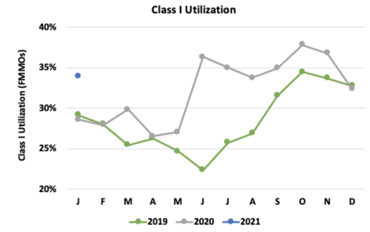 Demand from bottlers is steady to stronger in most parts of the country. Stay at home orders have driven strong fluid milk consumption over the past year but as students return to classrooms to varying degrees, fluid milk demand from educational institutions is likely to grow. Class I utilization among the federal milk marketing orders in January was 33.9%, the highest it has been for that month since 2012.
Nevertheless, milk remains plentiful and is growing seasonally across the country. In California, market participants report that the spring flush has arrived earlier than expected leaving milk marketers scrambling to find homes for all their loads. Across the rest of the West, volumes are also ramping up seasonally, with reportedly high component values increasing the availability of milk solids. In Texas, the impact of February’s winter storm is still being realized, particularly as producers are increasing the culling of animals that were negatively impacted by the cold temperatures.
In the Upper Midwest, even as milk production rises seasonally, increased raw milk use by processing facilities has greatly reduced the availability of spot milk loads. According to Dairy Market News, for the first time in 2021, spot loads can be picked up at parity with the Class III price – significantly stronger prices than just one week ago. 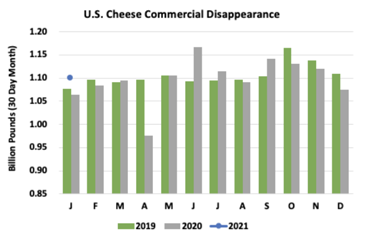 Despite this drastic change in the market, processors are not concerned about raw milk availability with most anticipating that milk production will continue expanding in the coming months.
Foodservice demand for cheese is improving as dining restrictions relax and a growing number of people feel comfortable eating in restaurants. This trend is likely to continue as stimulus checks make their way into people’s pockets and encourage extra spending at dining establishments. At 1.136 billion pounds, commercial disappearance of cheese in January posted the first year over year gain since September. Yet, despite the positive demand notes, cheesemakers are still running heavy schedules with some reporting that inventories continue to grow.
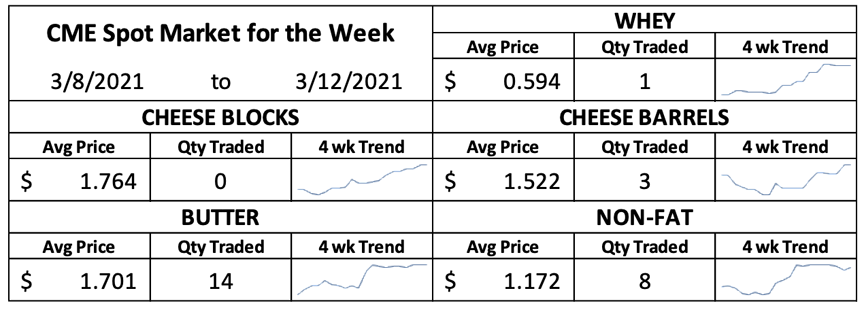
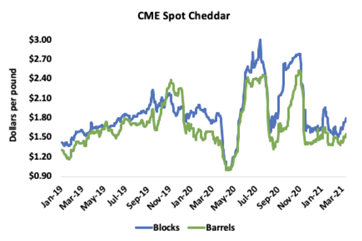 Positive sentiment for cheese prevailed at the CME this week, building on last week’s gains. Blocks moved upwards, albeit in fits and starts, rising as high as $1.7950/lb. on Thursday before giving up a half cent in today’s session close the week at $1.79/lb. This represents an increase of 5.75¢ compared to prior week, though not a single load traded hands. Block prices are now the highest they have been since midJanuary. Barrels also gained some ground, ultimately finishing the week 4.5¢ higher than last Friday at $1.5525/lb. The blockbarrel spread sits at 23.75¢, slightly narrower than earlier in the week, but still wide by historical standards.
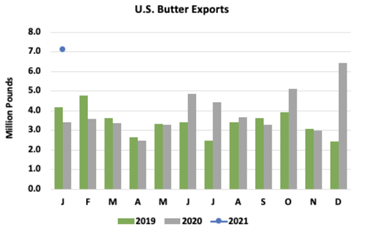 CME spot butter prices were also able to find some traction this week. Despite moving up and down over the course of the week, Friday’s spot session closed with a price of $1.715/lb., up 2.5¢ compared to last Friday with a total of 14 loads trading hands. Export interest has remained robust while a resurgence in foodservice has also helped to firm up prices. Commercial disappearance of 155.2 million pounds of butter in January led prior year but remains lower than for the same month in 2019. Churns continue to run hard schedules with heavy butter production and inventories still threatening to weigh on the market.
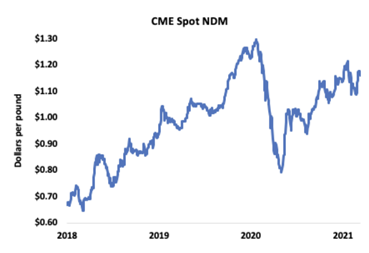 While cream heads to churns, condensed skim is readily available for dryers. Yet, in spite of strong production, export interest is purportedly growing and helping to support prices as U.S. product remains at a discount to global alternatives. Nevertheless, spot NDM at the CME gave up .75¢ over the week, realizing losses on Tuesday, Wednesday, and Thursday. A modest gain on Friday’s session pulled prices up to cap the week at $1.17/lb.
The bulls show no signs of relenting in the whey markets. A 1.5¢ gain on Monday propelled the CME spot whey price to a new record high of 59.5¢/lb. Even after a slight retreat on Wednesday, spot whey prices remain strong, closing the week out at 59.25¢/lb. on Friday, an increase of 1.25¢ versus the prior week. Export demand is robust, particularly from Asian buyers that have returned invigorated following the Lunar New Year. Mexican whey demand has reportedly improved, as well.
USDA’s World Agricultural Supply and Demand Estimates (WASDE) report, released Tuesday, left February’s projections for corn and soybean supply and total use unchanged. Corn production in the 2020/2021 marketing
Market observers are carefully watching the corn and soybean harvest in South America, where the weather has turned dry once again. In the WASDE report USDA increased the soybean production estimate for Brazil by one million metric tons while reducing Argentina’s output by half a million metric tons.
Original Report at: https://www.jacoby.com/market-report/one-year-after-pandemic-declared-normalcy-on-the-horizon/

Be the first to comment