
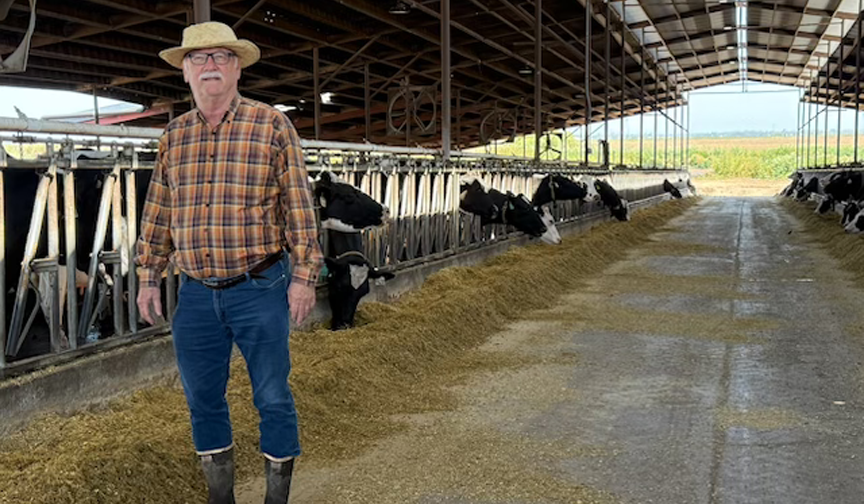
As on-again, off-again tariffs on products from virtually all U.S. trading partners capture the headlines in the Trump Administration’s first 100 days, their impact on U.S. exports remain unknown but cause for concern, nonetheless. Rich Denier, who dairies with his brother near Galt, Calif., spent much of his career leading a firm that was the largest exporter of U.S. dairy genetics. With this extensive international business experience, he reflects on dairy product exports which now amount to almost 20 percent of U.S. production.
1. You recently returned from a trip to the largest European agricultural trade show in France where you have longtime business associates and friends. You also visited Switzerland. You’ve said the opinions you heard there about the U.S. and its trade policies were of great concern to you. Tell us what you found.
He went on to say, “There’s growing resentment in Europe over the U.S. tariffs, the way Zelensky was treated in the Oval Office, and the fact that the U.S. voted alongside Russia and North Korea on a resolution condemning Russian aggression in Ukraine.”
Joel, those were his exact words. I also spoke with several European colleagues I’ve known for years, and they expressed similar sentiments. If they can avoid it, they said, they prefer not to buy American products—echoing the shift we’re seeing in Canada as well.
2. You spent your career leading a firm that exported U.S. dairy and beef semen to many international markets. Give us a thumbnail of your work in international markets.
Yes, I worked in the international export market for 27 years with World-Wide Sires, from 1974 until my retirement in 2001. I spent the last 17 of those years as CEO and roughly half that time working outside the United States.
World-Wide Sires (WWS) was founded in 1972 by Bill Clark, and I joined the company in 1974 as his first salesperson. At that time, WWS represented four U.S. artificial insemination (AI) cooperatives. By 1975, it had expanded to represent all 11 U.S. AI coops in international markets—everywhere except the Americas, where those cooperatives already had representation.
Our core business was exporting U.S. bull semen, and during my tenure, we served over 65 countries. In the early years, our global market share was below 50%, but by 1979—and continuing through the 1980s and 1990s—we became the dominant exporter in the world. Our market share ranged between 69% and 76%, with our nearest competitor, ABS, holding around 15–16%.
It was an extraordinary experience building trust and long-term relationships with international partners and helping establish the U.S. as a leader in livestock genetics.
3. What are some of the lessons you learned about international trade for U.S. agricultural products that you think apply today and will apply in the future?
Joel, I don’t think it’s complicated. International customers want two things: a dependable supplier and people they can trust. That was true throughout my time in the export business, and it’s just as true today—maybe even more so. Trust and consistency are the foundation of long-term trade relationships, especially in agriculture, where supply disruptions or policy shifts can have serious consequences.
4. The Trump Administration has imposed huge tariffs on foreign imports to the U.S. and then suspended at least some of them, creating what seems to be a lot of confusion. How will these decisions and reversals impact U.S. ag exports?
I believe these tariff decisions—and especially the constant reversals—have been and will continue to be very damaging to U.S. agricultural exports. Why? Because international buyers want consistency and reliability. The uncertainty created by sweeping tariffs and sudden policy changes erodes trust, and we’ve already seen the consequences.
Take the first Trump Administration’s tariffs in 2018–2019. According to Hoard’s Dairyman (April 21, 2025), over 30% of U.S. exports of dry whey, whey protein concentrate (WPC), whey protein isolate (WPI), and permeate go to China—all now facing retaliatory tariffs of at least 100%. When China imposed just a 20% retaliatory tariff on U.S. dry whey back in 2018, exports to China plummeted by 69% between April 2018 and February 2020. So, we can only imagine the damage a 100% tariff might do now.
This isn’t limited to bulk commodities. China has been the largest market for U.S. bull semen for the past four years, both in terms of value and volume. But my
industry contacts tell me China has now stopped importing U.S. semen entirely. That’s a clear signal of lost trust, even in high-value, specialized ag products.
To be clear, I’m not saying the U.S. shouldn’t take a tough stance on trade with China—but we need to be strategic and thoughtful. Sweeping, unpredictable tariffs don’t just hurt our trading partners—they hurt our own credibility.
As Caitlin Welsh, a food security expert at the Center for Strategic and International Studies, put it: “If the Trump administration continues to enact sweeping tariffs, U.S. farmers will likely continue to lose out in the global marketplace.” She added that this reinforces the perception that the U.S. is no longer a reliable trading partner—making it harder for American farmers to find and keep buyers.
That aligns exactly with the most important lesson I’ve learned in international trade: customers want a reliable supplier, and they want to buy from people they trust.
5. With nearly 20 percent of U.S. dairy products being exported today, what are your concerns about this new trade environment?
My main concern is that the U.S. is no longer being seen as a trusted, reliable supplier. In today’s global marketplace—where nearly 20% of U.S. dairy products are exported—that perception matters more than ever. If the current trade uncertainty continues, international buyers will look elsewhere for consistent supply. Countries like New Zealand and those in the European Union are ready and able to step in. Once that market share is lost, it’s extremely difficult to win back.
6. You are and have been a longtime partner in a family dairy farm in California. Do you believe this tariff situation will impact commodity prices paid to U.S. farmers, and if so, to what extent?
Joel, I believe the impact is already being felt. I’m currently receiving $1.50 less per hundredweight than I was back in January. If we’re not smart about how we handle tariffs—especially with key partners like Canada and Mexico—prices could drop even further.
Mexico, for example, buys about half of our cheese exports. If we lose that market due to trade tensions, the consequences for U.S. dairy farmers could be severe. We could see more dairies going out of business or even filing for bankruptcy.
And that’s just the dairy sector. If you look at the crop sector, the impact could be even worse.
7. Do you see tariffs impacting the pricing or availability of equipment and supplies you need to buy as a U.S. dairy producer?
I do expect tariffs will impact the pricing and availability of equipment and supplies we rely on as dairy producers, but I’ll admit I don’t have enough specific information to say exactly which imports will be affected. That said, any disruption in global supply chains usually leads to higher costs and longer wait times—both of which directly affect our ability to operate efficiently.
8. Two important organizations for U.S. dairy farmers that advocate for government policy are the National Milk Producers Federation and the U.S. Dairy Export Council, an arm of the checkoff organization, DMI. As a producer, what do you believe these groups should be asking of the Administration and Congress?
Let me start by referencing the joint statement released on April 3, 2025, by the National Milk Producers Federation (NMPF) and the U.S. Dairy Export Council (USDEC).
Herewith:
”Dairy leaders called for a targeted approach to tariffs and an emphasis on positive negotiations with most trading partners as the Trump Administration moved ahead with a plan for stepped-up tariffs worldwide on Tuesday.
“Tariffs can be a useful tool for negotiating fairer terms of trade,” said NMPF President & CEO Gregg Doud in a joint statement with U.S. Dairy Export Council President & CEO Krysta Harden released earlier today. “We are glad to see the administration focusing on long-time barriers to trade that the European Union and India have imposed on our exports. The administration has rightly noted both countries’ penchants for restricting sales of American products.
Frankly, I was surprised—and disappointed—by this statement. Just two days earlier, at the Western Dairy Management Conference in Reno, I heard NMPF President Gregg Doud speak. In his presentation on April 1, two days prior to the joint statement, he emphasized reducing tariffs with key trading partners like Canada and Mexico. Afterward, I personally spoke with him and voiced my concern that imposing tariffs on Canada and Mexico—our top two dairy export markets—would be harmful. Mr. Doud agreed. That’s why I found the April 3 statement so concerning; it contradicted the very position he had just supported in person.
So, what should NMPF and USDEC be asking of the Administration and Congress? First and foremost, they must be honest and consistent in their advocacy. Imposing tariffs on Canada and Mexico is not just a bad idea—it’s potentially devastating. These two countries together represent over 40% of U.S. dairy exports. Canada takes two-thirds of our butter exports; Mexico buys half of our cheese. Jeopardizing these relationships risks serious economic damage to our industry which may result in less support from the ag industry to the current administration.
Second, I believe both organizations need a deeper, evidence-based understanding of the global marketplace. Policy recommendations must be grounded in trade realities—not assumptions. For instance, during his Reno talk, Mr. Doud criticized the EU for not accepting U.S. hormone-fed beef. But the EU banned hormone use in livestock in 1981, with Directive 81/602/EEC, and implemented a moratorium on bovine growth hormone in 1990, making the ban permanent in 2000. Expecting them to allow U.S. hormone-fed beef imports is unrealistic.
Another example is butter. Most global markets, including the EU, demand 82% fat unsalted butter. The U.S. primarily produces 80% salted butter—which simply isn’t what these markets want. Aside from Canada and Mexico, there’s little demand for our product. Likewise, trying to sell mild cheddar, sharp, extra sharp cheddar and mozzarella to France—where they produce well over 400 unique cheeses—is not a viable strategy. We can’t just push our product onto global customers; we need to understand and meet their needs.
In conclusion, if NMPF and USDEC want to be effective advocates, they need to advocate for realistic policies that strengthen our global credibility. That means protecting relationships with our closest trading partners and grounding our trade strategy in market realities and evidence-based information. Ultimately, customers want reliable suppliers who they trust. Trade policy negotiations must be built on trust, reliability, and rigorous, evidence-based information that substantiates and legitimizes our policy positions.

Be the first to comment