

Due to frequent droughts and reduced water well capacity, dairy farmers are considering sorghum silage as a forage alternative to corn silage because of its drought tolerance. The main obstacle to sorghum silage adoption has been its lower fiber and starch digestibility compared to conventional corn silage. 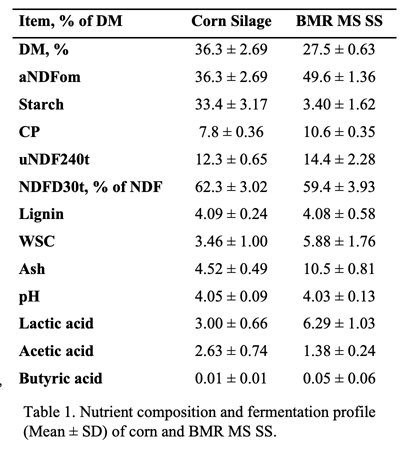 However, our previous articles have discussed how BMR sorghum hybrids and new sorghum kernel processing strategies can significantly increase fiber and starch digestibility. In addition, we have discussed the benefits of using brown mid rib male-sterile sorghum silage, BMR MS SS and strategies to decrease leachate production when harvesting forages with high moisture content. This article will discuss the effect of partially replacing corn silage with BMR MS SS on milk production of lactating dairy cows.
BMR male-sterile sorghum production
A BMR male-sterile sorghum hybrid was seeded in a pivot irrigated field in Stephenville, in July 2023, and harvested in November 2023. Sorghum was wilted in the field in the morning, chopped in the afternoon, and ensiled in a silo-bag. The male-sterile sorghum silage and corn silages nutrient composition and fermentation profile are presented on Table 1.
BMR male-sterile sorghum silage feeding trial
A total of 48 multiparous crossbred cows were randomly assigned to receive one of three diets varying in replacement rates of corn silage with BMR MS SS. The experiment was conducted in Stephenville 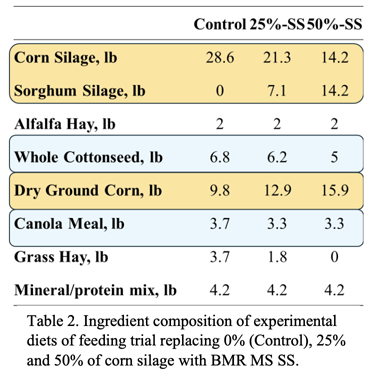 from February to April 2024. Three diets were formulated varying in replacement rates of corn silage with BMR MS SS. The “control” diet had corn silage as the only silage. The other two diets had 25% and 50% of dietary corn silage replaced with sorghum silage, Table 2. Because the male-sterile sorghum has low starch content, dry ground corn had to be increased proportionally as the amount of sorghum silage increased. Additionally, adjustments in canola meal, grass hay and whole cottonseed inclusion were made to maintain diets with similar levels of protein, energy and forage and total neutral detergent fiber.
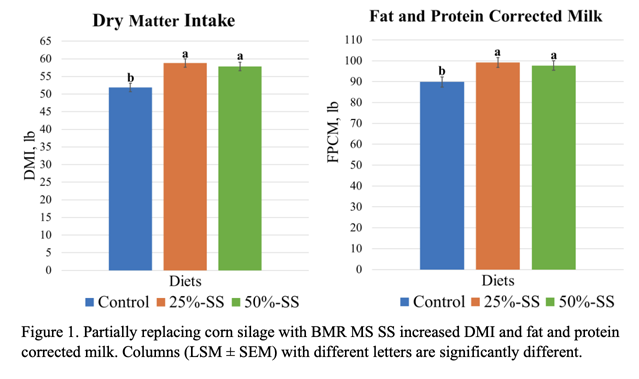
Cows were fed individually and their dry matter intake data collected. Weekly milk weights and samples were taken and analyzed for fat, protein, and lactose contents. Fat and protein corrected milk and dry matter intake were assessed to compare the effects of replacing 0%, 25%, and 50% of corn silage with BMR MS SS in lactating dairy cow diets on milk production.
Partially replacing corn silage with BMR MS SS increased intake and milk production
Partially replacing corn silage with BMR MS SS in lactating dairy cow diets increased daily dry matter intake and fat and protein corrected milk production by roughly 6 and 9 pounds, respectively (Figure 1). Diets where corn silage was partially replaced with BMR MS SS and dry ground corn may have had lower rumen degradable starch leading to lower rumen propionate production, a potent feed intake suppressant1 , which may explain the increased feed intake and milk production in these diets compared to the control diet.
The control diet had more rumen degradable starch coming from the starch in corn silage, whereas the sorghum diets contained more dry ground corn which degrades slower in the rumen. Increased degradability of starch in the rumen increases the production of propionate from its fermentation. Increasing the amount of dry ground corn in replacement of the higher moisture starch from corn silage shifts the digestion of the starch from the rumen to the intestine. In turn, this would increase intestinal glucose absorption and decrease ruminal propionate absorption, allowing greater feed intake.
Acknowledgements
We would like to acknowledge the United Sorghum Checkoff Program and Dairy Management Inc. for their support and the students who helped with this project.
References
Allen M.S. 2014. Drives and limits to feed intake in ruminants. Anim. Prod. Sci. 54:1513-1524.
Oba M., and Allen M.S. 2003. Effects of corn grain conservation method on feeding behavior and productivity of lactating dairy cows at two dietary starch concentrations. J. Dairy Sci. 86:174-183.


Be the first to comment