

Figure 1. Schematic representation of the development of the bovine stomach. In neonatal calves the fourth and last stomach compartment (abomasum) is the most developed one. Modified from Nickel et al., 19794.
What causes abomasal bloat in calves?
The cause of abomasal bloat is not completely understood; however, some risk factors have been associated with the disease. Briefly, excessive amounts of fermentable content in the abomasum in the presence of gas-producing bacteria and with factors contributing to delaying the abomasal emptying increases the risk of abomasal bloat5 (Figure 2).
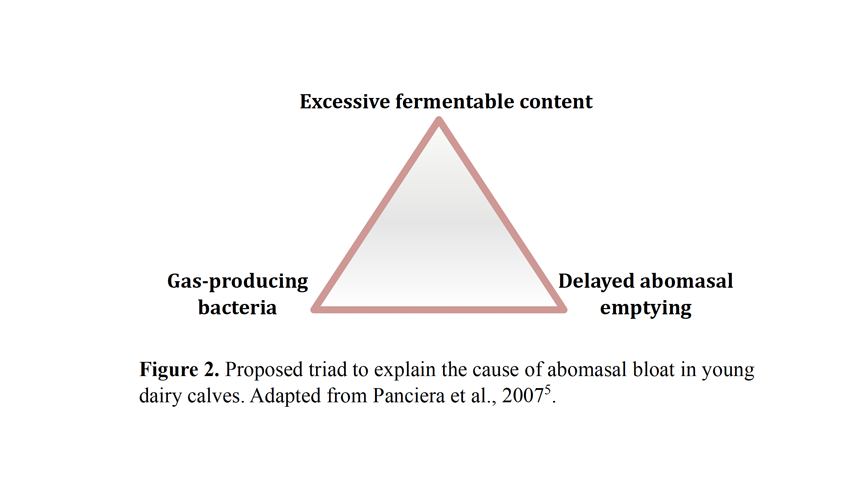
Excessive fermentable content
Typically, milk has a total amount of solids between 12% to 13% and concentration of solutes (osmolality) of approximately 300 mOsm, similar (i.e., isotonic) to that of calf’s blood. However, current industry accelerated calf-feeding programs add milk supplements, thus increasing these solids and osmolality. In addition, many calf-rearing operations now have increased their feeding program from 2 quarts to 3 quarts of milk or milk replacer twice or three times a day to newborn calves. While these accelerated calf-feeding programs have several advantages, personnel should be cautious when adding milk supplements to whole milk or preparing milk replacer in order to prevent errors in mixing and to not exceed 15% total solids in milk. One easy way to check this would be to routinely check milk samples at the beginning, middle and end of the feeding using a Brixx refractometer or sending samples to measure total solids.
Delayed abomasal emptying
Factors that delay abomasal emptying include feeding a large volume of meal, electrolyte solutions with high concentration of glucose or any solutions with high concentration of solutes6 (i.e., hypertonic or solutions with high osmolarity). Electrolyte solutions are used primarily to re-hydrate calves with diarrhea and, less frequently, in some calf-rearing operations routinely between milk feedings. Some of these products may have high concentrations of glucose resulting in very hypertonic solutions1 (>600 mOsm/L), which delays abomasal emptying (Table 1).

Gas-producing bacteria
Several bacteria species are proven to cause enteric diseases in calves, and some of these have been reported to be found in abomasal diseases. The most common bacteria to be reported is Clostridium perfringes type A9, which is suspected to be one of the main bacteria involved in abomasal bloat. Other species of Clostridium, Sarcina and Lactobacillus have also been suggested to play a role in this disease10. High fermentable sugars allow for quick proliferation of bacteria, which can result in gas production that might lead to bloat11. In addition, these bacteria, especially Clostridium species, have potential to produce toxins that will increase inflammation and may lead to shock9, increasing mortality risk.
Conclusion
Abomosal bloat occurs when enough substrates (fermentable carbohydrates), gas-producing bacteria reside sufficient time in the abomasum to allow excessive gas and acid production. To prevent abomasal bloat in calves, control the following risk factors that increase fermentation in the abomasum and delay its emptying:
- Do not exceed 15% of total solids in milk or milk replacer.
- Reduce the amount of volume per meal by increasing the number of meals offered per day, especially if feeding milk or milk replacer with total solids content of almost 15%.
- Aim to be as consistent as possible. Deliver the same amount of milk at the same time with the same concentration of solids at the same temperature every day.
- Avoid feeding high osmolality fluids, with high concentration of carbohydrates especially when feeding high volume meals.
- Good hygiene practices are key to reducing the load of gas producing bacteria.
References
1. Smith, G.W. and J. Berchtold. 2014. Fluid therapy in calves. Vet Clin Food Anim Pract. 30:409–27.
2. Marshall, T. S. 2009. Abomasal ulceration and tympany of calves. Vet. Clin. Food. Anim. 25:209–220
3. Nickel, R., Schummer, A., Seiferle, E. and Sack, W.O., 1979. The viscera of the domestic mammals. Pages 149-151.
4. Bell, F. R., and S. A. D. Razig. 1973. Gastric emptying and secretion on the milk-fed calf. J. Physiol. 228:499–512.
5. Panciera, R.J., M.J. Boileau, and D.L. Step. 2007. Tympany, acido sis, and mural emphysema of the stomach in calves: Report of cas-es and experimental induction. J. Vet. Diagn. Invest. 19:392–395.
6. Burgstaller, J., T. Wittek, and G. W. Smith. 2017. Invited review: Abomasal emptying in calves and its potential influence on gastro-intestinal disease. J. Dairy Sci. 100:17–35.
7. Sen, I., P. D. Constable, and T. S. Marshall. 2006. Effect of suckling isotonic or hypertonic solutions of sodium bicarbonate or glucose on abomasal emptying rate in calves. Am. J. Vet. Res. 67:1377–1384.
8. Nouri M., P.D. Constable. 2006. Comparison of two oral electrolyte solutions and route of administration on the abomasal emptying rate of Holstein-Friesian calves. J Vet Intern Med 20:620–6.
9. Songer J.G. and Miskimins D.W. 2005. Clostridial abomasitis in calves: Case report and review of literature. Anaerobe 11:290-294.
10. Van Kruiningen H.J., Nyaoke C.A., Sidor I.F., Fabis J.J., Hinckley L.S. and Lindell K.A. 2009. Clostridial abomasal disease in Connecticut dairy calves. Can Vet J. 50:857-860.
11. Schoenian S. 2014. Abomasal bloat. Marylan Small Ruminant Page. Access on: 4/30/23.



Be the first to comment