

Digital dermatitis, also known as hairy heel warts, is a pervasive and highly contagious bacterial infection targeting the skin of dairy cattle hooves, primarily the rear feet. This condition is marked by painful lesions, redness, swelling, and foul-smelling discharge, leading to discomfort, lameness, reduced milk production, and decreased fertility. Consequently, it poses a substantial economic burden on dairy producers. According to Palmer and O’Connell (2015), digital dermatitis costs the U.S. dairy industry an estimated $1.1 billion at a 25% prevalence rate. Factoring in inflation through 2023, this cost escalates to roughly $1.4 billion. The prevalence of digital dermatitis in a herd can reach as high as 80%, with 95% of large dairy operations reporting cases. Lameness, often resulting from digital dermatitis, is a major cause of involuntary culling, thereby reducing the productive life of dairy cows. Extending the productive life of cows is vital for the economic health and sustainability of a dairy operation. Various pressures, such as lameness, consistently shorten the average age of a herd, often preventing cows from reaching the break-even point where they recoup their rearing costs. Adopting a productive life model ensures that promising heifers mature into older, healthy, and productive cows through multiple lactations.
Prevention is Essential Implementing preventive measures is crucial to reduce premature culling and extend the productive life of dairy cows. A comprehensive management approach is necessary to effectively combat digital dermatitis. Creating a comfortable and conducive environment for cows is key in preventing digital dermatitis. Providing adequate shade, proper ventilation, and cooling can help mitigate heat stress. Additionally, maintaining clean and dry walking surfaces reduces the risk of infection and minimizes the spread of bacteria associated with digital dermatitis. Limiting the time cows spend standing on hard surfaces and installing rubber flooring in certain areas can also be beneficial. Stalls should be clean, dry, comfortable, and spacious enough for cows to stand up easily, and avoiding overstocking barns can reduce increased standing time.
Nutritional Support
Diet plays a pivotal role in maintaining cow health and immune function. A well-balanced and properly formulated diet supports rumen health and optimizes the cow’s ability to combat lameness challenges, including digital dermatitis. Ensuring an adequate supply of high-quality forage, balanced mineral supplementation, and maintaining optimal rumen pH through careful ration formulation can positively impact hoof health. Incorporating proper feed additives such as a postbiotic product can help stabilize the rumen, enhance microbiome populations, support gut integrity, and maintain intake and digestion,
providing more available energy to the animal. Ultimately, this can result in greater profitability on the farm. Consulting with a professional nutritionist can aid in adjusting the diet to ensure adequate rumen function, contributing to overall hoof health and resilience against diseases.
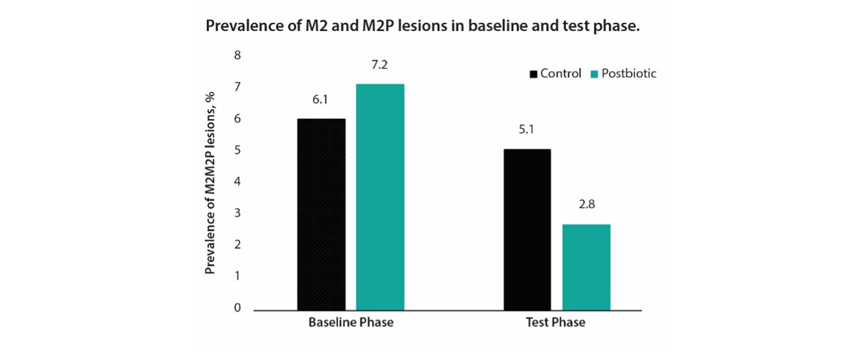
Lameness and Longevity A study led by Dr. D. Döpfer of the University of Wisconsin-Madison evaluated the effects of a postbiotic on the prevention and control of digital dermatitis in lactating dairy cows on a commercial dairy farm in the Midwest (Anklam et al., 2022). The field study involved 968 cows randomly assigned to four study pens at a Holstein dairy farm with 3,000 milking cows. Conducted from June to November 2018, the first 12 weeks served as baseline observations and the last 12 weeks as test observations. Digital dermatitis image data were captured every two weeks with GoPro cameras stationed at robotic milking units, resulting in 6,920 observations. Lesion scores are defined as follows in order of least to most severe: normal healthy (M0); chronic stage with thickened epithelium (hyperkeratosis, M4H); chronic stage with proliferative growth of epithelium (M4P); active ulcerative or granulomatous skin with diameter >2.0 cm (M2); and active ulcerative with proliferative growth (M2P). Scores were grouped as healthy or contained (M0M4H); chronic lesions (M4P); and active lesions (M2M2P). The study found that cows supplemented with a postbiotic had a slower progression of severe digital dermatitis lesions compared to the control group. Although the overall prevalence of digital dermatitis was not significantly altered, the odds of developing severe lesions (M2M2P) were reduced by 1.8 times in cows supplemented with a postbiotic. Enhanced protection from digital dermatitis through postbiotic supplementation is advantageous for the longevity, performance, and well-being of dairy cattle.
Digital dermatitis presents a significant challenge for the dairy industry, affecting the well-being and lifetime productivity of cows. By implementing effective management strategies, such as maintaining optimal hygiene, following proper footbath protocols, early detection and treatment, as well as adjusting the diet to support rumen health, dairy producers can minimize the occurrence and severity of digital dermatitis. Through proactive measures and a comprehensive approach, the impact of digital dermatitis on cow health and performance can be effectively managed, leading to improved animal welfare, enhanced productivity in the dairy sector, and a more productive life for cows.
As we conclude this second article in our Productive Life Series, the journey towards a productive dairy operation should focus on hoof care and its critical role in shaping future productivity. In the next installment, we will explore the importance sustainability has on productive life. Stay tuned!

Be the first to comment