
On Monday, more than two months after the U.S. House of Representatives passed its pandemic relief bill, Senate Republicans introduced their own version, the Heath, Economic Assistance, Liability Protection and Schools (HEALS) Act. The last major stimulus bill was passed in late March; some of its most significant provisions have already expired, will expire within days, or have run out of funding.
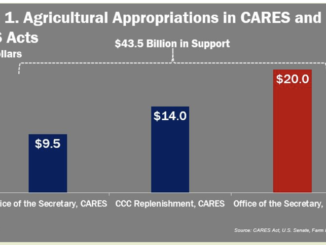
Of the $1 trillion provided by the proposal, $23.5 billion is earmarked for agriculture. Most of that – $20.457 billion – is allocated to Secretary of Agriculture Sonny Perdue to “prevent, prepare for, and respond to coronavirus by providing support for agricultural producers, growers, and processors impacted by coronavirus.”
Significantly smaller sums are provided to support salaries and expenses at several U.S. Department of Agriculture agencies, including the Farm Service Agency (FSA), Rural Development (RD), the Food and Nutrition Service (FNS), the Foreign Agricultural Service (FAS), and the Animal and Plant Health Inspection Service (APHIS). Though it offers a modest amount to cover the administrative costs of nutrition assistance programs, it neither expands the Supplemental Nutrition Assistance Program (SNAP), nor does it extend the Pandemic EBT program, which offered nutrition assistance to families whose children lost access to free or reduced-price meals following school closures.
In a statement, National Farmers Union president Rob Larew expressed appreciation for the additional support provided by the HEALS Act, but urged “congressional oversight of and greater transparency about how and to whom assistance is offered” in order “to ensure that the funding earmarked by the bill is fairly and equitably distributed.” Additionally, he emphasized the need to boost SNAP, citing the fact that “thirty million Americans are out of work, causing food insecurity to double over the last several months.” Because the program is “an effective, low-cost, and flexible way to help hungry Americans feed their families,” he urged Congress to expand benefits “so that it can adequately serve everyone who needs it.”
The bill would also extend the Paycheck Protection Program (PPP), with some adjustments. Perhaps most importantly, it would allow existing PPP borrowers to apply for a second loan. Second-time borrowers would have to meet more stringent requirements than first-time borrowers, and loans would be restricted to firms with fewer than 300 employees that have experienced at least a 50 percent reduction in gross revenue. Furthermore, it would improve the loan calculation approach; currently, most farmers and ranchers cannot receive a PPP loan if they show net negative income on their Form 1040, Schedule F, which disqualified many producers. Under HEALS, covered farmers and ranchers may instead use their 2019 gross income, capped at $100,000.

Be the first to comment