
The T.C. Jacoby Weekly Market Report Week Ending July 1, 2022
CME spot butter leapt 9.5ȼ to $3.01 per pound. That’s the highest spot butter price since 2015. The other spot products also climbed, however milk futures struggled.
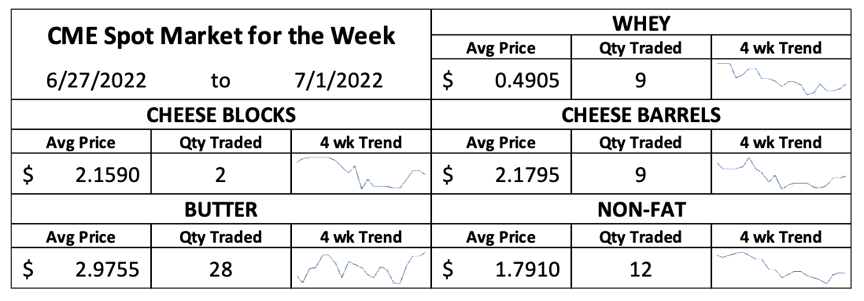
The spot markets sizzled in Chicago this week, but the futures fizzled. CME spot butter leapt 9.5ȼ to $3.01 per pound. Cue the fireworks! That’s the highest spot 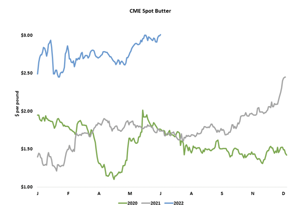 butter price since 2015. The other spot products also climbed, albeit with less cause for fanfare. Spot nonfat dry milk (NDM) rallied 1.25ȼ to $1.8025. Cheddar blocks jumped 8.25ȼ from last week’s lows to $2.1725. Barrels added 5.75ȼ and reached $2.205. Whey powder gained 2.5ȼ and closed at 50ȼ.
Nonetheless, milk futures struggled. Class III contracts closed deep in the red, led by a $1.08 drop in the August contract. October Class III managed to cling to the $23 mark, but all other Class III contracts fell short. USDA announced the June Class III milk price at $24.33, down 88ȼ from the all-time high set in May but up $7.12 from June 2021. Those astoundingly high prices help to explain why Class III futures faltered despite the strength at the spot market. There is no shortage of cheese, and the futures simply got ahead of themselves.
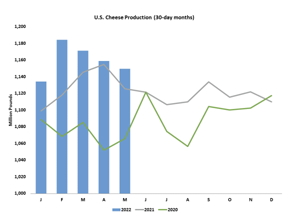 U.S. cheese output tipped the scales at 1.19 billion pounds in May, up 2.1% from a year ago and an all-time high for the month. Mozzarella production jumped 4.6% from May 2021, suggesting that pizza demand and fresh cheese consumption was high in the final months of the school year. Cheddar output fell 3.7% below the all-time high set in May 2021 but was still robust compared to typical monthly production.
 It’s impressive to see a 2.1% year-over-year increase in cheese output when milk production was 0.7% lower than in May 2021. But in a world where freight is expensive and unreliable, it is unsurprising. Milk output grew in the cheese states in the Upper Midwest, even as it fell in the rest of the nation. Vats are full as cheesemakers in Wisconsin and Minnesota enjoy steep discounts on spot milk. In a typical year, much of the excess milk would move to Class IV balancing plants to the east, but this is not a typical year.
More cheese meant more whey. Production of dry whey and whey protein concentrates both climbed well above year ago levels. Whey powder stocks waned imperceptibly from April to May, but they were still 7.5% higher than last year.
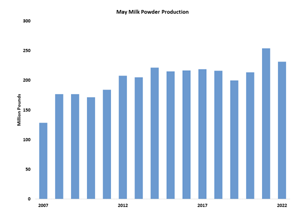
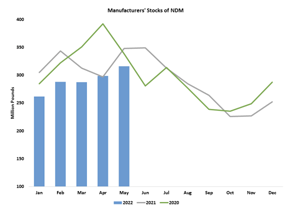 Butter churns and milk powder driers felt the brunt of the impact from the May milk production deficit. Butter output fell 0.7% from the prior year to 181.7 million pounds. Combined production of NDM and skim milk powder (SMP) fell 8.9% short of last year, to 231.3 million pounds. But, for both butter and powder, comparisons to last year are a bit misleading. Excluding May 2021, butter and NDM/SMP output posted the highest May volumes on record. Thankfully, demand has largely kept pace. Butter stocks grew at a typical rate in May. Manufacturers’ stocks of NDM increased from April to May but are now 9.3% below year-ago levels. Still, stocks are not tight, and buyers are reportedly backing away whenever NDM approaches $1.80.
The grain markets were routed this week. USDA confirmed that corn and soybean supplies on June 1 were quite a bit larger than last year, and slightly higher than the average crop analyst had expected ahead of Thursday’s quarterly Grain Stocks report. Inventories are tight, to be sure, but old crop stocks are perhaps not scarce enough to justify $8 corn or $17 soybeans.
The crop markets headed into the long weekend with more certainty about which crops are in the ground and with a favorable forecast. It’s been hot and mostly dry for a while, but the next two weeks look quite wet. In some areas, the June stress has done lasting damage, and crop yields will not reach their full potential. But July and August weather matter a lot more, and regular showers should revive thirsty crops as they march toward the crucial pollination period. If the rains fall as expected, the bears will remain charge of the grain pits.
September corn settled today at $6.1975 per bushel, down 73ȼ this week to its lowest price since February. December corn futures, which project the cost of grain when the harvest arrives, plummeted 66.5ȼ to $6.075. Despite the surprisingly steep drop in soybean acreage, soy futures lost ground too. August soybeans closed at $15.0975, down 28.5ȼ. But meal costs climbed. August soybean meal finished at $422.10 per ton, up nearly $11 this week.
Original Report At: https://www.jacoby.com/market-report/spot-markets-sizzle-but-futures-fizzle/

Be the first to comment