
The T.C. Jacoby Weekly Market Report Week Ending April 23, 2021
Spring is here. Tankers are lining up at milk powder plants around the nation. A shortage of trucks and drivers is complicating the annual rush to move milk from regions with surplus to regions with spare balancing capacity. Milk powder demand remains strong as whey futures reached 14-year highs early in the week but then retreated.
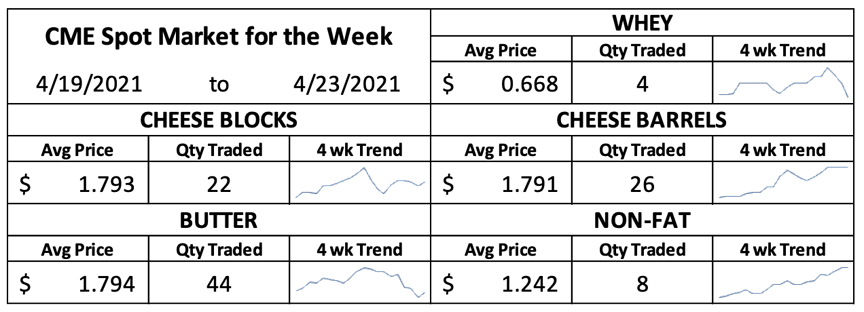
The Class III markets ended the week not far from where they began it, but the calm on the surface belied the roiling waters below. CME spot whey powder, which has long had the wind in its sails, was buffeted by the waves this week. It dropped 5.5ȼ to 62ȼ per pound. Orders remain aggressive for high protein whey products, but some buyers are starting to balk at lofty whey powder values. Whey futures reached 14-year highs early in the week but then retreated.
 After much back and forth, CME spot Cheddar blocks closed at $1.7925 today, up 1.25ȼ from last Friday. Blocks are plentiful, but barrels are tighter, and the imbalance is reflected in the price. Barrels jumped 11.5ȼ this week to $1.805, their highest value since November. Barrels are now worth more than blocks for the first time since July.
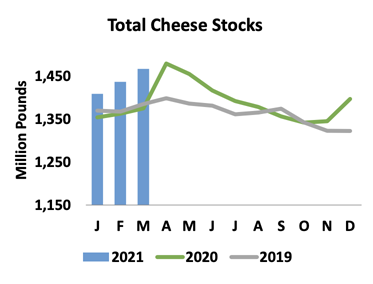
Barrel supplies may be a little snug, but there is more than enough cheese to go around. USDA reported 1.47 billion pounds of cheese in cold storage at the end of last month, the second-highest total ever and the highest March volume on record. Stocks increased 30 million pounds from February to March, nearly twice the normal rate.
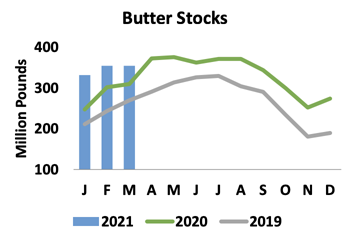 Butter inventories are also extremely heavy. There were 354.6 million pounds of butter in cold storage on March 31, the highest March total since 1993. Stocks are 14.5% greater than they were a year ago. However, as more milk heads to cheese vats, the year-over-year butter surplus is shrinking. Butter stocks grew at roughly half the typical pace from February to March and they did not grow at all last month. A plateau is rare at this time of year, and it confirms reports of strong demand from foodservice. However, USDA’s Dairy Market News notes that retailers are starting to slow their orders. At the spot market, butter continued to fade this week. CME spot butter fell 8ȼ from last Friday and closed at $1.77.
Spring is here. Tankers are lining up at milk powder plants around the nation, although the queue is a little shorter in the Midwest than it was last year, thanks to expanded cheese capacity. A shortage of trucks and drivers is complicating the annual rush to move milk from regions with surplus to regions with spare balancing capacity, which is exacerbating discounts for milk in the Southwest. Milk powder demand remains strong. Exporters continue to move big volumes to Asia, and Mexican orders are picking up steam even as
China’s appetite for foreign dairy continues to astound. In March, China imported recordbreaking volumes of cheese and whey, with arrivals up 74% and 77%, respectively, from a year ago. Chinese first-quarter skim milk powder (SMP) imports were record-large, up 35.5% from the first three months of 2020. Chinese imports of whole milk powder (WMP) in the first quarter were 22% higher than the prior year and were just shy of the breakneck pace set in 2014.
China’s aggressive purchases have largely cleaned up New Zealand’s dairy product stockpile. In Europe, slower milk output has tightened their exportable inventories, particularly for milk powders. In January and February, European SMP production was 7% lower than the prior year, adjusted for leap day. As long as we can secure the containers and ships needed to send product abroad, the United States is well-positioned to capture a greater share of China’s burgeoning dairy market. That’s welcome news, because we have a lot of milk to move.
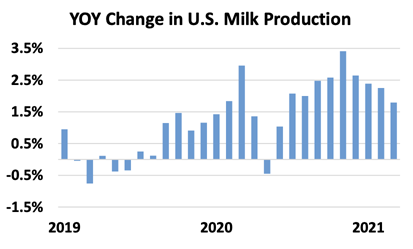 U.S. milk production totaled 19.75 billion pounds in March, up 1.8% from a year ago. That’s a slight slowdown in year-over-year growth, which has been 2% or higher since July 2020. However, the headline figure is misleading in its modesty, because this represents a respectable increase on top of the strong 3% growth reported in March 2020. Milk output was 4.8% greater than March 2019, the strongest two-year increase since September 2015. Production was particularly formidable in the Plains states and the Midwest.
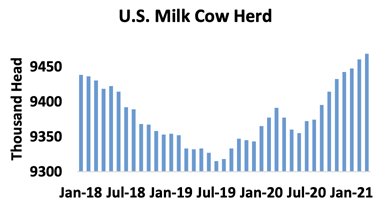 Dairy producers added another 8,000 cowsin March, which will fuel further growth in the months to come. There are now 9.468 million cows in U.S. milk parlors, 77,000 more than there were a year ago. The U.S. dairy herd hasn’t been this large since 1995. We’re going to need to sustain big exports or we’ll be drowning in milk.
Someone tied a rocket to the corn market and lit the fuse. July corn futures closed today at $6.325 per bushel, up nearly 60ȼ since last Friday. Corn futures jumped more than 10% this week and are up 32% for the year to date. Corn 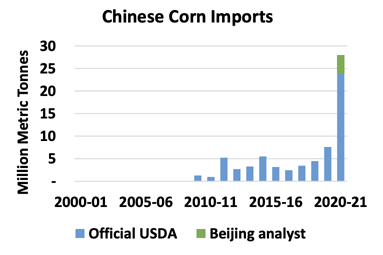 prices have not been this high since 2013, on the heels of a paltry harvest after the 2012 drought. These prices suggest that last year’s corn crop may be smaller than previously thought. And demand is daunting. USDA’s analyst in Beijing raised his estimate of 2020-21 corn imports to a record-shattering 28 million metric tons, which is 4 million metric tons higher than USDA’s official projection. That’s a difference of 157 million bushels. If correct, this would significantly tighten U.S. corn stocks, putting more pressure on farmers to deliver a bumper crop this season. Light rainfall in Brazil suggests their second corn crop will disappoint, pushing even more demand to the United States.
With corn prices at such heights, soybeans are losing acreage they desperately need to meet global protein demand. Struggling to keep pace with the grains, the soy complex shot higher this week. July soybeans settled at $15.16, up 93.5ȼ from last Friday. July soybean meal rallied nearly $20, to $425.80 per ton. Even these sky-high values understate the cost to many dairy producers, who must pay unusually high premiums for freight to keep their cows fed.
Original report at: https://www.jacoby.com/market-report/spring-is-here/




Be the first to comment