
Environmental Modifications
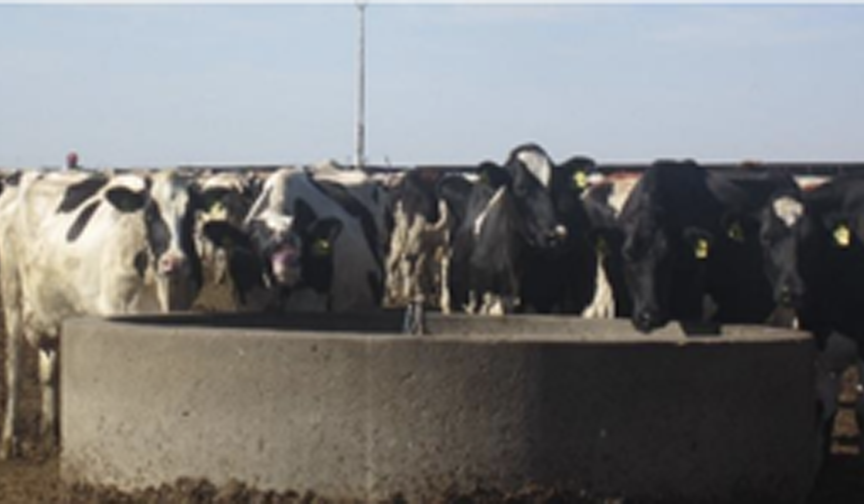
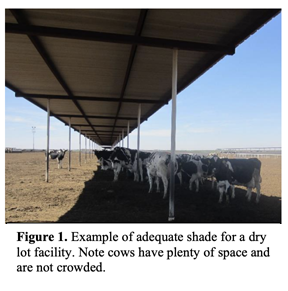
Creating a comfortable and cool environment for dairy cattle is crucial in combating heat stress. Providing shade through natural or artificial means, such as shade cloth or buildings, can offer relief from direct sunlight (Fig. 1). Shades have been shown to reduce respiration rates and rectal temperatures and even increase milk yield by as much as 10%6 . Shades also help to reduce heat accumulation and solar radiation; however, shades have no effect on air temperature and humidity.
Ventilation systems and fans help maintain air circulation and lower ambient temperatures. Furthermore, evaporative cooling using sprinklers, misters or foggers can be installed in free-stall barns and holding pens to cool the animals and reduce heat stress7 . Each of the evaporative cooling methods release water to help with evaporative cooling and the difference is the size of water particle dispersed.
Nutritional Management
Optimizing the nutritional management of dairy cattle is vital during summer heat stress, as it alters a cow’s nutritional needs, reduces DMI and increases the need for an energy-dense ration. Adjustments can be made to the ration to alleviate the effects of heat stress on reproductive performance and may include:
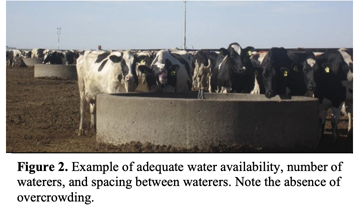
- Fresh Water Availability: Ensure easy access to clean water throughout the day, as water intake is crucial for maintaining hydration and thermoregulation. Dairy cows consume between 30 to 50 gallons of water per day, and for every 1.8°F increase in ambient temperature from 22°F to 74°F, water consumption increases by an average of 1.5 kg/day9,11. Water consumption is influenced by average ambient temperature, milk production, body weight and sodium intake11. Cows should have easy access to water, and there should be adequate water space with at least 20% of the cows in the pen being able to drink at once9 (Fig. 2). It is important that cows have access to water immediately after milking as the majority of drinking water intake will occur within one hour after milking9,10 .
- Balancing Diets: During the summer, energy-dense diets are necessary as DMI decreases when cows experience heat stress. Increasing the energy density of a ration can be done through increasing the amount of fats and grains in the diet6,8 . In addition, mineral supplementation, particularly electrolytes such as potassium, are lost due to sweating and increased water intake8 . Always consult with your nutritionist to make the necessary adjustments to meet your cows’ nutritional needs during the summer.
- Feeding Schedules: Alter feeding times to provide sufficient feed at reach during cooler parts of the day, such as early morning or late evening, to minimize heat stress during feeding9 . Additionally, adaption of evaporative cooling methods such as sprinklers, misters, and foggers to function during the day when cows consume more feed (e.g., at the time of feed delivery, during feed push-up, right after milking, etc.) can help cool cows effectively7,9 .
Reproductive Management Practices
Managing heat stress directly is crucial for improving reproductive performance. Implement the following practices:
- Breeding Programs and Heat (Estrus) Detection Frequency: During the summer, expression and duration of estrus decreases while the incidence of anestrus and silent ovulations increase12 . In fact, research indicates that estrus expression decreases by 20-30% of winter estrus expression12,13 . By increasing the frequency of heat detection or using precision technology, there will be an increased chance of observing signs of heat. Implementing a timed AI protocol can help to adjust a cow’s reproductive cycle and ensure insemination occurs at the optimal time, regardless of heat detection reliability.
- Semen Handling: Implement proper semen handling and storage protocols to ensure the quality and viability of semen are not compromised by high temperatures. Ensure that semen tanks remain cool by keeping them in a truck or shaded area during breeding. Additionally, breeding technicians may consider loading fewer guns during the summer to reduce the chance of sperm heat shock, which negatively impacts sperm motility and function14 .
- Genetic Selection: Emphasizing genetic selection for heat tolerance, fertility traits and overall adaptability to warmer climates for replacement heifers or when selecting sires can help to improve overall heat tolerability of a herd. The heritability of body temperatures in Holsteins is relatively low (0.17) but crossbreeding dairy cows with heat tolerant breeds can help reduce the negative effects of heat stress15
Conclusion
Heat stress can significantly impact dairy cattle reproductive performance during the summer months. However, with appropriate management strategies in place, the negative effects can be minimized. By providing a comfortable environment, optimizing nutrition, implementing heat stress management techniques, and practicing effective breeding management, dairy farmers can improve reproductive outcomes during the summer. Successful implementation of heat stress management will not only improve reproductive performance but also contribute to the overall profitability and sustainability of dairy farming operations, even in challenging summer conditions.
References
- Lucy M. C. 2001. Reproductive loss in high producing dairy cattle: where will it end? J. Dairy Sci. 86(6):1277-1293.
- Al-Katanani, Y. M., D. W. Webb, and P. J. Hansen. 1999. Factors Affecting Seasonal Variation in 90- Day Nonreturn Rate To First Service in Lactating Holstein Cows in a Hot Climate1. J. Dairy Sci. 82(12):2611-2616.
- De Rensis, F., P. Marconi, T. Capelli, F. Gatti, F. Facciolongo, S. Franzini, and R. J. Scaramuzzi. 2002. Fertility in postpartum dairy cows in winter or summer following estrus synchronization and fixed time AI after the induction of an LH surge with GnRH or hCG. Theriogenology 58(9):1675- 1687.
- Wilson, S. J., C. J. Kirby, A. T. Koenigsfeld, D. H. Keisler, and M. C. Lucy. 1998a. Effects of controlled heat stress on ovarian function of dairy cattle. 2. Heifers. J. Dairy Sci. 81(8):2132-2138.
- Wilson, S. J., R. S. Marion, J. N. Spain, D. E. Spiers, D. H. Keisler, and M. C. Lucy. 1998b. Effects of controlled heat stress on ovarian function of dairy cattle. 1. Lactating cows. J. Dairy Sci. 81(8):2124-2131.
- Collier, R. J., G. E. Dahl, M. J. VanBaale. 2006. Major Advances Associated with Environmental Effects on Dairy Cattle. J. Dairy Sci., 89(4):1244-1253. DOI: https://doi.org/10.3168/jds.S0022- 0302(06)72193-2.
- Armstrong, D. V. 1994. Heat Stress Interaction with Shade and Cooling. J. Dairy Sci., 77(7):2044-2050. DOI: https://doi.org/10.3168/jds.S0022-0302(94)77149-6.
- West, J. W. 1999. Nutritional Strategies for Managing the Heat Stressed Cow. J. Anim. Sci., 77(2):21- 35.
- Tyson, J. 2020. Competition in the Dairy Barn. Dairy Business. Accessed from https://dairybusiness.com/competition-in-the-dairy-barn-2/.
- Jensen, M. B., and M. Vestergaard. 2021. Invited Review: Freedom from thirst – Do dairy cows and calves have sufficient access to drinking water? J. Dairy Sci. 104(1):11468-11385.
- Meyer, U., M. Everinghoff, D. Gadeken, and G. Flachowsky. 2004. Investigations on the water intake of lactating dairy cows. Livestock Prod. Sci. 90(2-3):117-121. DOI: https://doi.org/10.1016/j.livprodsci.2004.03.005.
- Gwazdauskas, F. C., W. W. Thatcher, C. A. Kiddy, M. J. Paape, and C. J. Wilcox. 1981. Hormonal patters during heat stress following PGF2α-tham salt induced luteal regression in heifers. Theriogenology, 16(3):271-285.
- De Rensis, F., and R. J. Scaramuzzi. 2003. Heat stress and seasonal effects on reproduction in the dairy cow – a review. Theriogenology, 60(6):1139-1151.
- Gong, Y., H. Guo, Z. Zhang, H. Zhou, R. Zhao, and B. He. 2017. Heat Stress Reduces Sperm Motility via Activation of Glycogen Synthase Kinase-3α and Inhibition of Mitochondrial Protein Import. Front Physiol. 8:718.
- Dikman, S., J. B. Cole, D. J. Null, P. J. Hansen. 2012. Heritability of rectal temperature and genetic correlations with production and reproduction traits in dairy cattle. J. Dairy Sci. 95(6)3401-05. http://doi.org/10.3168/jds.2011-4306.

Be the first to comment