

A new processing technology may be a game changer for sorghum silage
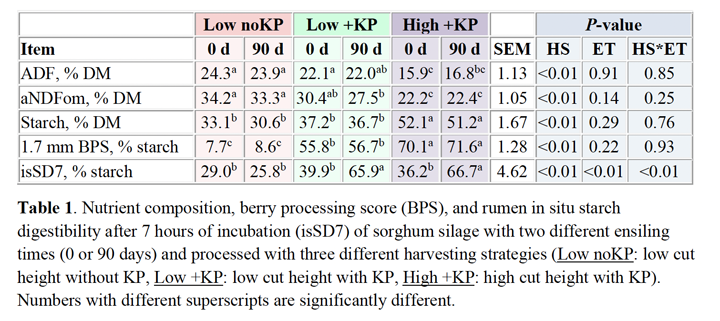
In collaboration with Scherer Inc., we randomly collected duplicated samples from three different areas of a field with a forage sorghum hybrid (Pearl, MOJO seeds, Hereford, Texas) under center pivot irrigation harvested at the hard dough stage3. The objectives were to assess the effect of a novel kernel processing, KP, technology and ensiling time on sorghum silage processing and rumen in situ starch digestibility after seven hours of incubation. The experiment consisted of two different ensiling times — 0 or 90 days — and three different harvesting strategies:
- – Low noKP: Low cut height (8 in) without KP.
- – Low +KP: Low cut height (8 in) with KP.
- – High +KP: High cut height (48 in) with KP.
Compared to Low noKP, using KP significantly increases the berry processing score, BPS, (percentage of starch passing a 1.7 mm sieve, Table 1)3. Noticeably, Low +KP achieved a BPS more than three times higher than the 17% suggested as an initial goal by other authors4.
Sorghum silage harvested with this outstanding berry processing combined with a fermentation length of 90 days achieved a remarkable rumen in-situ starch digestibility. Regardless of cut height, using KP and fermentation length of 90 days roughly doubled the in-situ starch digestibility compared to not using KP. Noticeably, the in-situ starch digestibility after seven hours of incubation increased after ensiling both cut heights when harvesting with KP and ensiling for 90 days but not without KP. This may happen due to the increased access of bacteria to starch during the ensiling time in the treatments with KP where berry processing was successful whereas the pericarp would impede bacterial access to the starch in the Low noKP treatment.
Increasing the cut height did not increase in situ starch digestibility
We hypothesized that increasing the cut height from 8 inches to 48 inches, to increase the sorghum panicle to stover proportion, would increase berry processing and in situ starch digestibility. Compared to Low +KP, High +KP increased the BPS by roughly 26%. However, there was no significant difference between Low +KP and High +KP on in situ starch digestibility (Fig. 2). Perhaps this could be attributed to both treatments achieving a very good BPS. Johnson (2017) proposed a BPS of >50% as adequate5. In this study, the BPS of Low +KP and High +KP were roughly 56% and 71%.
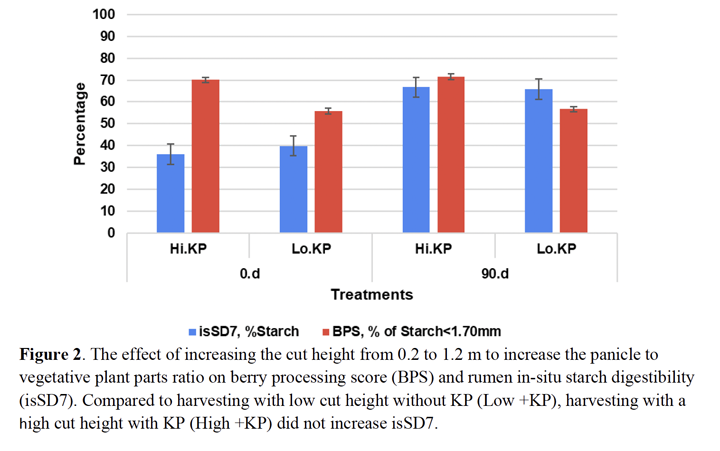
Our results suggest this new processing technology combined with a 90-day ensiling time increases sorghum berry processing and in-situ starch digestibility, and increasing cut height may increase BPS but may not further increase in-situ starch digestibility. The remarkable 66% of rumen in-situ starch digestibility after seven hours of incubation achieved is 12% below the 75% average from Rock River Lab for corn silage in the U.S6. Future studies should assess the effect of further increasing ensiling time in sorghum silage harvested with this technology on starch digestibility.
We would like to acknowledge Sherer Inc. and Rock River Laboratory for their support and collaboration with this ongoing research as well as dairy farmers and students who participated in the field data collection and curation.
References
1 USDA-NASS. 2004-2024. Crop production 2003 to 2023 Summary reports.
2 Piñeiro J.M., D. Duhatschek, A.G. Pilati, L. Luckasson. 2024. Strategies to include sorghum silage in lactating cows rations. Part 2. Texas Dairy Matters.
3 D. Duhatschek, A. Grando Pilati, L. Luckasson, J. Goeser, E. Coons, L.F. Ferraretto, J.M. Piñeiro. 2024. The effects of a new grain processing technology on forage sorghum processing. J. Dairy Sci. (accepted for publication).
4 Raver K., J. Goeser, S. Marshall. 2023. A survey of berry processing score and nutrient content of sorghum silage on commercial livestock operations across the US. J. Anim. Sci.
5 Johnson, J. 2017. Techniques to increase silage stability and starch availability and the effects of heat stress abatement systems on reducing heat load in dairy cattle. p 90-119. PhD Thesis. Kansas State University, Manhattan.
6 Rock River Laboratory, 2023. Corn Silage isSD7 data from samples submitted to Rock River Laboratory between September 29th, 2023 and November 30, 2023.


Be the first to comment