
Strategy No. 1. Focus on fiber production and fiber digestibility
The first important question dairy farmers need to answer before considering which sorghum hybrid to use is, “What are your two or three main priorities?” Several dairy farmers in the Texas Panhandle answered: “yield and fiber digestibility.” Clearly, if the sorghum silage also has high starch and protein content, with reasonable starch and protein digestibility, that would also be advantageous and would decrease feed costs from energy and protein concentrates. However, if the main reason we feed silage to cows is for fiber, then it seems reasonable that fiber digestibility should be prioritized.
In this scenario, BMR male-sterile forage sorghum hybrids are an interesting alternative to consider.
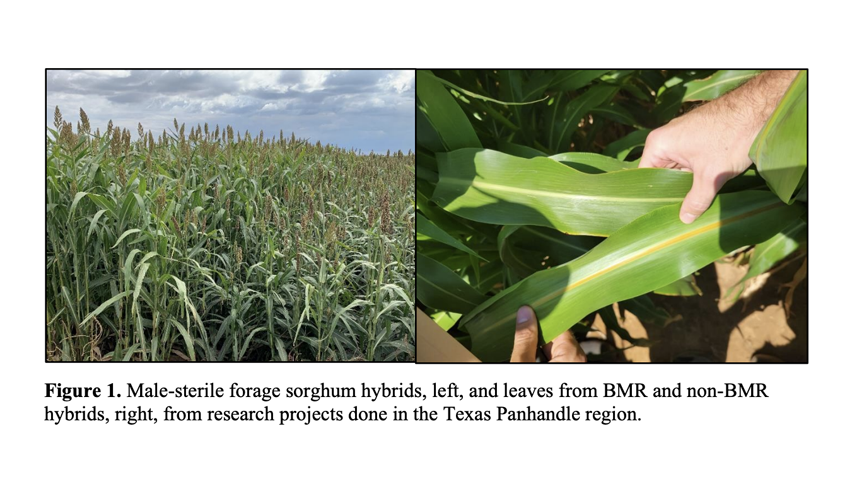
Why BMR? On average, BMR sorghum hybrids have less lignin and higher fiber digestibility compared to non-BMR hybrids. Increased fiber digestibility can improve feed intake, allowing for higher milk production2 .
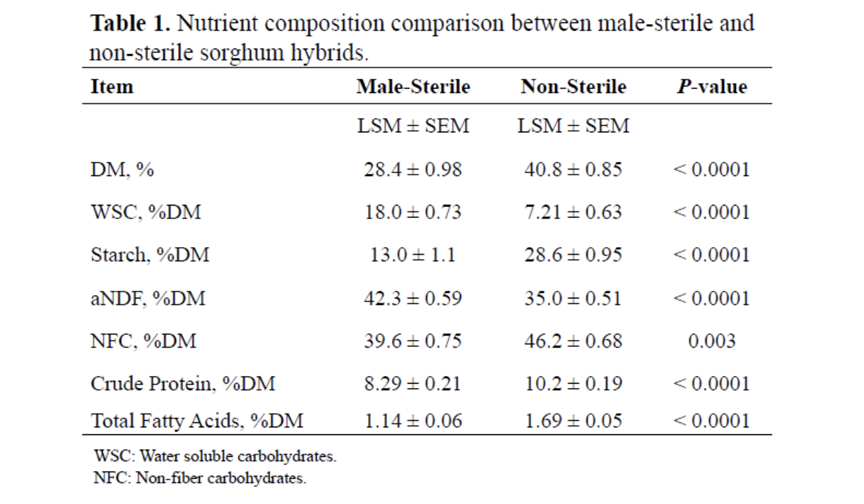
Why male-sterile? These hybrids do not develop grain, which in turn decreases lodging risks. In addition, results of a study conducted by our team in Texas show that the content of sugars – water soluble carbohydrates (WSC) – duplicate compared to hybrids that develop grain (Table 1) 3 . This has been covered in this article.
Is dry matter (DM) of male-sterile hybrid’s at harvest an issue?
If harvested at the right time with the right harvest settings and appropriate packing, direct cut and chopping is possible. The absence of grain in male-sterile hybrids drops the DM of the plant between 5-15% compared to hybrids that would develop grain six to 10 weeks after the boot stage. Decreased dry matter at harvest, especially below 25% DM, increases leachate risks because of higher humidity. However, early to mid-maturity male-sterile hybrids may reach a DM of ∼30% when harvested six to eight weeks after the boot stage. Late-maturity male-sterile hybrids may have a higher yield potential but will dry down slower. In addition, kernel processing is not needed when harvesting male-sterile hybrids, which would significantly decrease leachate risks. Furthermore, chopping at a moderate length, 0.75 inch, and using a silage additive to aid a quick drop of the silage pH should further reduce risks of leachate and abnormal fermentation.
One disadvantage of this strategy is that nutritionists may need to increase the starch content in the ration from other sources such as dry ground corn to increase the energy when including a greater proportion of male-sterile sorghum silage in diets of cows with higher requirements. Right now, the price of corn grain has significantly decreased, and this approach could be considered.
References
1 Sánchez-Duarte, J. I., K.F. Kalscheur, A.D. Garcia, and F.E. Contreras-Govea. 2019. Short communication: Meta-analysis of dairy cows fed conventional sorghum or corn silages compared with brown midrib sorghum silage. J. Dairy Sci. 102:419–425.
2 Pupo, M.R., Wallau, M.O. and Ferraretto, L.F., 2022. Effects of season, variety type, and trait on dry matter yield, nutrient composition, and predicted intake and milk yield of whole-plant sorghum forage. J. Dairy Sci. 105:5776-5785.
3 Duhatschek, D., Bell, J.M., Druetto, D., Ferraretto, L.F., Raver, K., Goeser, J., Smith, J.K., Paudyal, S., and Piñeiro, J.M. 2023. Comparing the nutritional value and the trade-off between sugars and starch of male-sterile with non-sterile sorghum hybrids. J. Ani. Sci. 101:487-488.


Be the first to comment