
BARRELS ARE EASIER TO SOURCE BUT STILL FAR FROM PLENTIFUL
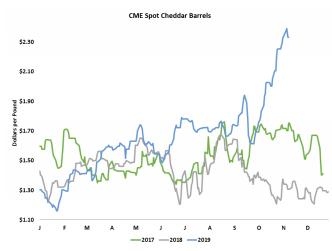 CME spot Cheddar barrels reached a fresh five-year high on Wednesday at $2.39 per pound. But then the bids dried up. Barrels fell 6ȼ yesterday, their most convincing setback in the past seven weeks. Class III futures moved sharply lower. The December contract traded as much as 75ȼ in the red, at the lower daily trading limit, although it regained some ground before the close.
Earlier this fall, when barrels were still inexpensive, cheesemakers continued to move milk to other cheese varieties. U.S. cheese production totaled 1.08 billion pounds in September, up 2.1% from a year ago. Output of Swiss, Italian, and Hispanic-style cheeses jumped 2.8%, 4%, and 9.1%, respectively. In contrast, Cheddar output fell 3.1% from September 2018. But the meteoric rise in barrel values likely convinced cheesemakers to move more milk into Cheddar last month, and some of that fresh cheese is likely just making its way to Chicago for the first time this week. The trend for higher barrel production is likely to continue. USDA’s Dairy Market News reports that cooler weather in the Southeast has 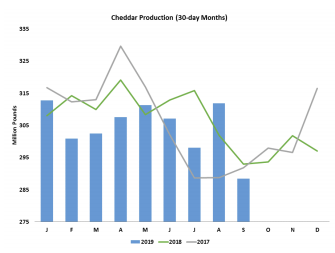 boosted milk yields and slowed the flow of tankers from the MidAtlantic and Midwest states. For the first time in months, some spot milk is selling at a discount in the Upper Midwest, which has encouraged cheesemakers to work longer hours and top up their vats.
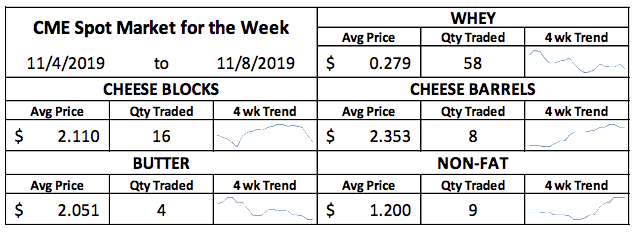
This week’s sales signal that barrels have gotten a little easier to source. But they are still far from plentiful. There were no offers at the spot market today. The futures shrugged off another retreat in block prices and focused instead on the soothing silence in the barrel market. Both Class III and cheese futures moved higher after the spot trade today. Barrels closed at a still sky-high $2.33, steady with yesterday and up a half-cent from last Friday. Blocks dropped to $2.015, down 14ȼ for the week. Nearby futures gave back some – but not all – of last week’s massive gains. The November contract settled at $20.02 per cwt., down 17ȼ. December closed at $19.09, down 61ȼ. Early 2020 contracts finished in the red, while deferred contracts moved roughly a nickel higher.
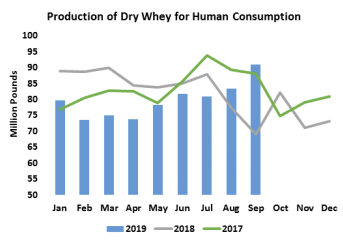 Whey remains in the doldrums. Spot whey powder slipped 0.75ȼ this week to 27.5ȼ. In September, dry whey output jumped to a two-year high of nearly 91 million pounds, 31.8% higher than the perplexingly low volumes of September 2018. Manufacturers’ stocks of dry whey climbed to the highest level since January. Exports remain anemic, as China turns its attention elsewhere.
Spot butter faded to a new 2019 low at $2.0375, down 4.25ȼ. Cream remains cheap and plentiful, and inexpensive foreign product continues to pour in. U.S. butter production declined seasonally in September to 136.6 million pounds. Still, that was 1.2% higher than September 2018 and the greatest output for the month since 2011.
Milk powder values continue to rally around the world. At the Global Dairy Trade (GDT) auction on Tuesday, skim milk powder (SMP) values leapt 6.7% to their highest average price since March 2015. GDT SMP now stands at the equivalent of nonfat dry milk (NDM) at $1.42 per pound. At the CME spot market, NDM advanced 2.25ȼ to $1.205, a five-year high. Combined production of NDM and SMP reached 171.8 million pounds in September, a new high for the month and 6.9% more than September
2018. But demand is more than keeping pace. Cheesemakers are fortifying their vats with NDM, and importers are shopping for SMP. U.S. exports of NDM/SMP advanced to 144 million pounds, up 24.2% 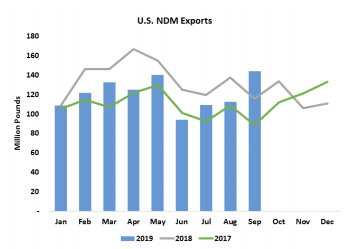 year-over-year. That’s the highest volume so far in 2019 and a record high for the month of September. Now that Europe has worked through its stockpile, there may be room for U.S. exports to keep improving. Optimism about milk powder prospects pushed Class IV futures higher this week, aside from a 4ȼ loss in the November contract. Most 2020 contracts gained 15ȼ to 20ȼ from last Friday’s settlement.
Strong milk powder, cheese and fluid milk/cream sales propelled overall U.S. dairy product exports above 2018 volumes for the first time in 11 months despite dreadfully low butterfat sales. Total export volumes were up 2% from a year ago in September, and the value of aggregate dairy exports jumped 17%.
Row crop values faded this week. December corn settled at $3.7725 per bushel, down 12ȼ from last Friday. January beans lost 6.25ȼ and closed at $9.31. The bean market was batted back and forth by the trade headlines once again. Chinese officials stated that the U.S. and China planned to de-escalate tariffs, which boosted commodity and stock values. However, when the White House contradicted those claims, the markets reversed course. Investors were reminded once again that they should be skeptical of all comments regarding the trade deal until the ink is dry.
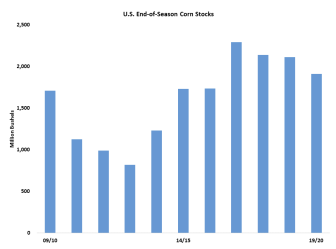 Winter has already arrived in the Corn Belt, and nearly half of the corn crop remains in the field. Farmers are frustrated with subpar yields, impassable fields, and variable quality. In today’s World Agricultural Supply and Demand Estimates report, USDA lowered its assessment of the corn yield by a sizeable 1.4 bushels per acre. At 167, the national average corn yield is the lowest since the 2013-14 season. U.S. corn production is projected to drop to a fouryear low, and global corn stocks are expected to tighten noticeably this year, marking their fourth consecutive year-over-year decline. Nonetheless, there is plenty of grain in the world and demand for U.S. corn is fading. Corn exports are projected to fall to their lowest level since 2012-13, when the drought pushed corn prices above $8 per bushel and throttled foreign demand. Unless ethanol production or exports perk up, U.S. corn values could remain under pressure despite this year’s disappointing harvest.
Original Report can be found at: https://www.jacoby.com/market-report/barrels-are-easier-to-source-but-still-far-from-plentiful/



Be the first to comment