
1. Take the early crop chop quiz!
- What is the recommended length of chop for winter forages and alfalfa?
- 3 inches
- 1 – 1 1/2 inches
- 3/8 to 1/2 inches
- 3/4 to 1 1/4 inches
- Boot length
- At what dry matter percent (DM%) should winter forages and alfalfa be harvested?
- 40 to 50 percent
- 35 to 45 percent
- 25 to 30 percent
- Really dry
- Really wet
- Who should be included in your preharvest meeting?
- Nutritionist
- Chopping contractor or chopper operators
- Person driving pack tractor
- Covering contractor or crew
- All of the above, with coffee and cookies provided
- Here are four safety tips – which one is most important?
- Plan and build a 1:3 or 1:4 drive over pile or bunker
- Shut off the chopper and remove the key when unplugging
- Wear safety clothing and make eye contact with chopper operator when approaching in the field.
- Don’t overfill bunkers or piles
- All of the above, all are important to send everyone home safely
- What is the best way to apply inoculant?
- Drive the wagon or truck under an overhead boom spray
- With a hand sprayer on top of the pile/bunker
- From a tank on the chopper that’s not insulated
- On the chopper – calibrated – from an insulated tank
- Throw it on the pile/bunker with a big bucket a day later
|
2. The six-inch secret |
|
Want to know how the best farmers make denser, safer, and nutritious forages? They pay extra attention to dry matter and chop length, measuring throughout the day, and adjust as needed. They’ve got someone assigned to checking these values all day – it’s their top priority, and they speak up when a value isn’t falling within the preset guidelines. Spring crops tend to dry out quickly, and when they get too dry, they’re harder to pack. But you knew that. After forages pass inspection, they are bladed into a pile or bunker that has been carefully planned and boundaries are marked clearly ahead of time. There’s a blade tractor and an appropriately sized pack tractor (or 2 or 3 or 4, depending on the number of choppers in the field) waiting to layer that forage in – in six inch layers.
That’s the secret – layering just enough to get a dense pack – from the ground up. The more forage is packed and layered, packed and layered, the more money you’ll save after fermentation. Why? Because packing out oxygen is key to better fermentation, less spoilage, more ending inventory, better nutrition, and safer forage piles and bunkers.
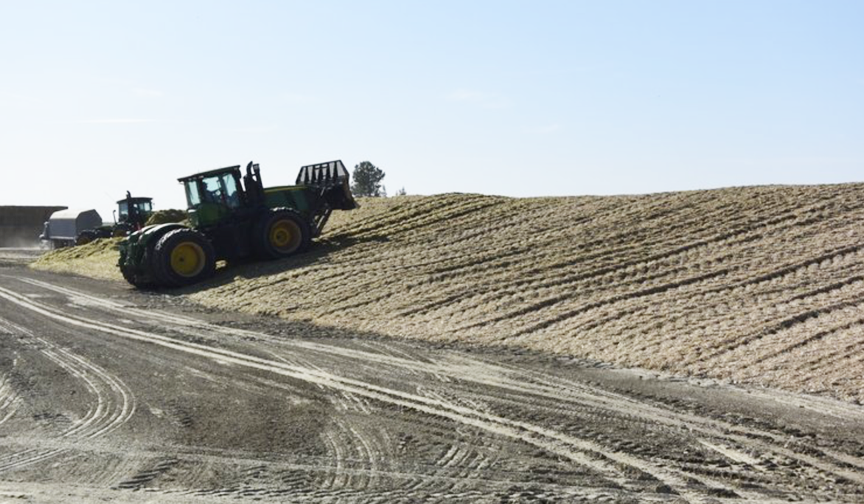
Look at the pile in the photo below: the blade has done the work of layering in, the pack tractor is doing it’s job of packing perpendicular to the blade, staying on the pile to make use of the tractor weight without dragging dirt into the field. There’s no tire tracks that go off the edge of this pile! Forward, reverse, repeat, at an even pace without digging wheels into the surface. People who do a good job blading and packing are important! Now you know the secret too – if you need help figuring pile or bunker size, pack tractor weight, or have any other harvest question, be sure to call your Sealpro® distributor! |
3. How Sealpro TITANIUM® got it’s name
Several years ago, when Ron and I developed our own brand of barrier films (after introducing oxygen barrier to the western US), we needed to come up with product names that exemplified their strength, barrier capabilities, and their value to our customer. We knew we had films that would be best in class performers.
After kicking a few catchy names around, we asked our agents and our marketing consultants for their ideas. They came up with some doozies! In the end, we asked our family: Catharine, Kyle, Chris, and Madeline to get on a Facetime call to vote. After some discussion, it was unanimous – Sealpro TITANIUM® would be the name of our best, strongest barrier film. By the way, the name had been suggested by Eddie Mello, one of our California agents – way to go, Eddie!
So our family business operates much like yours does. When it comes to big decisions, we consult everyone in our family. They bring personality, experience, and fresh perspectives to our table. Just like yours.
QUIZ ANSWERS: 1 C. 2 B. 3 E. 4 E. 5 D.
Be the first to comment