
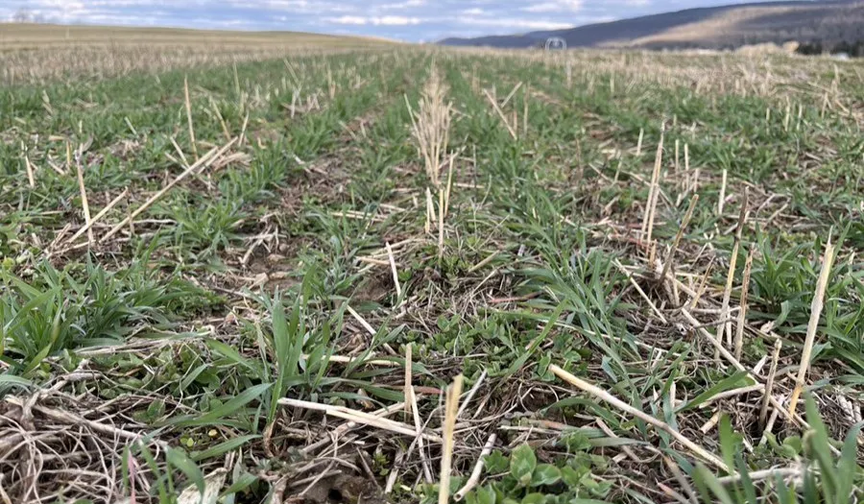
Best management practices for terminating winter cereal forages and cover crops with pre-plant burndown programs.
As planting season approaches, here are a few best management practices for starting clean in fields with winter cereals that will be harvested for forage or cover crops that will be terminated ahead of planting.
Terminating winter cereals harvested for spring forage.
Cover crop termination strategies.
When terminating cover crops, consider the need for additional tank-mix partners in glyphosate- or paraquat-based burndown programs to control emerged weed populations and to optimize control of grass, legume, and brassica cover crop species. Based on field trials within this region, we recommend three keys for developing cover crop burndown programs:
-
Know which weeds are present in your cover crop stand. A well-established cover crop stand suppresses many fall- and spring-emerging weed species. But some species, such as glyphosate-resistant horseweed, may also be present in the understory of cover crop stands. Consequently, it may be necessary to adjust your cover crop burndown program or application timing to achieve effective weed control.
- Tank-mix synthetic auxins for legumes and brassicas. Though both glyphosate and paraquat have activity on broadleaf cover crops, Mid-Atlantic field trials consistently showed including dicamba or 2,4-D LVE in the tank improved control of legumes and brassicas (Table 1).
- Understand pre-plant application restrictions for tank-mix partners. Make sure to check herbicide labels to understand restrictions in both corn and soybean (Table 2). For example, cover crop termination timing and soybean seed trait technology (i.e., Enlist 3, Xtend, XtendFlex, LibertyLink) will determine which herbicide formulations and rates that can be used.
Table 1. Effectiveness of burndown herbicides and tank-mixtures for control of overwintering grass, legume, and brassica cover crops. Control ratings (1-10) based on Mid-Atlantic field trials. Control ratings of 9 or greater should be selected to optimize control of cover crops.
| Corn or soybean program | Annual ryegrass |
Winter cereal† |
Med red clover |
Crimson clover |
Hairy vetch |
Brassica spp.†† |
|---|---|---|---|---|---|---|
| glyphosate (0.75 lb ae) | 8 | 9 | 7 | 8 | 7 | 6 |
| glyphosate (1.5 lb ae) | 9 | 9+ | 7+ | 8+ | 8 | 7+ |
| paraquat (0.75 lb ai) | 6 | 8 | 8 | 8+ | 8 | 8 |
| glyphosate (0.75 lb ae) + Sharpen (1 oz/ac) |
8+ | 9 | 7 | 8 | 8 | 7 |
| glyphosate (0.75 lb ae) +
2,4-D LVE (0.5 lb ae) |
8 | 9 | 8 | 9 | 9+ | 8 |
| glyphosate (0.75 lb ae) +
2,4-D LVE/choline (1 lb ae) |
8 | 9 | 9 | 9 | 9+ | 9 |
| glyphosate (0.75 lb ae) +
dicamba (0.5 lb ae) |
8 | 9 | 9 | 9 | 9+ | 7 |
| glyphosate (0.75 lb ae) +
clethodim (6-8 oz) |
9+ | 9+ | 7 | 8 | 7 | 6 |
| paraquat (0.75 lb ai) + 2,4-D LVE (0.5 lb ae) |
6 | 8 | 8+ | 9 | 9+ | 8+ |
| paraquat (0.75 lb ai) +
dicamba (0.5 lb ae) |
6 | 8 | 8+ | 9+ | 9+ | 8 |
| Corn program only | ||||||
| glyphosate (0.75 lb ae) + rimsulfuron (0.015 lb ai) |
9+ | 9+ | 7 | 8 | 7 | 6 |
| paraquat (0.75 lb ai) + atrazine (1 lb ai) |
7 | 8+ | 8+ | 9+ | 9 | 9 |
† winter wheat, triticale, cereal rye; †† overwintering brassica spp; winter canola, rapeseed
Table 2. Herbicide restrictions and BMPs in cover crop termination scenarios within field crops.
| Tank mix partners | Restrictions and BMPs (Always consult herbicide labels) |
|---|---|
| Sharpen (saflufenacil; G14) | Apply 0-14 days pre-plant in corn at 1-3 oz/ac and in soybean at 1 oz/ac. Add MSO (1% v/v) + AMS. |
| 2,4-D LVE (G4) | Apply >7 days pre-plant in corn at 0.5-1.0 lb ae/ac. |
| dicamba (G4) | Apply >7 days pre-plant in corn at 0.5-1.0 lb ae/ac. |
| clethodim (G1) | Apply SelectMax >6 days pre-plant at 6 fl oz in corn and pre-emergence up to 8 fl oz in soybean. Restrictions and adjuvants will differ for other clethodim products. |
| metribuzin (G5) | Tank mix with paraquat before corn or soybean at 0.2 lb ai/ac. Check label for rate restrictions based on soil type. |
| atrazine (G5) | Tank mix with paraquat before corn only at 1 lb ai/ac. |
| rimsulfuron (G2) | Apply Resolve 25 DF or Basis Blend 30WDG at 1 oz/ac in corn only. |

Be the first to comment