
The T.C. Jacoby Weekly Market Report
Week Ending February 28, 2020
The bulls nearly drowned in a flood of red ink this week. The markets were swamped in wave after wave of selling due to fears that the coronavirus would continue to spread, and consumers would hunker down, throttling economic activity around the world. The stock market suffered its worst week since the financial crisis, and commodity values were battered. The dairy bulls finally came up for air on Friday, even as the broader market continued to sink.
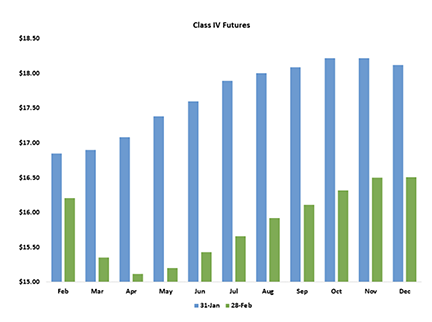 Today’s recovery brought some muchneeded calm to the dairy complex. But though the rebound was reassuring, it was still much smaller than the initial retreat. Most Class III futures contracts settled 30ȼ to 60ȼ lower than last Friday. Class IV losses were even steeper. Over the past month, February through December Class III futures have given up 92ȼ per cwt. on average, while Class IV futures plummeted $1.70. While Class III contracts sit comfortably above $16, March through July Class IV are still trading in the $15s.
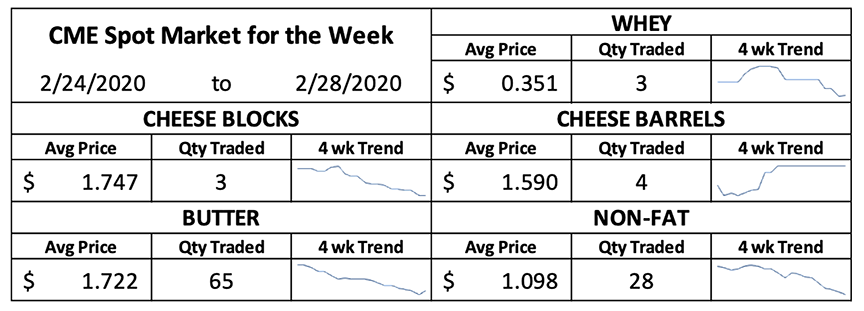
Prices moved decidedly lower at the CME spot market. Spot butter dropped all the way down to $1.695 per pound, the lowest price since March 2015. But today it came back in convincing fashion. Traders exchanged 39 loads and spot butter closed at $1.725, much better 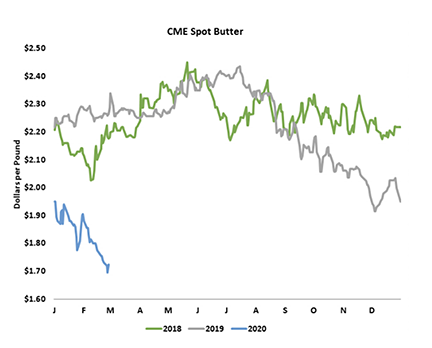 than the Thursday low but still down 6ȼ for the week. The milk powder market continued to fade. Spot nonfat dry milk fell 10.5ȼ to a five-month low of $1.065. Spot whey powder slipped 3ȼ to 34ȼ. Spot Cheddar blocks dropped 4.5ȼ to $1.7225. Barrels fell so far in January that even a global market panic couldn’t shake them. They held steady at $1.59.
Outside market factors were the main culprit for this week’s selloff, but the markets had some dairy-specific data to digest as well, and it provided little fodder for the bulls. USDA’s Cold Storage report showed January 31 butter inventories at 242.7 million pounds. That’s 14.9% greater than last year and the 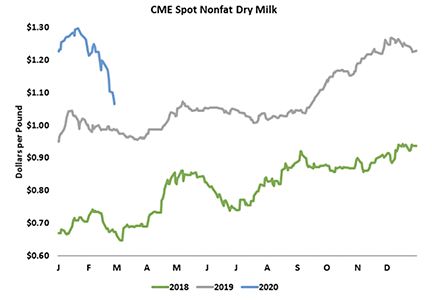 largest January reserve since 1994. Butter makers usually pile up product in January and this year was no exception. Cream is cheap, so stocks have likely continued to swell. The good news is that this abundance of butter has already been factored into pricing. In fact, U.S. butterfat is now the cheapest in the world, which is likely to shift the trade balance in favor of new export demand and smaller imports.
There were 1.35 billion pounds of cheese in cold storage warehouses at the end of last month. Although cheese stocks were 1.2% lower than the prior year, they were still the second largest January 31 total on record. The December-to-January increase was the largest in 20 years. American cheese stocks grow roughly 3 million pounds from December to January in a typical year, but this year they surged 29.1 million pounds. Cheap spot milk and a sharp decline in mozzarella output have likely 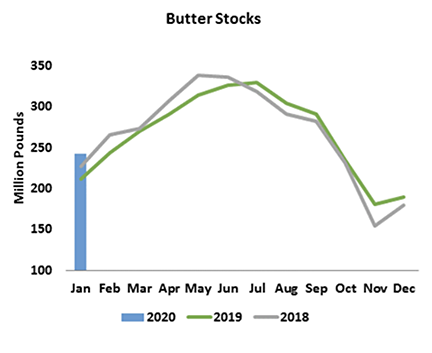 boosted Cheddar production and fresh cheese stocks at the expense of spot Cheddar values. But, as evidenced by the steady trade in barrels this week, cheese prices may have fallen far enough for now.
The milk powder market is the most dependent on exports and the most vulnerable to contagion from the coronavirus. Buyers can smell the fear and they are waiting patiently, purchasing largely on a hand-to-mouth basis. Milk powder prices are slipping around the world. But global inventories are well balanced. European skim milk powder (SMP) output in 2019 was 0.3% smaller than the prior year. Manufacturers on both sides of the Atlantic have trimmed their stockpiles noticeably. 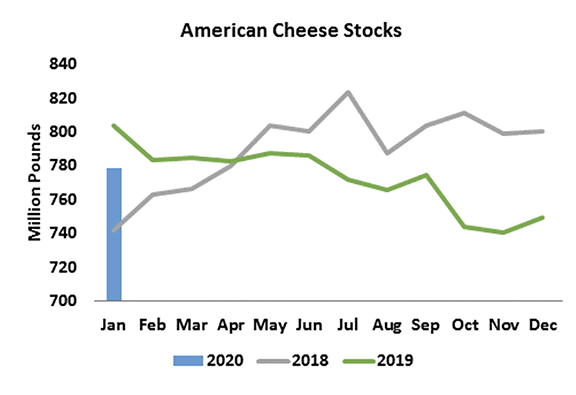 And milk output in Oceania has sputtered, likely reducing SMP output there.
In the near term, market direction could depend on whether or not the world is able to contain the coronavirus without significantly disrupting economies and destroying consumer demand for goods of all sorts. Assuming the disease is contained, it’s pretty easy to be bullish from way down here. But the market is not ready to assume anything at this point.
Dairy producers simply can’t make $15 milk work, especially given their tenuous relationship with their creditors. Spring discounts make these prices even less palatable. USDA’s Dairy Market News notes that spot milk is trading at $1 to $5 under Class III in the Midwest. And in the mountain states, “there are reports of milk
Soybean futures lost a little ground this week, but soybean meal held firm. May meal closed at $305.60 per ton, up more than $10 from last Friday. Argentina’s Ministry of Agriculture suspended registrations for agricultural exports until
Grain prices moved lower in tandem with the outside markets. Corn values came under added pressure as estimates of the South American corn crop continue to creep higher. May corn settled at $3.6825 per bushel, down 12.5ȼ from last Friday.
Original Report: https://www.jacoby.com/market-report/the-bulls-nearly-drowned-in-a-flood-of-red-ink-this-week/

Be the first to comment