
The T.C. Jacoby Weekly Market Report Week Ending December 24, 2021
The dairy markets are full of Christmas cheer for producers, while dairy buyers are grunting “Bah! Humbug,” into their egg nog. The milkfat market is especially festive and the whey market just keeps climbing.
The dairy markets are full of Christmas cheer for producers, while dairy buyers are grunting “Bah! Humbug,” into their egg nog. The milkfat market is especially festive, as 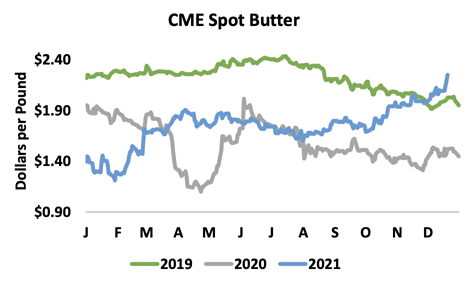 befits the season. Cream is scarce around the world. Global milk production has faltered but cheese makers are still topping up their vats, leaving less milk and cream for other uses. At the Global Dairy Trade (GDT) auction on Tuesday, anhydrous milk fat and butter values both scored four-year highs. U.S. butterfat is the most affordable in the world, which is likely to keep U.S. imports to a minimum, further tightening the U.S. fat supply. Churns ran slow in November and manufacturers pulled butter from storage to satisfy orders last month.
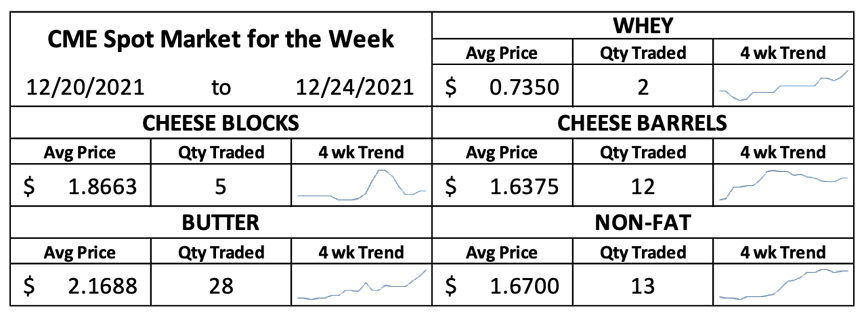
Stocks dropped below 212 million pounds, down 15.9% from a year ago. Butter prices rose accordingly. At the CME spot market this week butter shot straight up to $2.25 per pound, up 15.75ȼ in just four trading sessions.
Global power prices are mixed. GDT skim milk powder (SMP) climbed 0.6% this week to a fresh seven-year high. But whole milk powder (WMP) slipped 3.3% due to concerns that China’s appetite for milk powder will slow. CME spot nonfat dry milk (NDM) followed WMP lower. It dropped 0.75ȼ to $1.67 per pound. The market is extremely wary that the powder markets have overindulged in 2022 and that they will suffer a massive hangover in the new year, echoing the boom and bust of 2014 and 2015. But the facts are different this time.
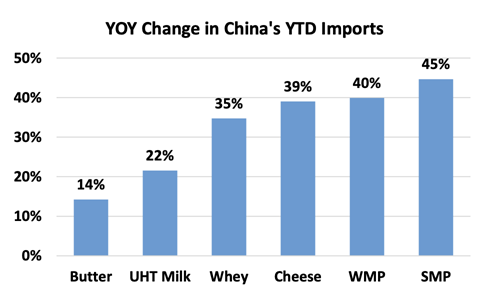 China remains hungry for foreign dairy products, and that is unlikely to change. The government has promoted dairy as a way to improve health and boost immunity to Covid19, and consumers have responded. Chinese milk production is up 7% this year, but domestic milk consumption is up 18%. China is filling in the gap with imports, and shattering previous trade records. Chinese WMP and SMP imports remained strong in November, exceeding last year by 45% and 5.4%, respectively. In the coming months, it may be difficult for 2022 shipments to best the massive volumes of milk powder China bought in early 2021, especially as new trade agreements reduce the incentive for Chinese importers to stock up on product early in the year. The trade will be easily spooked if Chinese purchases do start to slip in a given month. But in the aggregate, Chinese dairy imports are likely to remain formidable.
In 2014, China’s insatiable appetite spurred the dairy markets to new heights and prompted a surge in global milk output. Dairy producers will surely respond to high prices once again, but they will likely be less nimble this time around. High feed costs are eating deeper into milk checks around the globe. In the United States, there are few regions where processors welcome new milk, and dairy producers are reticent to invest in new facilities without a ready buyer. Dairy producers are also taking an, “I’ll believe it when I see it” stance to the futures market, as many have been scarred by depooling and steep discounts for nearly two years. In Europe and New Zealand, dairy producers face even greater barriers to expansion. Their paddocks are already full, and there are stricter environmental regulations on the horizon. Milk output continues to disappoint in Europe and Oceania.
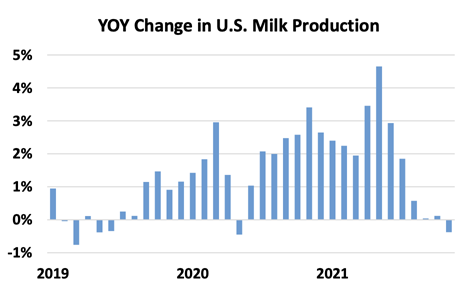 U.S. milk output did not fall short of year ago volumes in October, according to USDA’s revised estimates. But milk production did drop below last year in November. It slipped 0.4% to 18 billion pounds. The dairy herd continued to contract, albeit at a slower rate. U.S. dairy producers trimmed cow numbers by 45,000 head in August, 33,000 in September, 19,000 in October, and 10,000 in November. There are now 9.385 million cows giving milk in the U.S., down 47,000 from last year.
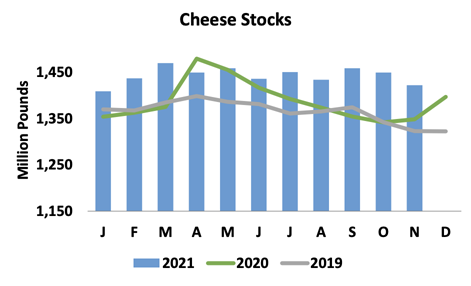 There is still plenty of milk for cheese vats. Thankfully, demand is strong. There were 1.42 billion pounds of cheese in cold storage warehouses at the end of November. That is 5.5% more than in November 2020, but it’s better than the 8% year-over-year surplus in October. Consumers are loading up their grocery cart with cheese, but foodservice sales are less predictable as the omicron variant has deterred some would-be restaurant patrons. Exports are booming. The cheese markets seem comfortable in their recent trading range. Spot Cheddar blocks dropped 1.5ȼ this week to $1.8725. Barrels added 2ȼ and reached $1.65.
There is no quit in the feed markets. Old crop corn futures pushed above $6 and didn’t look back. March corn settled at $6.0575 per bushel, up 12.5ȼ this week. January soybeans rallied more than 45ȼ to $13.32. Soybean meal surged $26.60 to $406.10 per ton. A dry forecast for southern Brazil and Argentina has exacerbated concerns about South American crop yields, and buyers are quick to jump in as inflation has the commodity markets on edge.
Original report at: https://www.jacoby.com/market-report/the-dairy-markets-are-full-of-christmas-cheer-for-producers/




Be the first to comment