
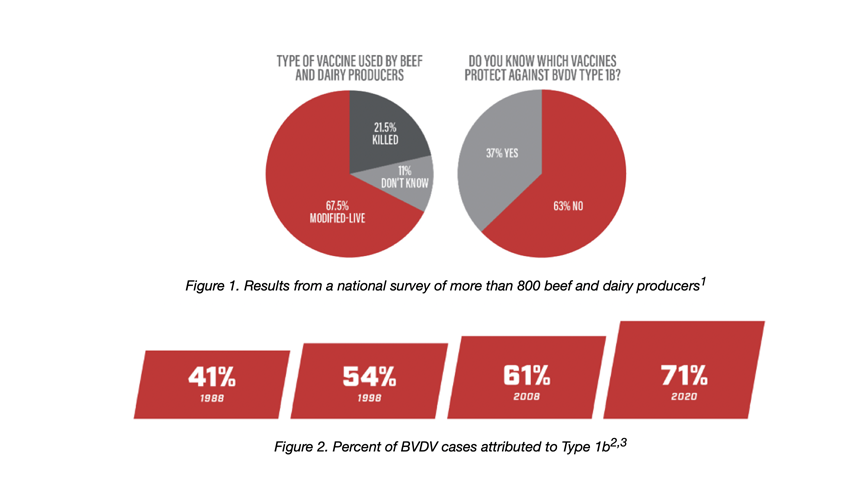
Results from a recent national survey of more than 800 beef and dairy producers show positive strides in the industry’s understanding and management of bovine viral diarrhea virus (BVDV), but the fight isn’t over yet.
Key findings of the study:1
1) 81% of producers vaccinate for BVDV. Of those who vaccinate, 68% use a modified-live virus (MLV) vaccine. Broken down further, the survey shows that 63% of beef producers and 69% of dairy producers use a MLV vaccine. “We’re happy to see that percentage of producers using MLV vaccines, but we’d like to see this number continue to rise,” said Joe Gillespie, DVM, Boehringer Ingelheim.
Vaccinating cattle with a modified-live BVDV vaccine protects their health, reproductive efficiency and prevents persistently infected (PI) calves. “PI calves are the most common way BVDV spreads throughout a herd,” explained Dr. Gillespie, “and killed vaccines don’t provide complete PI protection.”
2) 53% of respondents know that Type 1b is the most common subspecies of BVDV, but only 37% know which vaccines protect against it. “Whether yours is a dairy or beef operation, when your cattle are exposed to BVDV, it’s very likely that you’ll be dealing with Type 1b,” said Dr. Gillespie. The most recent data on BVDVTracker.com show that out of more than 1,200 samples collected, Type 1b accounts for 71% of infections.2
“People assume that, if you’re giving a BVDV vaccine, you’re completely protecting that animal,” Dr. Gillespie noted. “But Type 1b is not commonly found in the antigens contained within most vaccines. You have to get that cross-protection and choose a vaccine that’s specifically labeled to protect against Type 1b. The right vaccine can help you avoid losses from BVDV such as infertility, pneumonia, abortions, stillbirths and immunosuppression down the road.”
3) 63% of producers do not test their herds for BVDV and those that do, don’t test often. 54% say the last time they tested was over a year ago. “Cattle are more mobile than ever before — and when they move to a new facility or are brought in from another area, we’re opening up the risk of spreading the virus,” said Dr. Gillespie. “Sixteen percent of the producers who tested their herd discovered BVDV, so we know it’s a more prevalent problem than we’re giving it credit for.”
If you’re seeing an increased number of animals getting respiratory disease or experiencing fertility issues such as decreased conception rates or pregnancy losses, that’s where testing for BVDV comes in. “To start, I recommend testing all calves,” Dr. Gillespie emphasized. “If you discover a positive case, then it’s time to go back and test the entire herd.”
Producers can test their animals for free through BVDVTracker.com. All samples submitted are anonymous and processed by the Animal Disease Research and Diagnostic Laboratory at South Dakota State University.
“BVDV is a challenging disease, but thankfully, we have tools available, like vaccination and testing to control it,” concluded Dr. Gillespie. “To implement the best BVDV management protocols for your cattle operation, get together with your veterinarian to design a program that makes sense for your herd.”
The lives of animals and humans are interconnected in deep and complex ways. We know that when animals are healthy, humans are healthier too. Across the globe, our 9,700 employees are dedicated to delivering value through innovation, thus enhancing the well-being of both.
Respect for animals, humans and the environment guides us every day. We develop solutions and provide services to protect animals from disease and pain. We support our customers in taking care of the health of their animals and protect our communities against life- and society-threatening diseases.
Boehringer Ingelheim Animal Health is the second largest animal health business in the world, with net sales of $4.7 billion (4.1 billion euros) in 2020 and presence in more than 150 countries.
Boehringer Ingelheim Animal Health has a significant presence in the United States, with more than 3,100 employees in places that include Georgia, Missouri, Iowa, Minnesota, New Jersey and Puerto Rico. To learn more, visit www.boehringer-ingelheim.us, www.facebook.com/BoehringerAHUS or www.twitter.com/Boehringer_AH.
Be the first to comment