

Alexandria Benoit and Mike Van Amburgh
Cornell University Department of Animal Science
FATS BEYOND A BUCKET OF ENERGY
Many feeds and commercial fat sources are added to cattle diets to increase the energy density and increase the fatty acid (FA) supply for increased energy intake and possibly milk fat yield. Although, fat is not just a bucket of energy and there is likely a requirement for individual FA such as palmitic acid (PA), stearic acid (SA), and oleic acid (OA). Data from Michigan State University1 showed that FA supplements with a blend of 60 percent PA and 30 percent OA fed during the fresh period (0 to 21 days in milk) decreased body weight loss and maintained milk production with positive carry-over effects up to 60 days in milk (DIM). In a prior study2, the same blend of PA and OA increased milk and protein yield in mid-lactation dairy cows suggesting a blend of PA and OA may be beneficial to improve both milk fat and protein production throughout the entire lactation.
WHAT DRIVES MILK FAT?
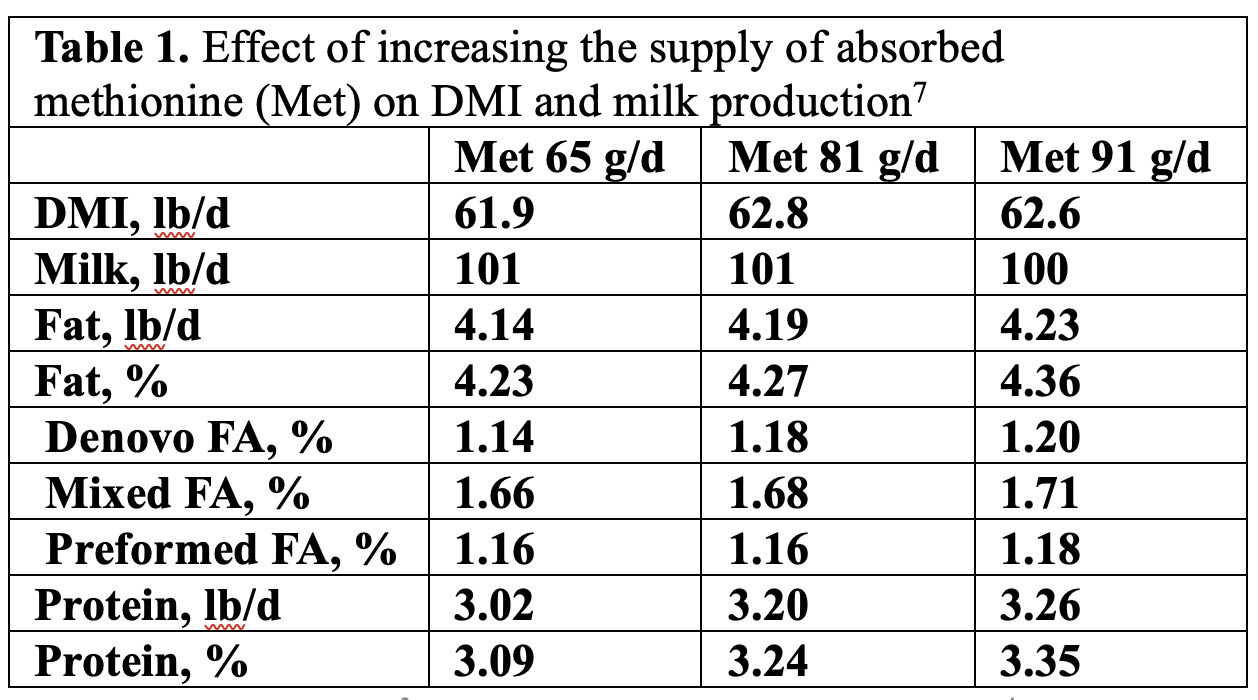
Milk fat is derived from three different sources: de novo FA that are synthesized in the mammary gland of the cow using volatile FA produced during rumen fermentation, preformed FA that originate from the diet as described above, and mixed FA or PA that comes from both sources. Under most conditions, increases in milk fat are mainly driven by increases in de novo FA and mixed FA rather than preformed FA3. Increases in de novo FA synthesis can be achieved by feeding highly digestible forages and dietary sugars (see below), balancing for amino acids (AA; Table 1), maintaining dietary fat between 4.0 to 4.5 percent DM, and management practices that allow adequate feed intake, lying time and rumination4.
MEETING AMINO ACID REQUIREMENTS INCREASES MILK PROTEIN AND MILK FAT
In recent studies, increasing the supply of AA to meet the requirements for production increases milk protein and, to a greater extent, increases milk fat. Using recommendations for AA previously determined at Cornell University5,6, the study7 shown in Table 1 assessed the effect of increasing the dietary inclusion of a rumen-protected methionine product to increase the methionine supply from 65 to 91 grams/day. Increasing methionine increased milk protein percent and yield, and increased milk fat by increasing de novo and mixed FA which are synthesized in the mammary gland. Meeting the requirements for AA can be achieved by feeding highly digestible NDF, starch, and sugar sources while balancing protein sources that are digested in the rumen (soybean meal, canola meal, hay crop silages) with protein sources that provide AA post-rumen (bloodmeal blends, heat-treated soybean meal, rumen-protected AA sources) to maximize microbial protein and reduce the excretion of protein nitrogen.
 |
DO DAIRY COWS HAVE A SWEET TOOTH?
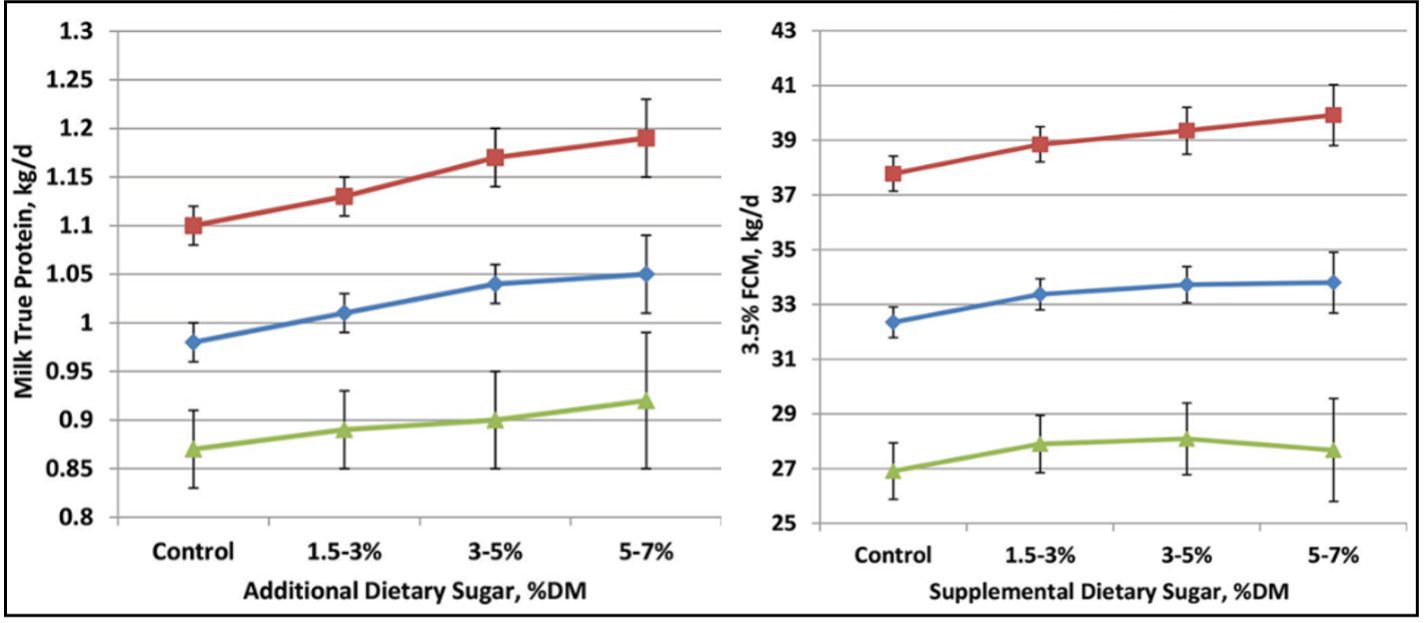
Balancing the supply of rumen fermentable NDF, starch, and sugar sources may be key to optimizing milk component production. Feeding high quality, highly digestible forage NDF is a great opportunity to optimize the rumen and supply adequate energy to the cow. In addition, balancing the dietary starch plus sugar to be 32 to 35 percent DM with 5 to 7 percent DM sugar and 25 to 28 percent DM starch may be beneficial to optimize microbial protein and milk component synthesis. Feeding dietary sugar up to 7 percent DM has been reported to increase milk fat and protein yields compared to lower sugar diets, and replacing starch sources with sugar sources has had positive effects on rumen pH and milk fat production8. Dietary sugar can be increased by feeding citrus and beet pulp, molasses, table sugar, candy and bakery by-products and whey.
|
As the genetic capacity of the modern dairy cow continues to increase, it is important that we feed her a balanced diet that meets the demands for lactation and allows for maximum milk component production. Often, dietary ingredients in the appropriate ratio and concentration have positive dual effects that increase both milk fat and protein such as the few that were outlined above. In unison with optimal diet formulation, management practices that allow for adequate feed intake, lying and rumination time, reduced stocking density, and adequate cooling systems are needed to maintain healthy and high performing cows for maximal milk component production.
|
CORNELL CALS PRO-DAIRY


Be the first to comment