
The USDA-NASS Cash Rents Survey provides county-level estimates of land rental rates for cropland and pastures.
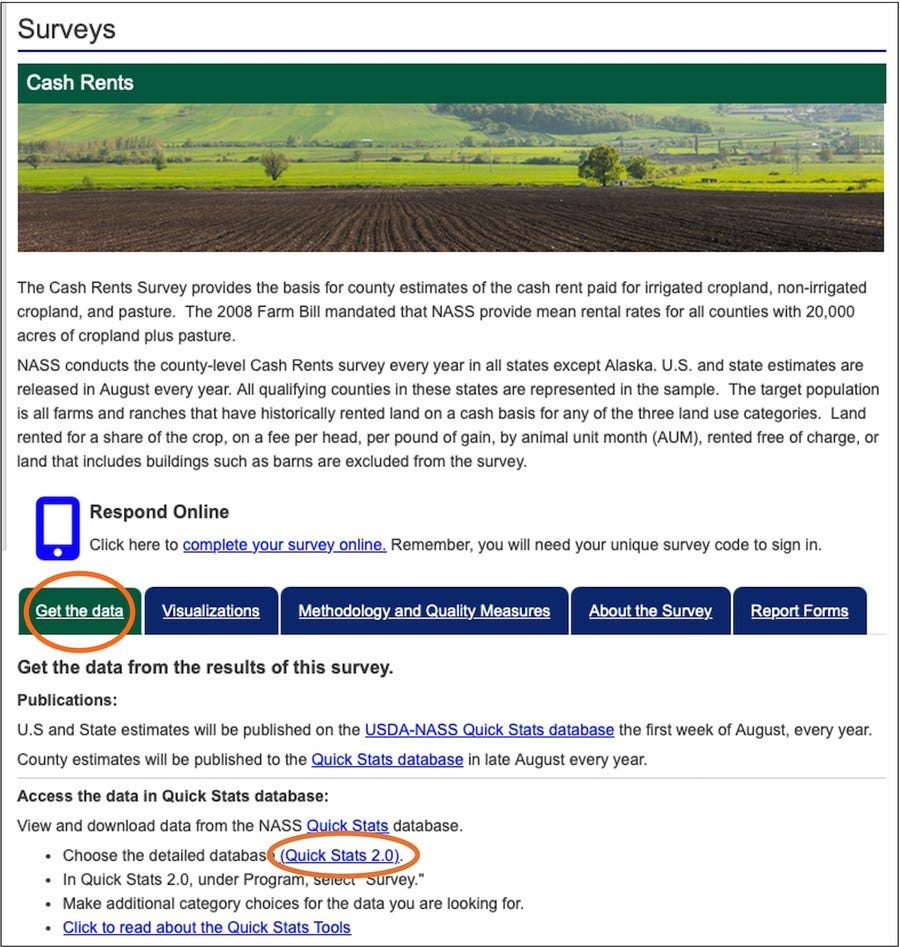
The information can be found on the USDA-NASS Cash Rents website. To access the county-specific data, go to “Get the data” and then to “Quick Stats 2.0” (Figure 1).
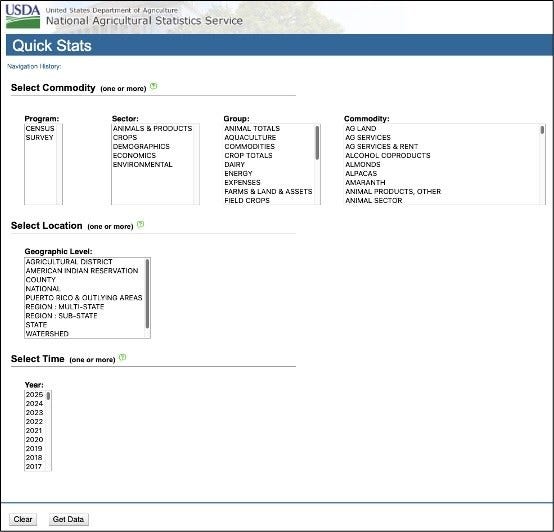
Next, you will be prompted to the Quick Stats page, where you will see several boxes with information (Figure 2).
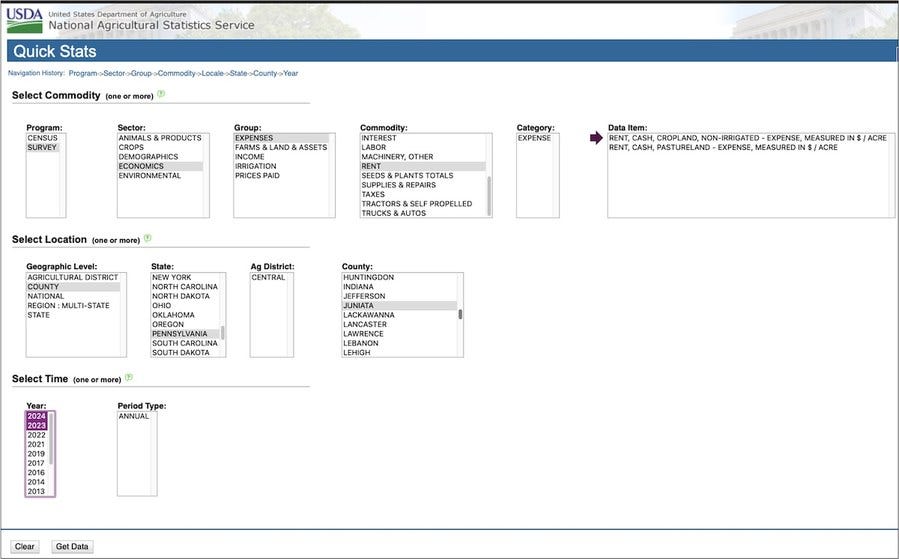
- Program: Survey
- Sector: Economics
- Group: Expenses
- Commodity: Rent
- Geographical level: County
- State: Pennsylvania
- County: Select the county
- Data item: Select “Rent, cash, cropland non-irrigated- expense measured in $/ acre”
- and/or “Rent, cash, pastureland – expense measured in $/ acre”
- Year: Select year (to make multiple selections in any of the boxes, click the “ctrl” key and keep it pressed while you select multiple years, counties, data items, etc.)
- Click on “Get data.“
Note that every time an item is selected, the page takes a few seconds to update. Before the final selection is made, the webpage should look as shown in Figure 3.
Cash rent estimates are reported in $ per acre per year, and information is available for most counties from 2008 to 2014 and 2016 to 2025.
Details on data collection, handling of data and outliers, sample size, response rates, and coefficients of variation can be found in the section “Methodology and Quality Measures.” For example, the sample size for Pennsylvania in 2025 was 5177 farms, and the response rate was 44.4%. The number of farmers who responded to the survey each year per county is not available on the website.
Cash rents can be quite variable within the state, a county, a town, and even among farms along the same road. Each cropland or pastureland has unique characteristics that can lead to very contrasting rental rates, including soil types, average yields, access to water, previous crops, and prevalent weeds, among many other factors that should be considered before signing a lease. Additionally, stay informed about what others are charging, market prices for agricultural products, and other external factors that may impact cash rental rates. Additional information and resources can be found in the article “Owning and Leasing Agricultural Real Estate.”


Be the first to comment