
Every pet owner has looked into their four-legged loved ones’ eyes and guessed what was going on in their mind. Whether improvising a dialogue with pets about wanting more treats or toys or the more serious inquiry of telling them not to chew on something, we clearly long to communicate with animals.
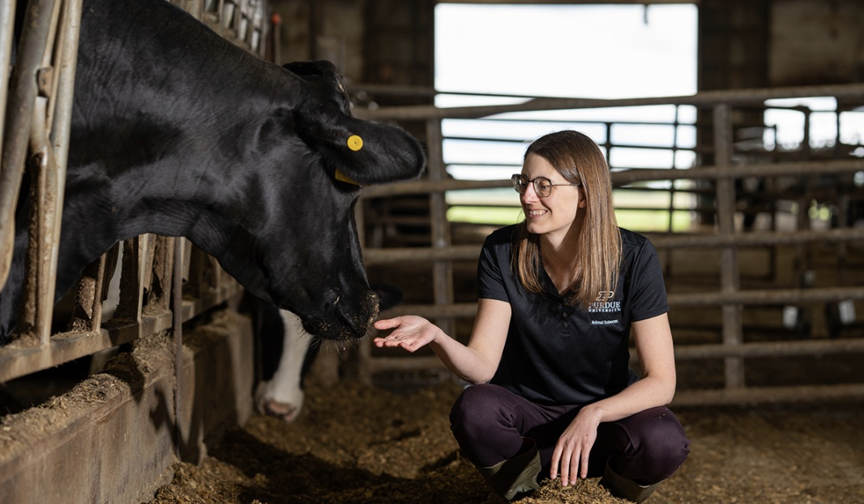
Heather Neave, assistant professor of animal science at Purdue, said farmers also face this challenge. Dairy cattle and other livestock can be stoic. Showing emotion would make the creatures susceptible to predation, but their evolved quiet features make it difficult to find out if they are happy or even in pain.
Neave researches animal welfare, a field focused on understanding what practices can improve the lives of animals on farms, which also makes them more productive. Lately, she’s been trying to tackle the big question of how to read an animals’ emotions.
Some of her experiments come from human psychology literature. As an indirect way to judge how an animal is feeling, she has used a “judgement bias” test, similar to asking a person if a glass of water is half empty or half full. Someone feeling more positive will interpret this glass as half full,
In this experiment, Neave showed cows and calves a computer screen. If it flashed red and the cow approached, they received a treat. If it flashed white and they approached, they did not get the reward, so the animals learned quickly to go to the red screen and back away from the white screen. Then, Neave presented them with an ambiguous pink screen and studied their responses. If they were already feeling negatively, like after having a medical procedure, they were less likely to take the risk of approaching the pink screen. This is how the judgement bias test examines emotional state, by examining interpretation of uncertain information.
By indirectly asking cows how they are feeling, researchers can understand what management practices, housing environments and other resources make animals more content or stressed.
“In my research, one element is the basic understanding of the animal and their behavior. How can we improve management that allows positive behaviors to be expressed or make the animal feel good?” Neave said. “The other element is: how can we make this easy for farmers to do? How can we use technology to help us measure behavior to better understand the animal?”



Be the first to comment