

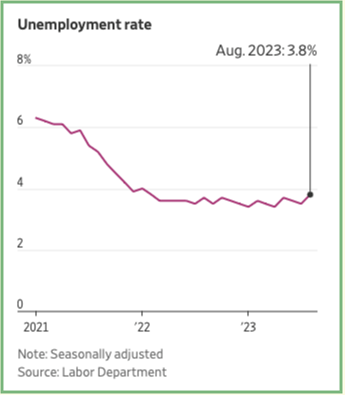
Workers are choosing arrangements such as part-time, flexible or remote work, prompting employers to adapt to fill roles. This could be one of the key drivers explaining why despite the increased immigration numbers, we are not seeing many of them show up to seek jobs in agriculture and dairy, as we may have seen in past immigration fluxes. This magnifies the importance of talent management: once you have recruited and developed the talent, making sure that talent doesn’t leave becomes critical, and the cost associated with turnover increases as good workers decide to leave.
Have you spent any time learning about and developing a plan how to develop and retain talent for your dairy? There are many good resources available online, even for agriculture, and most of it points at the need to focus on the person vs. the position, and developing talent from within. It speaks about changing from a “hunter & gatherer” environment (hire the guy with the right talent), to a “homegrown” philosophy, or recognizing, developing and nurturing homegrown talent within the operation.
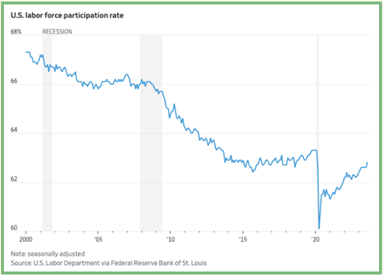
Back to the WSJ article: total employment according to the Labor Department will only grow with 0.3% vs the 1.2% seen over the last decade, which means “hunting and gathering” as described above will only become more difficult. Baby Boomers, who had been on a steady trend of working more years, pulled back during the pandemic, and many have retired and haven’t returned. The U.S. birthrate—the number of births per 1,000 people—has been falling for decades, declining by about half since the 1960s. These numbers say that workforce participation, once at 67.3% in 2000, has steadily declined, and took a huge hit during the pandemic from which it still has not recovered.
How to fill the void? “Labor shortages can be eased by funneling more people into the labor force or making the current workforce more productive. That can be done through immigration; outsourcing more work overseas; tapping underutilized labor pools such as people with disabilities and the formerly incarcerated; and improving productivity through automation, training and refining business and production processes.”
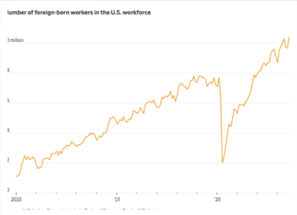
If we agree that for US Ag and dairy outsourcing is not a solution, and immigration is not providing either the talent or the willingness to perform physically challenging jobs, we have to look at other options.
Tapping underutilized labor pools is something we are currently looking at through AgrAbility, a program that provides resources to people with disabilities currently working or wanting to work in Ag. We are primarily looking at returning and transitioning military (many of whom suffer from PTSD and would likely appreciate the jobs Ag has to offer in working with animals and out in the open), who have 2 key characteristics with growing importance to working in Ag: mission oriented (meaning no clock, get’er done attitude), and secondly, they are trained to work with technologies now flooding our industry. AgrAbility, among others, provides training programs for transitioning veterans such as Battle ground to Breaking Ground developed at Texas AgriLife AgrAbility. NMSU Dairy Extension is applying for an AgVets grant to obtain the resources to bring that program to New Mexico and train transitioning veterans for the 4 military installations in New Mexico. In the past several dairy owners have also tried to bring formerly incarcerated workers onto dairies to fill the void. On the human side the program was very successful, but ran into multiple bureaucratic snares and snags which at the time proved an insurmountable challenge and ultimately suffocated the program.
The final solution indicated in the article: “improving productivity through automation, training and refining business and production processes”, is where most believe the best and most valuable answer for Ag and Dairy lies. Training the resources, we already have to work with, maximizing the benefits provided by existing technologies and future automation and robotics. But also training current employees to be the caretakers and stewards of these technologies. One of the main obstacles I see on most dairy operations is that employees, even at management level, know how to obtain the data, but do not know what those data mean for the decision-making process. That’s where the training comes in. The question I ask producers often is: how much money do you believe we are leaving on the table by not utilizing properly the data we already have but are not adequately utilizing in any part of our operations? As the industry continues to consolidate, and the availability of labor as described above is likely not going to become any better, continued adoption of technology for automation and robotics is the most productive answer to labor shortages in our industry. However, to translate that into an ROI, this needs to come with a focus on training and development of the current talent pool. How much are you investing in that?
Be the first to comment