
The T.C. Jacoby Weekly Market Report Week Ending April 9, 2021
Nearly all products gained ground at the CME spot market with the exception of Whey. The other spot dairy products moved decisively upward.
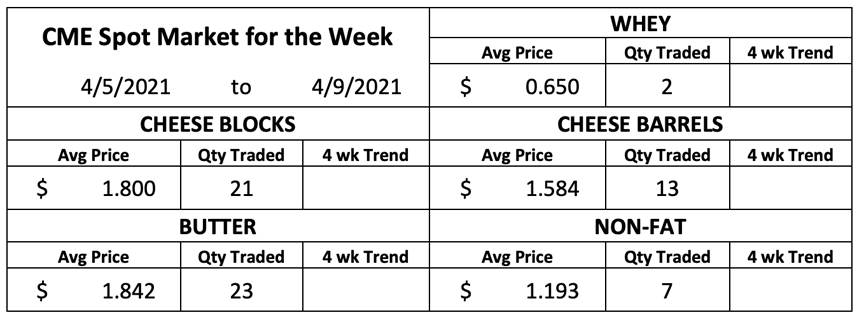
It was another big week on LaSalle Street, and nearly all products gained ground at the CME spot market. Whey was the exception. CME spot whey fell 3ȼ from its all-time high. But, at 63ȼ per pound, whey powder remains lofty. Demand is strong. China continues to import large volumes of whey for pig feed, and consumers have developed a growing appetite for high protein products.
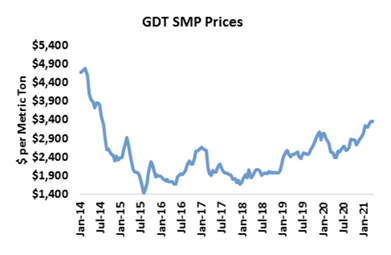 The other spot dairy products moved decisively upward. On Tuesday, skim milk powder (SMP) climbed 0.6% at the Global Dairy Trade (GDT) auction and reached its highest GDT value since 2014. In Chicago, spot nonfat dry milk (NDM) followed suit and advanced 1.5ȼ to $1.205, a 13-month high. Spot butter rallied 3.5ȼ to $1.88, its highest perch since midJune. With both butter and powder on the rise, second-half Class IV futures scored life-of-contract highs.
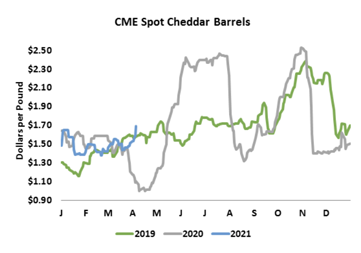 Cheddar posted the strongest performance at the spot market. Blocks added 5.5ȼ and reached $1.83. Propelled by a 10.75ȼ jump today, barrels vaulted 18ȼ this week. At $1.6925, they stand at their highest price since mid-November, when euphoria over the impact of government purchases began to wear off.
Nearly every Class III contract on the board posted life-of-contract highs yesterday. But they may have climbed too far, too fast. Today, cheese and Class III futures watched barrels sprint upward, shrugged, and moved in the opposite direction.
As more Americans receive their vaccines and return to some of their old habits, cheese makers are stepping up sales to restaurants. Meanwhile, sales to grocery outlets remain firm. In this rapidly changing environment, grocers and restaurateurs find it difficult to project how much food they’ll need. After last year’s shortages, they’re likely inclined to keep their shelves and larders extra full. Todays’ retreat suggests that the trade may be concerned that either retailers or restaurants are
Global trade in general and U.S. exports in particular have slowed due to a litany of woes. The U.S.-Chinese trade imbalance and backlogs at U.S. ports clogged with Pelotons and home-office furniture tied up the containers needed to move goods of all sorts. Winter storm Uri hammered Houston, home to the sixth-largest port in the nation. A massive container ship was stuck in the Suez Canal for nearly a week, further entangling global supply lines. High water on the lower Mississippi River slowed barge traffic, and there are more rains in the forecast for the Delta. It all adds up to major headaches for exporters looking to move product.
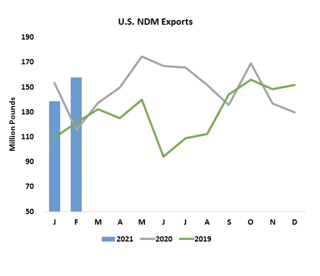 Nonetheless, U.S. dairy exports are going strong, a testament to our competitive prices. The United States sent huge volumes of whey and milk powder abroad in February, with both categories scoring record-high volumes for the month. That helped lift the value of U.S. dairy exports to $557.8 million, the highest February totalsince 2014. Compared to the prior year, the United States stepped up exports of NDM by 36.1% and whey powder by 30.5%. Exporters more than doubled butter shipments in February, although, at 7.6 million pounds, the total is still a relatively small share of the market.
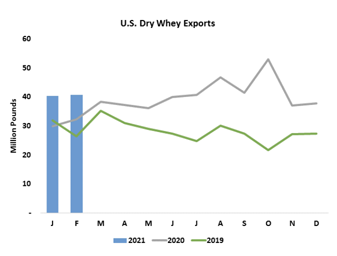 U.S. cheese exports of 66.5 million pounds were up a modest 1.1% from the prior year. Southeast Asian buyers remain hungry for U.S. dairy products, and shipments to Mexico are starting to recover. U.S. dairy producers are milking more cows than they have in over a quarter-century, and both milk yields and components continue to impress. If the U.S. dairy industry plans to sustain this kind of growth, it will need robust exports to keep dairy product inventories in check.
The grain markets continued to climb. In USDA’s monthly update to crop balance sheets, the agency raised its estimates of feed, ethanol, and export demand, tightening ending stocks. U.S. exporters continue to book big sales, which suggests there is room for USDA to pencil in greater demand and even lower stocks on next month’s report. On the 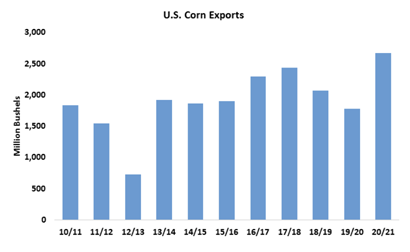 heels of the report, December corn futures traded briefly above $5 per bushel for the first time in years. They ultimately settled at $4.965, up 12ȼ this week. May corn futures jumped 17.5ȼ this week to $5.7725.
USDA raised its projection for soybean exports but lowered domestic demand, resulting in no change to end-of-season stocks. The agency also boosted its estimate of Brazilian soybean production by 2 million metric tons. Soybeans traded in the red today, but they eked out a penny gain for the week. May soybeans closed at $14.03. However, May soybean meal futures dropped $9 to $401.20 per ton, offering dairy producers some modest relief from painfully high protein prices.
Original Report at: https://www.jacoby.com/market-report/another-big-week-on-lasalle-street-and-nearly-all-products-gain-ground/



Be the first to comment