
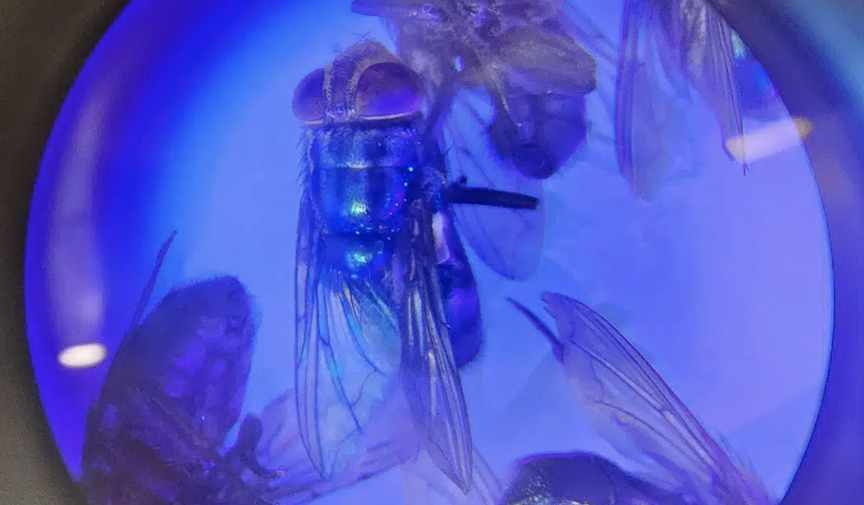
As the Southern U.S. continues to navigate cases of New World screwworm, the Foundation for Food & Agriculture Research (FFAR) and the University of Notre Dame are investing $140,389 in a Rapid Outcomes from Agricultural Research (ROAR) grant to evaluate whether an existing drug can be repurposed to kill screwworm larvae.
Led by Dr. Lee Haines, associate research professor of biological sciences at the University of Notre Dame, and Dr. Álvaro Acosta-Serrano, professor of biological science at the University of Notre Dame, a team of researchers are evaluating whether nitisinone, a U.S. Food & Drug Administration (FDA)-approved drug with an established safety profile in humans, can effectively kill screwworm-related blowfly larvae. Research breakthroughs over the last five years have shown that nitisinone also kills several blood-feeding arthropods (including mosquitoes, ticks, kissing bugs, bed bugs, tsetse flies and stable flies) by blocking a key enzyme they need to digest blood, which is also found in screwworms.
“We’ve already demonstrated nitisinone’s transformative ability to kill other blood-feeding insects, and applying this knowledge to screwworms opens up a timely new frontier in livestock protection. Growing up on a farm, I watched our animals suffer from other blood-sucking insect pests every summer, and that experience taught me early on just how much these tiny predators can wear an animal (and the farmer) down. We are eager to build on our recent breakthroughs in vector-borne diseases to develop a much-needed and complementary tool for protecting U.S. livestock and producers from the screwworm populations expanding across the country.” said Lee Haines, Ph.D. Associate Research Professor of Biological Sciences, University of Notre Dame.
FFAR is investing in this research to evaluate a novel treatment strategy for New World screwworm, providing the scientific foundation for new tools to improve producer preparedness, animal health and response efforts. The ROAR grant provides rapid-response funding for a pilot study to establish and refine research methods and determine nitisinone’s toxicity to secondary screwworm, with a particular focus on larvae and its potential use to treat the wound environment. The findings and methodologies developed through this project will provide a foundation for subsequent research at a larger scale, including studies of additional applications of nitisinone and its effectiveness against adult flies. This research supports USDA’s research priority on Protecting the Integrity of American Agriculture from Invasive Species.
“New World screwworm is a significant and urgent threat to animal health, U.S. producers’ profitability, competitiveness and the food supply chain. This research could expand the limited options available for controlling New World screwworm. By evaluating a drug already approved for human use, the project could accelerate the path toward veterinary applications by building on existing safety data.” According to Jasmine Bruno, Ph.D. Scientific Program Director, Cultivating Thriving Production Systems
FFAR’s ROAR program rapidly funds research and outreach in response to emerging or unanticipated threats to the U.S. food supply or agricultural systems.
The Foundation for Food & Agriculture Research (FFAR) builds public-private partnerships to fund bold research addressing big food and agriculture challenges. FFAR was established in the 2014 Farm Bill to increase public agriculture research investments, fill knowledge gaps and complement the U.S. Department of Agriculture’s research agenda. FFAR’s model matches federal funding from Congress with private funding, delivering a powerful return on taxpayer investment. Through collaboration and partnerships, FFAR advances actionable science benefiting farmers, consumers and the environment.
Be the first to comment